It had been six years since Celeste Moreau’s world had fallen apart.
Her only child, Gabriel, had vanished one sunny afternoon from their garden in Marseille. The police found no clues—no ransom note, no witnesses, nothing. For years Celeste searched the world, offering fortunes to anyone who could help, but every lead turned to dust. In time, she buried her grief beneath silk dresses, marble offices, and the image of an untouchable woman who had everything.
On a cold autumn evening in Paris, Celeste’s black limousine stopped in front of Maison Éclat, the restaurant where the city’s elite whispered and plotted over champagne. Dressed in a silver suit and diamond earrings, she stepped out, a living portrait of power and poise.
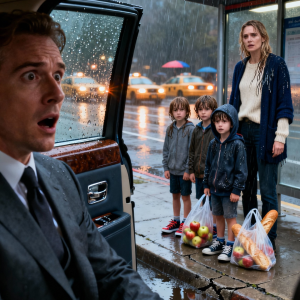
Rain had begun to fall, slicking the cobblestones and painting reflections of passing headlights. As Celeste walked toward the entrance, a small figure darted from an alley—a boy of perhaps ten, skinny, soaked, and clutching a crumpled paper bag of food scraps. Before anyone could react, he slipped and collided with her legs, sending dirty water across her immaculate clothes.
She froze, her breath sharp. “Watch where you’re going!”
The boy stumbled back, terrified. “I’m sorry, madam. I didn’t mean to—”
Her voice sliced through the murmuring crowd. “Do you have any idea what you’ve done? This suit costs more than everything you own!”
People stopped to stare. Some filmed. Others whispered. The glamorous business icon, famed for her poise, now stood yelling at a homeless child. Her temper snapped, and she pushed him away. He fell hard into a puddle.
Gasps erupted. Cameras flashed.
The boy looked up, trembling but silent. Then Celeste’s gaze caught on something—on his wrist was a tiny crescent-shaped scar, faint yet unmistakable. Her heart stuttered. Gabriel had one just like it.
The boy murmured, “I’m sorry, I just wanted to eat.” Then he turned and vanished into the blur of rain and light.
That night, Celeste could not close her eyes. Every time she tried, she saw his face—those gray-blue eyes that mirrored her son’s, that scar that she had once kissed. At dawn, she called her assistant.
“Lucien,” she said quietly, “find that child from last night. The one everyone’s talking about.”
Days later, Lucien returned with an envelope. “His name’s Noah,” he said. “No records, no family. Lives under the Pont de la Reine with an old man who calls himself Henri.”
That evening, Celeste disguised herself in a plain coat and walked along the river. The perfume of rot and rain filled the air. She found them beneath the bridge—an old man wrapped in a blanket and a boy curled beside him, asleep inside a cardboard box.
Around the child’s neck hung a small silver locket. The engraving was worn but still legible: “Gabriel.”
Her knees gave way. “Dear God…”
Henri stirred, eyes wary. “Looking for someone, lady?”