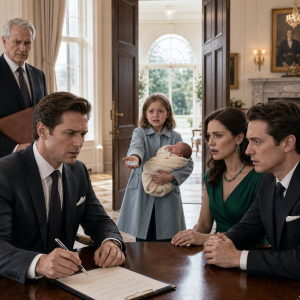
Soft music floated up from the grand hall below, winding through polished staircases and quiet corridors until it reached the nursery on the second floor of the Langston residence in Savannah, Georgia. I could hear violins mixing with laughter and the clinking of glasses. My name is Marina Blake, and I was twenty-five that winter evening, sitting beside the crib of baby Eli Langston, the eight-month-old son of one of the most powerful businessmen in the city. His mother, Claraine, had di:ed in a car crash the previous spring, and since then Mr. Langston had buried himself in work, his life reduced to numbers and silence.
I had only been hired a month before. The family went through twenty other candidates, but they said I stayed calm when Eli began crying during the interview. No one knew that I had spent most of my life caring for my younger brother Ryan, who suffered from severe asthma. I had learned early that panic solves nothing.
That night the ballroom downstairs glittered with guests. Laughter rolled through the house, echoing up the staircase. I prayed it would not wake the baby. Then I heard heels on the stairs, light but purposeful. The door opened without a knock. Standing there was Mrs. Lorraine Langston, the child’s grandmother. Her perfume reached me first, strong and floral, exactly what the pediatrician had warned us to avoid.
I stood quickly, placing myself between her and the crib. “Good evening, Mrs. Langston,” I said quietly.
She smiled with practiced grace. “Good evening, dear. I want to take little Eli downstairs for just a minute. Everyone wants to see him.”
“The doctor said no large crowds, ma’am,” I reminded her. “And no perfume.”
Her eyes narrowed slightly. “I raised his father without a doctor’s manual. He will be fine.”
Before I could respond, she had lifted Eli in her arms. “Come along if you like,” she said as she left the room.
I followed, my bag tight against my shoulder. Inside it were things I always carried: a small inhaler, an epinephrine pen, a plastic cup I used as a spacer, and a list of emergency numbers. It was a habit that came from too many nights saving my brother’s breath.
The ballroom shimmered with gold light and noise. Women in sequined dresses turned to coo over the baby. A camera flash went off. Eli stirred and began to cry. I saw his little hands tremble. Then Mr. Langston appeared, his expression tight.
“Mother, what are you doing?” he said sharply.
“I’m showing my grandson,” she replied. “He needs to be part of the family, not hidden away.”
“The doctor said—”
“Oh, stop being dramatic,” she interrupted, and turned to accept a dessert from a waiter. Chocolate mousse with chopped nuts. She smiled, then leaned toward Eli with a small spoon.
“Just a taste,” she said softly.
I froze. “Mrs. Langston, no!”
But it was too late. Eli’s lips touched the spoon. Five seconds passed. Ten. His breathing quickened. Red blotches spread across his cheeks.
She tried to brush it off. “He’s just tired.”
I saw the panic rising in his tiny body. His chest moved too fast. I took him and ran up the stairs, holding him close. By the time I reached the nursery, he was wheezing, eyes wide, skin turning pale.
I laid him on the changing table under the lamp. His breathing was shallow, his throat swelling. I reached for the epinephrine pen, but the cabinet was empty. It was supposed to be there.
“Help!” I shouted. “Call 911!”