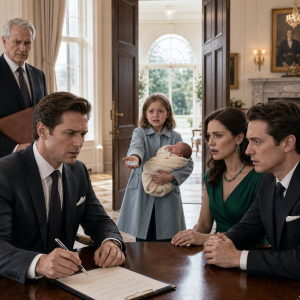
That night, when my grandson’s voice trembled through the phone—“Grandma, I’m at the police station. My stepmother ʜ!ᴛ me, but she’s saying I attacked her. Dad doesn’t believe me”—I learned something I thought 68 years of life had already taught me: betrayal always finds new ways to cut.
It was 2:47 a.m. when the ringing dragged me out of sleep. At that hour, no one calls with good news.
“Kellan?” I rasped, already sitting up, heart pounding. “Where are you?”
“The precinct in West Village,” he whispered. “Grandma, I’m scared. They said if a responsible adult doesn’t come, they’ll send me somewhere else.”
“Listen to me carefully,” I cut in, feet hitting the cold floor. “Don’t talk to anyone. Not a word. I’m coming.”
“Yes, Grandma.”
He hung up.
For a moment I just sat in the dark, clutching the phone like it was the last solid thing in the world.
My name is Rowan Ashford. I’m sixty-eight. To most people now, I’m just a silver-haired widow who shops discounts and moves slow in grocery aisles. But for thirty-four years, I was Commander Rowan Ashford, NYPD Criminal Investigations. I interrogated murderers until their lies dissolved, broke trafficking rings, walked through scenes that haunt even seasoned officers.
Eight years into retirement, I’d learned to be quiet. To let the city breathe without me. But tonight, that woman woke up again—sharp, cold, and steady.
I threw on black slacks, a charcoal sweater, and boots I could still run in. Before leaving, I opened an old drawer and pulled out a leather wallet. Inside lay my badge—expired, edges worn, but still mine. COMMANDER ROWAN ASHFORD.
I slid it into my pocket.
Outside, the city sat in that eerie, suspended silence only New York at 3 a.m. knows. I flagged a taxi.
“West Village precinct,” I said. “Fast.”
As we sped through near-empty avenues, Kellan’s words echoed: Dad doesn’t believe me.

Mercer.
My son. The boy I raised alone. When he lost his wife five years ago, I thought grief might bring us closer. Instead it brought Lyria Marston—the woman who dealt blackjack, smiled like a movie star, and watched my son with the hunger of someone who finally found her golden ticket.
At first I tried to welcome her. But poison works slowly.
“She’s too controlling, Mercer.”
“She doesn’t respect us.”
“Maybe keep some distance until she learns boundaries.”
And my son—the boy who once curled against me during thunderstorms—began to drift like a leaf pulled by someone else’s wind.
The only one who stayed was Kellan, sneaking over on weekends to sit in my kitchen and drink cocoa, hugging me like he feared I’d vanish.
When I stepped into the precinct, the scent of bleach and burnt coffee wrapped around me like an old memory.
“I’m here for Kellan Ashford,” I said.
The young officer glanced up. “Domestic assault case. Are you family?”
“I’m his grandmother. Rowan Ashford.”
His posture snapped upright. He stared at my badge, eyes widening.
“C-Commander Ashford—uh—yes ma’am. Captain Boone is handling the case. I’ll take you.”
Down the corridor, through the glass of the waiting room, I saw him.
Kellan.
Sixteen. Bandage over his eyebrow. Eyes red. Shoulders shaking.
When he spotted me, he rushed forward.
“Grandma.”
He collapsed into my arms like the little boy who once scraped his knees on my driveway.
Behind him stood Mercer—arms crossed, jaw tight. And beside him, draped in a silk robe with a perfectly placed bruise, sat Lyria. She studied me with a slow, icy smile.
A door opened. Captain Aldric Boone—broad-shouldered, crisp uniform—stopped short.
“Commander Ashford.”
“Hello, Aldric,” I said. “Looks like my family landed on your desk.”
He blinked, recalculating. “Let’s talk in my office.”
Inside, with the door closed, I let the old commander settle into my bones.
“Start from the top,” I said. “Her story first. Then my grandson.”
Lyria spun a tale like she’d practiced it in the mirror. Kellan “attacked her,” she “feared for her life,” she “tried to restrain him.” She dabbed her eyes at all the right moments.