The Place She Chose to Hide
The first thing my six-year-old daughter asked me was not why her aunt had frightened her, or why no one had come looking sooner. She looked up at me from the narrow space beside a utility shelf, her small face wet with tears, and whispered, “Dad… am I supposed to say sorry to Aunt Rebecca?”
For a moment, I could not answer.
Outside, my parents’ backyard in Lexington, Kentucky, was still full of music and laughter. A white canopy stretched over long tables covered in coral-colored cloths, children raced between balloon arches and a rented bounce house, and somewhere near the patio, my mother was probably arranging another tray of cupcakes as though the success of the afternoon depended on perfect frosting. We were celebrating my niece Paige’s seventh birthday, and from the street the whole thing must have looked like one of those cheerful family gatherings people photograph for Christmas cards.
My daughter, Ellie, had disappeared nearly twenty minutes earlier.
At first, I told myself she had simply become overwhelmed. Ellie had always been a quiet child, but after my wife, Natalie, passed away two years before, she had grown even more sensitive to crowded rooms and loud voices. She did not demand attention. She did the opposite. At family gatherings, she often stayed close enough to touch the sleeve of my shirt, and when the noise became too much, she would find a calm corner with a book or a handful of crayons.
I checked the downstairs bathroom, then the guest room, then the kitchen pantry because she had once hidden there during Thanksgiving when my uncle brought a particularly loud karaoke machine. I called her name twice, trying not to sound worried.
Then, from behind the mudroom door, I heard the smallest sound.
Not a cry exactly.
More like a child trying very hard not to make one.
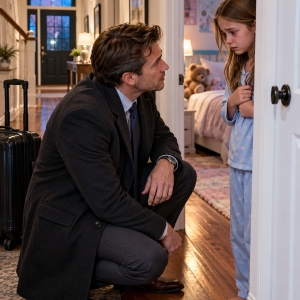
I opened the door and found her tucked into the space between a laundry cart and a cabinet of cleaning supplies, knees drawn to her chest. Her pale yellow party dress was wrinkled, and one side of her face looked flushed. There were faint reddish marks along one forearm where someone had clearly held her too tightly.
I knelt immediately.
“Ellie, sweetheart, look at me. What happened?”
She stared at the floor.
“Please don’t get mad, Daddy.”
Those six words unsettled me more than anything I had seen.
I reached for her carefully, but she pulled back for half a second before recognizing me and throwing both arms around my neck. I lifted her, and she buried her face against my shoulder.
I had not seen her shrink away from me like that before.
As I stood there, I remembered a winter afternoon two years earlier, when Natalie had taken my hand during one of her final days in medical care. She had been tired, but her voice had remained steady.
“Promise me Ellie will always know she has someone in her corner.”
I had promised.
Until that afternoon, I had believed keeping that promise meant working hard, packing school lunches, remembering dentist appointments, learning how to braid hair badly but enthusiastically, and sitting through every school concert even when Ellie spent most of it staring at her shoes.
Standing in my parents’ mudroom, I realized protection sometimes required something harder.
Sometimes it required refusing to excuse the people you had known all your life.
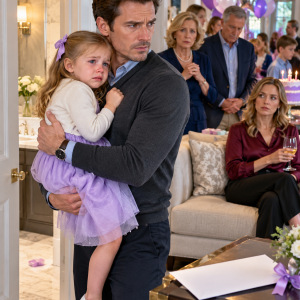
I carried Ellie back toward the patio.
The conversations faded almost at once.
My older sister, Rebecca, stood beside the birthday cake in an expensive lavender dress, one hand resting on the back of her daughter’s chair. My mother, Diane, was holding a stack of paper plates. My father, Walter, had been talking to a neighbor near the French doors.
They all saw Ellie’s face.
I looked directly at them.
“What happened to my daughter?”
No one answered immediately.
Rebecca gave an irritated breath and folded her arms.
“Oh, come on, Mason. Don’t turn this into some huge production. She got upset.”
“What did you do?”
“She knocked over Paige’s cupcake display. Then she started crying and wouldn’t calm down. I took her inside so she could collect herself.”
Ellie tightened her arms around my neck.
My mother moved toward us quickly.
“This is not the place for a family argument. We have guests.”
I looked at her and felt something inside me go strangely still.
My child was trembling against my chest, and my mother was thinking about guests.
My father lowered his voice in the way he always did when he wanted everyone else to accept his version of reason.
“Mason, slow down. Children stumble, children get upset, things happen at parties. Don’t turn Paige’s birthday into an interrogation.”
Then Rebecca said the one thing that made me stop hoping for an honest apology.
“You’ve been overprotective ever since Natalie was gone. Everyone knows it. Ellie cries, and you act like the whole world has failed her.”
The backyard became so quiet that I could hear the inflatable blower humming near the fence.
I studied the three people in front of me—my sister, my mother, my father—and understood that each of them had already made a choice.
“We’re leaving.”
My mother reached for my elbow.
“Please don’t embarrass us in front of everyone.”
I stepped away from her hand.
“I’m not the one who should be embarrassed.”
I carried Ellie through the house, past the framed family photographs and the birthday gifts stacked by the entryway, then out to my car. Ten minutes later, as I drove toward an urgent care center, she spoke again.
“Daddy?”
“I’m right here.”
“Do I have to apologize to Aunt Rebecca?”
I tightened my hands around the steering wheel, then forced myself to relax before answering.
“No, sweetheart. You never have to apologize for being frightened when someone treats you badly.”
My phone began ringing.
MOM flashed across the dashboard screen.
I let it ring.
At the time, I thought the worst part of the afternoon had already happened.
I was wrong.
What the Records Remembered
The physician who examined Ellie was a soft-spoken woman named Dr. Heather Collins, and I noticed immediately how carefully she approached her. She did not rush. She did not ask leading questions. Before touching Ellie’s arm, she explained what she wanted to check and waited for permission.
Then she stepped into the hallway with me.
“I want to document what we’re seeing,” she said. “That does not mean I’m making assumptions. It means details matter, especially when a child is this young.”
I nodded.
For the next hour, everything was recorded with calm precision: our arrival time, Ellie’s appearance, the visible marks, my account of where I had found her, and the statements she had made without prompting. A county child-welfare specialist joined us later and asked me to tell the story from the beginning.
The party.
The missing twenty minutes.
The mudroom.
Rebecca’s explanation.
My parents’ reaction.
I told her everything.
By the time we returned home, Ellie was asleep against the passenger-side window, still wearing the white cardigan she had brought to the party. I carried her inside, changed her into pajamas, and sat beside her bed long after she had fallen asleep.
The next morning, I found a brown paper bag on my porch.
Inside was Ellie’s stuffed rabbit, which we had left at my parents’ house, and an envelope in my mother’s handwriting.
The note said that I needed to think carefully before ruining Rebecca’s future. It said Rebecca had been under stress. It said Ellie had always been unusually sensitive. It said families survived difficult moments by forgiving one another.
It did not ask how Ellie was doing.
Not once.
I had barely finished reading when my phone buzzed.
Rebecca.
Her first message said I was overreacting.
Her second said that if anyone contacted me, I should explain that Ellie had slipped while running.
The third was worse because of how casually it was written.
Mom and Dad agree. Don’t tear this family apart over one kid’s drama.
I took screenshots of every message.
At noon, my father called.
I answered while Ellie was drawing at the kitchen table. The moment she heard her grandfather’s voice through the phone, her crayon stopped moving.
“Mason,” my father began, “we need to be reasonable adults.”
“Reasonable about what?”
He paused.