Hidden Moral Stories

Her Parents Refused to Hold Her Newborn and Demanded Her Multi-Million-Dollar Stake—Then the Man They Needed to Save Their Company Walked In and Said, “You Were Talking About My Son.”

The Child They Refused to Welcome

The nurse had barely settled the newborn into Mara Ellison’s arms when her mother stepped backward as though the small bundle might stain the polished image their family had spent decades protecting.

“We will not acknowledge a baby whose father is nowhere to be seen,” Judith Ellison said.

Mara’s father remained near the window of the private maternity suite, still wearing the charcoal overcoat he had arrived in, his silver hair neatly combed and his expression as severe as it had been during every board meeting Mara could remember.

“And neither of us will be holding him,” Raymond added. “You made this choice. You can live with it.”

For several seconds, the only sound in the room was the soft electronic rhythm of the monitor beside Mara’s bed. Beyond the wide windows, late-afternoon snow drifted over Minneapolis, covering the hospital courtyard in clean white layers.

Mara was thirty-two years old, fair-skinned and exhausted, with damp auburn hair resting against her temples. Her body ached, her thoughts moved slowly, and even lifting one arm required more strength than she had expected. Yet the moment her son curled his tiny hand around her finger, everything else seemed to move farther away.

She looked down at him.

He was warm and impossibly small, wrapped in a pale-blue blanket with only his round cheeks and dark wisps of hair visible. He did not know that his grandparents had judged him before learning the shape of his smile. He knew only her heartbeat.

Mara lowered her face and kissed his forehead.

“Then don’t hold him,” she said.

Judith’s mouth parted slightly.

She had expected an apology, perhaps a plea for forgiveness. For months, she had told relatives that Mara had lost her judgment, that the baby’s father had disappeared, and that motherhood would eventually force her daughter to return home under the family’s conditions.

Neither Judith nor Raymond had ever asked for the father’s name.

To them, Mara was still the quiet daughter who took notes during meetings, questioned expenses no one else bothered to examine, and refused to flatter people merely because they held impressive titles. Her older brother, Chase, was considered the natural heir to Ellison Hospitality Supply, the company Raymond had built from a small commercial-kitchen warehouse into a national supplier for hotels and restaurant chains.

Two years earlier, Mara had served as the company’s director of internal controls. She had discovered unusual payments to consulting firms that had no staff, no functioning offices, and no clear services. When she brought the records to her father, he dismissed her concerns before reading the complete report.

“Chase understands how business works,” Raymond had told her. “You see wrongdoing everywhere because you don’t understand calculated risk.”

Mara resigned the following week.

What no one knew was that she had preserved every document she had been legally entitled to review: contracts, approval chains, invoices, internal messages and wire instructions. She had not taken them to punish anyone. She had kept them because numbers did not become innocent simply because they appeared beneath a family logo.

Judith moved closer to the bed, filling the room with the sharp scent of expensive perfume.

“We did not come here to argue,” she said. “We came to prevent you from making your situation worse.”

From her leather handbag, she removed a cream-colored folder and placed it beside Mara’s water cup.

“Sign the transfer agreement. Your fourteen-percent ownership stake will pass to Chase. The company is negotiating a merger, and your current circumstances create unnecessary questions.”

Mara stared at the folder.

At last, she understood why they had arrived before she had even slept.

They had not come to meet their grandson. They had come because they believed pain, medication and exhaustion had made her easier to control.

Raymond approached the foot of the bed.

“Sign today, and we’ll arrange a monthly allowance,” he said. “It won’t be extravagant, but it will cover a modest apartment, childcare and basic expenses.”

“And if I refuse?” Mara asked.

Judith’s expression hardened.

“Then you can raise this baby without our money, our connections or our name.”

Mara glanced again at the agreement.

Her attorney had warned her that Chase might attempt to consolidate the family’s shares before the proposed merger. Mara’s stake was the final obstacle preventing him from gaining unquestioned control. According to preliminary valuations, her shares were worth several million dollars. The figure listed in the agreement was barely one-sixth of that amount.

She reached toward the call button beside her bed.

“Leave my room.”

Judith gave a humorless laugh.

“You are in no position to order us around.”

Before Mara could answer, the suite door opened.

A tall man entered wearing a navy wool coat, followed by the hospital administrator, two attorneys and a gray-haired woman carrying a sealed portfolio. Snowflakes still clung to his shoulders.

His name was Adrian Mercer.

At forty-one, Adrian was the founder of Cedar Ridge Cooperative Holdings, an employee-backed acquisition firm known for purchasing troubled manufacturers and rebuilding them without discarding longtime workers. His group was also the proposed partner whose financing could make the Ellison merger possible.

He crossed the room without acknowledging Judith or Raymond.

When he reached Mara’s bedside, his face softened. He kissed her temple, then bent toward the newborn and brushed one finger gently along the baby’s cheek.

Only after making sure Mara was comfortable did he turn around.

His voice remained controlled.

“What, exactly, were you saying about my son?”

The Truth They Never Bothered to Ask

Raymond recovered first.

“Mr. Mercer, this is a private misunderstanding,” he said, forcing a professional smile. “There is family history here that you may not fully understand.”

“I understand that you entered Mara’s recovery room, rejected our child and placed a financial document beside her bed,” Adrian replied. “That makes the matter fairly clear.”

Judith looked from Adrian to Mara.

“You and him?” she asked. “How long has this been going on?”

Mara adjusted the blanket around her son.

She and Adrian had met nine months earlier when Cedar Ridge hired her as an independent compliance specialist. His firm had been considering a partnership with Ellison Hospitality Supply, but several inconsistencies in the company’s financial records required a confidential review.

Adrian had not hired Mara because of her family name. He had hired her because she was meticulous, patient and unwilling to soften facts for powerful people.

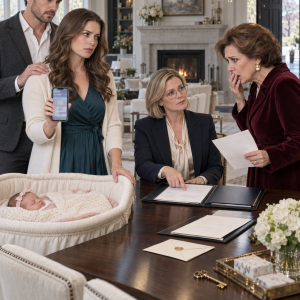
They spent months working through purchase orders, equipment leases and supplier accounts. Their relationship developed quietly over cold coffee, late-night video calls and long conversations about the difference between building a company and merely owning one.

They kept their personal relationship private because the review was still active, and because Mara wanted one part of her life that her family could not manage, display or bargain away.

Adrian picked up the transfer agreement and handed it to one of the attorneys.

The attorney read the first two pages before looking toward the Ellisons.

“The valuation is remarkably low,” she said. “The document also appears to have been presented without independent counsel while the shareholder was recovering from a medical procedure and receiving prescribed medication.”

Judith’s face lost some of its color.

Raymond turned toward Mara.

“Tell them we were offering support.”

Mara met his gaze.

“You offered rent money and diapers in exchange for shares worth millions.”

“We were trying to protect you,” Judith said.

“You were trying to purchase my silence at a discount.”

The hospital administrator stepped forward.

“Ms. Ellison has asked you to leave. Her request will be respected.”

Raymond’s expression tightened.

“You would not jeopardize a forty-year company over a personal disagreement,” he told Adrian.

Adrian did not raise his voice.

“My decision will be based on records, not emotion.”

Judith and Raymond left with stiff shoulders, attempting to preserve the appearance of control even as the door closed behind them.

By evening, the family had begun rewriting what had happened.

Chase called two board members and claimed Mara had formed a secret relationship with Adrian to seize the company. Judith told relatives that Adrian was uncertain about the baby and had demanded private testing. Raymond sent a formal message accusing Mara of violating her responsibilities as a shareholder.

They put nearly every accusation in writing.

It was their first major mistake.

For the next three days, Mara worked from her hospital suite while her son, whom she named Oliver, slept in a bassinet beside her. Adrian urged her to rest, but she insisted on organizing the records while every detail remained fresh.

She traced payments from Ellison Hospitality Supply to eleven small consulting companies. Several shared the same mailing address. Others listed managers who could not explain what services had supposedly been provided. Over three years, nearly twelve million dollars had been routed through those accounts.

Some of the money paid for Chase’s lake house and private travel. Other funds covered Judith’s jewelry purchases and Raymond’s undisclosed losses from speculative ventures. Inflated invoices had been approved, internal reports had been altered, and company loans had been used to conceal personal obligations.

The most painful evidence arrived without being requested.

At 1:47 one morning, Judith sent Mara a voice message.

“Sign the agreement while there is still time. Adrian will eventually lose interest. Men with his kind of money always do. When that happens, do not bring that baby to our door expecting us to rescue you.”

Mara listened once.

Then she forwarded the recording to her attorney and placed her phone facedown beside Oliver’s bassinet.

On Monday morning, Judith, Raymond and Chase arrived at Cedar Ridge’s downtown headquarters believing the partnership would finally be announced.

Chase wore a tailored navy suit and carried a bottle of vintage champagne. Judith greeted the receptionist as though she were entering a celebration arranged in her honor. Raymond walked toward the conference room with the confidence of a man who had spent years watching people stand whenever he entered.

When the doors opened, all three stopped.

Mara was seated near the end of the long table, dressed in a simple cream blouse and dark trousers. Oliver slept against her chest in a soft carrier.

Adrian sat beside her.

Also present were attorneys, independent members of the Ellison board, external auditors and representatives from a federal financial review unit.

Chase slowly lowered the champagne bottle.

Adrian closed the doors.

“You wanted to know who Oliver’s father is,” he said. “Now you know.”

The Meeting That Changed Everything

Raymond gripped the back of an empty chair.

“What is the purpose of this?”

“This is the partnership review you requested,” Mara answered. “It simply includes information you did not expect us to find.”

The screen at the front of the room lit up.

The first document showed a payment from Ellison Hospitality Supply to North Avenue Market Advisory.

Then came another payment to a second firm.

Then a third.

Eleven companies appeared in total, connected by shared addresses, repeated contact information and approval codes traced to Chase’s office.

The lead auditor spoke carefully.

“Our review found extensive evidence of false vendor billing, undisclosed related-party transactions and company funds used for private expenses.”

Chase pushed back his chair.

“Those files were taken illegally.”

Mara’s attorney responded.

“They were preserved by a shareholder and former compliance director who had authorized access at the time. They were later submitted through protected legal channels.”

Judith pointed toward Mara.

“She is doing this because we did not approve of her pregnancy.”

Mara pressed a key on the table.

Judith’s recorded voice filled the room.

“Adrian will eventually lose interest. Men with his kind of money always do. When that happens, do not bring that baby to our door expecting us to rescue you.”

When the recording ended, no one spoke.

The transfer agreement appeared next on the screen. Beside it was the independent valuation of Mara’s shares, followed by messages showing that Chase had already discussed selling the same ownership interest to an outside buyer for more than six times the amount offered to her.

Adrian’s attorney folded her hands.

“The evidence suggests an attempt to obtain a shareholder’s interest through concealed valuation information and pressure applied during medical recovery. The agreement and related communications have been submitted to the appropriate committees.”

Raymond turned to Adrian.

For the first time, his commanding posture seemed to fail him.

“This can be handled privately,” he said. “Public conflict harms employees, investors and families. You understand that.”

Adrian leaned forward.

“Cedar Ridge is withdrawing from the proposed merger. Our lending partners and institutional advisers were informed this morning.”

The champagne bottle slipped from Chase’s hand. It struck the carpeted floor, rolled beneath the table and came to rest against a chair leg.

A federal representative addressed him.

“Mr. Ellison, your company devices, corporate messages and transaction records are subject to preservation and review. You are instructed not to alter or remove any material.”

Chase stared at Mara.

“You planned all of this.”

She looked at him for a long moment.

“No. I asked you to correct it when there was still time. You mistook my quietness for weakness.”

Raymond immediately began offering concessions. He suggested appointing Mara chief executive, transferring Chase’s voting authority to her, giving her the family’s vacation property and introducing Oliver publicly as the next generation of Ellisons.

Judith’s voice trembled.

“I was trying to protect our reputation. I could not bear the thought of people whispering about us.”

Mara placed one hand over Oliver’s back.

“You turned away from a newborn so you could pressure his mother into surrendering what belonged to her,” she said. “You did not protect the family name. You showed everyone what had been hidden behind it.”

The board suspended Chase before the meeting ended. Raymond was removed from daily leadership later that week. Several credit facilities were placed under review, and the company’s proposed expansion was paused while auditors examined years of records.

The investigation uncovered more than Mara had expected: padded purchase contracts, hidden personal debts, fabricated service fees and property expenses paid through company accounts.

Chase eventually accepted responsibility for multiple financial violations and received a multi-year federal sentence along with substantial repayment obligations. Raymond avoided confinement, but he surrendered control of the company, much of his ownership and the lake property he had secretly pledged against company borrowing. Judith’s jewelry collection and several luxury assets were sold during the civil recovery process.

Mara did not celebrate any of it.

The employees had not created the deception, yet they were the ones arriving each morning unsure whether their paychecks, health coverage and retirement plans would survive. She worked with the independent board and Cedar Ridge’s advisers to stabilize the business, protect essential jobs and separate honest operations from the accounts under investigation.

Once the company was secure, Mara sold her shares through a transparent, independently reviewed transaction.

She used part of the proceeds to create the Clear Ledger Foundation, which provided legal guidance and temporary financial support to employees who reported misconduct inside family-controlled businesses. She understood how easily loyalty could be used to demand silence and how often a person was called disloyal simply for telling the truth.

The Family Oliver Was Given

Oliver’s first birthday was held in the backyard of a modest cedar house outside Stillwater, beneath strings of warm lights and tall maple trees.

There were white balloons, a vanilla cake, Adrian’s cousins, Mara’s closest friends and several former Ellison employees whose jobs had survived the company’s restructuring. No photographers waited at the gate. No one discussed share prices or family reputation.

There was no place set for Judith or Raymond.

Over the previous year, eleven letters had arrived.

Some contained apologies. Others spoke of grandparents’ rights, family tradition and the importance of allowing the past to remain in the past. In the final letter, Judith wrote that she wanted to hold Oliver once, even if Mara never spoke to her again.

Mara returned every envelope unopened.

She did not do it out of anger. She did it because forgiveness and access were not the same thing. A person could release bitterness without returning a child to the hands that had once rejected him.

Near sunset, Oliver pulled himself upright against a garden bench. Adrian crouched several feet away while Mara knelt beside the cake table.

“Come on, buddy,” Adrian said softly. “You’ve got this.”

Oliver released the bench.

He took one uncertain step, then another, his arms raised for balance. On the third step, his knees folded, but Adrian reached him before he reached the grass.

Oliver laughed so loudly that everyone around them began laughing too.

Mara lifted him into her arms and kissed the same small forehead she had kissed in the hospital, on the afternoon her parents declared that they would never hold him.

A year earlier, she had believed she was protecting her son from abandonment.

Only later did she understand that Oliver had never entered the world without a family. He had simply arrived before the wrong people had finished leaving.

The Ellisons had once measured family through ownership, obedience and public appearance. Mara had learned to measure it differently: by who remained beside you when there was nothing to gain, who guarded your dignity when you were too tired to defend it, and who welcomed a child without asking what that welcome might be worth.

Oliver rested his head against her shoulder while Adrian stood beside them, one hand against her back.

The people who refused to recognize the baby had lost the authority they believed would last forever.

But the child they called unwanted had never lacked a name, a home or love.

He had only revealed who truly deserved to be part of his life.

Related Posts

I Returned Home Early And Found My Husband’s Mistress Wearing My Late Mother’s Concert Gown Beside Her Piano. My Husband Said, This Is Not What It Looks Like. Then His Mistress Handed Him A Three-Point-Six-Million-Dollar Transfer Bearing My Forged Signature.

Part 1 – The Woman Wearing My Mother’s Dress The moment I saw my husband’s mistress touching my mother’s concert piano, I stopped asking whether my marriage could...

I Returned Only to Grab My Glasses and Froze When I Found My Daughter Being Publicly Humiliated by Her Mother-in-Law Right in Front of Her Husband—While He Calmly Kept His Eyes on His Phone. They Mocked Me for Owning Nothing More Than a Small Workshop While Secretly Dumping a $12 Million Debt Onto My Daughter… But Everything Changed at Sunday Lunch, When One Simple Greeting From the Company’s CEO Left the Entire Family Frozen in Shock—Because the Secret I Had Hidden for Years Had Finally Come to Light

The Afternoon I Returned for My Reading Glasses I had only gone back for my reading glasses. They were probably beside the porcelain lamp in the sitting room,...

I Came Home From a Six-Day Work Trip and Found My 4-Year-Old Daughter Facing the Wall With Her Curls Gone—My Mother-in-Law Blamed Her for a Missing Bracelet, My Husband Told Me to Apologize, but a Forgotten Camera Revealed Why They Needed Her to Take the Blame

The House Where No One Believed Her When I returned to Virginia after six days away for work, I expected my four-year-old daughter to come racing down the...

My Ex-Wife Laughed At The Scratched Watch On My Wrist During Our Reunion. Minutes Later, She Learned That The Quiet Contractor She Once Left Behind Had Become The Founder Of One Of New England’s Most Respected Infrastructure Companies. The Watch Had Never Measured Wealth. It Measured Character.

Part 1 – The Divorce Papers Beside The Christmas Ham Nine years before the reunion, my wife handed me divorce papers while my mother was still cutting her...

My Mother Called 911 Because My 5-Year-Old Wouldn’t Give Up Her Birthday Doll—And Told Her, “Your Mom Will Be Ashamed Of You.” I Came Home To Find Her Shaking Before Two Officers, Quietly Collected The Official Report, Blocked My Family From Her School, And Saved Every Message… Days Later, An Unfinished Call Exposed What They Had Planned.

The Morning I Came Home Early My mother was standing in the middle of my living room, pointing at my five-year-old daughter as though she were identifying a...

Để lại một bình luận

Email của bạn sẽ không được hiển thị công khai. Các trường bắt buộc được đánh dấu *