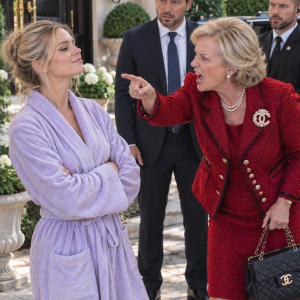
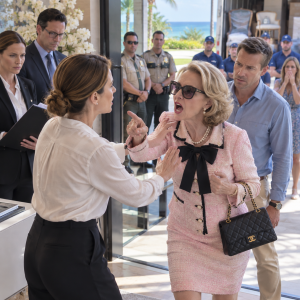
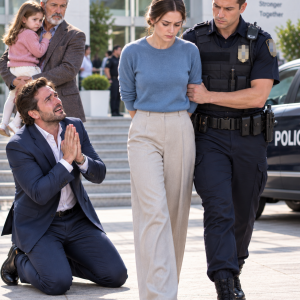
Part 1: The Night the Door Stayed Locked
“If you want to leave this house tonight, you will crawl beneath Atlas three times and ask me properly.”
Graham Mercer said it while turning the brass key between his fingers. Beside him, an enormous Anatolian shepherd stood across the marble entryway of our estate in Buckhead, Atlanta.
It was nearly two o’clock in the morning, and rain struck the windows hard enough to blur the city lights beyond the garden. Ten minutes earlier, Emory University Hospital had called to tell me that my father, Henry Caldwell, had died after an unexpected cerebral hemorrhage.
I was still holding the phone when Graham locked the front door.
“I need to reach the hospital before they move him,” I said. “I only want a few minutes with my father.”
Graham remained seated in a velvet chair, wearing a silk robe and the irritated expression of a man whose sleep had been interrupted by someone else’s grief.
“Your father has been an inconvenience for years,” he replied. “Tomorrow morning I have a financing presentation, and I will not drive through a storm because an old man finally stopped breathing.”
That night, however, he touched the one boundary I could no longer excuse.
I moved toward the door, but Graham tightened Atlas’s lead and positioned the dog across my path.
“Three times,” he repeated. “Crawl beneath him, apologize for waking me, and perhaps I will unlock the door.”
Atlas growled because Graham had trained him to respond to tension. The animal was not cruel, but he had learned fear from the man holding the lead.
Graham expected me to cry, bargain, and humiliate myself for permission to attend my father’s final moments. Instead, I straightened my coat, opened my phone, and called attorney Miriam Shaw, the longtime counsel for my father’s family office.
She answered on the second ring.
“Caroline, I am so sorry.”
“Activate the emergency control provisions in the Caldwell Legacy Trust,” I said. “Suspend every credit facility connected to Mercer Development Group, notify the secured lenders, and dispatch counsel to take control of the Buckhead property before sunrise.”
Graham stopped smiling.
“What are you talking about?”
I continued without looking away from him.
“Freeze all trust-backed vehicles, place the aircraft lease under review, and revoke Graham Mercer’s access to every account funded through Caldwell intermediaries.”
Miriam remained silent for half a second.
“Are you certain?”
“Completely.”
I ended the call, lifted a bronze sculpture from the console table, and struck the interior lock until the housing broke. Graham stood up, stunned less by the damage than by the certainty in my face.
Before stepping into the storm, I turned toward him.
“This house, your company, the cars outside, and the investor presentation you plan to give tomorrow all exist because my father financed them through structures you never bothered to understand.”
His face went pale.
“You told me your family had lost everything.”
“My father told you what he needed to learn whether you loved me without access to his wealth.”
I opened the door.
“Tonight, my father died. The woman who kept protecting you from the consequences of your own choices died with him.”
By dawn, Graham’s corporate cards no longer worked, two lenders had suspended funding, and the board of Mercer Development received notice that its controlling capital partner had demanded an emergency review.
Part 2: The Letter My Father Left Behind
I reached Emory University Hospital soaked through and shaking from exhaustion. My father lay beneath a white sheet in a private room, his face calmer than it had been during the final months of his life.
I held his hand and whispered, “I am sorry I waited so long to believe you.”
Miriam stood near the window with Julian Price, the chief administrator of the Caldwell family office. Neither interrupted me. When I finally stepped away from the bed, Miriam handed me a sealed envelope and a thick binder.
Five years earlier, my father had agreed to my marriage under several conditions. I signed a prenuptial agreement protecting inherited property, and he placed substantial assets inside a trust whose beneficiaries and controlling provisions remained confidential.
Graham believed Henry Caldwell had suffered catastrophic losses during a failed manufacturing expansion. In reality, my father controlled a private infrastructure fund, commercial real estate holdings, and a lending platform that had quietly provided most of the capital supporting Mercer Development.
He wanted to know whether Graham would remain loyal when he believed there was nothing left to inherit.
If Graham treated me with respect, he would eventually receive legitimate investment opportunities and a minority equity position. If he abused me, betrayed the marriage, or misused trust-backed assets, every line of support could be withdrawn immediately.
Miriam opened the binder.
The evidence inside was worse than the marriage.
Over four years, Graham had inflated construction invoices, routed payments through shell vendors, and transferred more than 11.4 million dollars into accounts he controlled. Several vendors existed only on paper. Others belonged to friends who returned part of each payment through consulting agreements.
A penthouse in Midtown Atlanta had been purchased through one of those companies for Simone Vale, Graham’s executive assistant and longtime mistress.
“Your father discovered the full pattern eighteen days ago,” Julian explained. “He was working with forensic auditors and preparing a board intervention.”
“Did the investigation cause his death?”
Julian chose his words carefully.
“The physicians cannot say that directly. However, the strain aggravated his blood pressure, and he refused to rest because he believed Graham might move additional funds.”
The knowledge settled heavily inside me. Graham’s greed had not legally killed my father, but it had consumed the final weeks of his life.
The funeral took place three days later at Oakland Cemetery. Graham, Rosalind, and Paige did not attend.
Simone came instead.
She wore a crimson dress beneath a black coat and placed a ten-dollar bill into the memorial box before approaching me. Around her neck hung a diamond pendant listed in Mercer Development’s accounts as equipment for an overseas project presentation.
“Graham asked me to tell you that you should remove your belongings from the Buckhead house,” she whispered. “He plans to file for divorce, and I will be moving in.”
I studied the necklace.
“Keep wearing it,” I replied. “It will make identification easier when federal investigators catalogue the assets.”
Her smile disappeared.
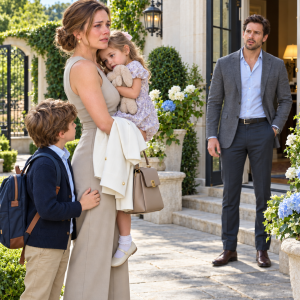
After the funeral, the trust formally transferred voting control of the Caldwell Infrastructure Fund to me. Through that position, I controlled seventy-eight percent of the preferred equity supporting Mercer Development.
I could have removed Graham immediately, but Miriam advised patience.
“We possess enough for civil recovery,” she said. “To establish the full criminal pattern, we need him to act without realizing the evidence has been preserved.”
Desperate to restore his status, Graham pledged machinery he did not own, misrepresented suspended accounts as available capital, and borrowed fourteen million dollars from private lenders at extreme interest rates.
He believed a major advance would arrive after a public signing ceremony.
One week later, he scheduled that ceremony inside the Grand Ballroom of the St. Regis Atlanta and invited investors, journalists, lenders, and city officials.
At nine-thirty that morning, Graham lifted a fountain pen above the contract.
The ballroom doors opened.
I entered wearing a charcoal suit, followed by Miriam, Julian, independent auditors, federal investigators, and representatives from the Securities and Exchange Commission.
Graham dropped the pen.
“Before anyone signs,” I said, “the people in this room deserve to know who has actually funded Mercer Development and how much of that money has been stolen.”
Part 3: The Project That Never Existed

The ballroom screens illuminated with a map of transactions linking Mercer Development to shell companies, false vendors, inflated material invoices, and accounts controlled by Graham.
A photograph of Simone’s Midtown penthouse appeared beside the transfer used to purchase it.
Miriam approached the microphone.
“Under the Caldwell Legacy Trust and the governing agreements of Mercer Development Group, Caroline Caldwell Mercer now exercises controlling authority over the capital structure supporting this company. Effective immediately, Graham Mercer is suspended from every executive and financial function.”
Graham stared at her.
“Caroline is a homemaker. She does not understand corporate finance.”
I faced him.
“I earned an MBA from Columbia, worked in structured finance for seven years, and designed two of the credit vehicles your company later used. Leaving my career to support our marriage was a sacrifice, not evidence of incompetence.”
His mouth opened, but no answer came.
“Harbor Point Savannah does not exist,” I said. “It was a controlled proposal created to determine whether you would misrepresent assets after your legitimate credit facilities were suspended.”
Documents appeared showing Graham’s pledges of trust-owned equipment, false liquidity statements, and personal guarantees based on property he never owned.
“You borrowed fourteen million dollars using assets controlled by the Caldwell trust,” I continued. “You also represented this house, aircraft lease, and construction fleet as personal property.”
“Graham, my accounts are frozen,” Simone shouted. “Federal agents are at the penthouse, and they say everything inside may be seized.”
He turned toward her.
“Stop talking.”
“You promised the money belonged to you. You said Caroline had no family assets and would receive nothing after the divorce.”
I signaled to the technician.
An audio recording played through the ballroom. Graham and Simone discussed raising concrete prices, dividing vendor rebates, and moving money before the board could review quarterly results.
Two federal agents stepped toward the stage and identified themselves. They presented Graham with warrants related to wire fraud, conspiracy, falsified financial statements, and misappropriation of investor funds.
His confidence collapsed.
He moved toward me, ignoring the agents.
“Caroline, tell them this is a marital dispute. I will sign the divorce papers, return the money, and resign from the company.”
“The money belongs to investors, employees, and the trust. I cannot erase crimes because you suddenly fear the consequences.”
His voice dropped.
“The private lenders expect payment next week. If you do not cover the fourteen million, they will destroy me.”
“Your personal borrowing was never authorized by the trust.”
“I am your husband.”
“You were my husband when you locked me inside the house on the night my father died. You were my husband when you mocked him, stole from his fund, and financed another woman with company money.”
He reached toward my arm, but an agent stepped between us.
“You chose to become someone I must protect myself from.”
Graham was escorted from the ballroom while cameras recorded every step. Simone was detained for questioning after investigators found evidence that she approved false invoices and knowingly received stolen property.
The signing ceremony ended without a signature.
Harbor Point Savannah disappeared because it had never existed.
Mercer Development survived only because the board removed Graham before his fraud pulled the entire company into collapse.
Part 4: The House That Was Never His
While Graham remained in federal custody, trust representatives arrived at the Buckhead estate with court orders confirming ownership and preserving assets.
Rosalind and Paige had moved into the guest wing months earlier, claiming Graham needed family support because I had become emotionally distant. They treated the property as though they had inherited it through proximity to their son.
Rosalind confronted the attorneys in the entrance hall.
“My son owns this house.”
Miriam handed her a certified deed.
“The property belongs to the Caldwell Legacy Trust. Mr. Mercer held a revocable occupancy license connected to his employment and marriage.”
Paige pointed toward the staircase.
“My clothes, jewelry, and furniture are upstairs.”
“You may remove documented personal belongings under supervision,” Miriam replied. “Trust-owned items must remain.”
“You called me a parasite while living in a house financed by my father,” I told Rosalind.
“Graham told us you contributed nothing.”
“You preferred that story because it allowed you to feel superior without asking questions.”
Rosalind sold designer clothing to rent a modest apartment outside Marietta. Paige accepted a receptionist position after discovering that social connections did not pay utility bills.
I did not celebrate their discomfort. I simply stopped financing it.
Atlas remained at the estate after animal-control specialists evaluated him. The trainer concluded that Graham had used intimidation, punishment, and food restriction to make the dog appear aggressive.
Under consistent care, Atlas became calm and responsive. I transferred him to a rescue program specializing in large working breeds, where he was eventually adopted by a family with several acres outside Athens.
The animal had never been the threat.
The person holding the lead had been.
Part 5: The Trial and the Accounting
Simone cooperated after prosecutors showed that the penthouse, jewelry, and travel expenses could be traced directly to stolen funds. She surrendered the assets and testified that Graham instructed her to destroy invoices and delete communications.
Graham pleaded not guilty at first, insisting that the Caldwell trust had informally approved every transaction. The recordings, board minutes, digital authorization logs, and testimony from former employees contradicted him.
The jury convicted him of wire fraud, conspiracy, falsifying corporate records, and misappropriating investor funds.
At sentencing, he turned toward me.
“You could have stopped this before it became public.”
I met his gaze.
“You mean I could have continued hiding what you did.”
“You destroyed my life.”
“You built your life on money that belonged to other people. I only stopped supporting the structure.”
He received a lengthy federal sentence and substantial restitution obligations. The fourteen-million-dollar private loan remained part of separate litigation because the lenders had relied on fraudulent guarantees.
Part 6: Rebuilding What Greed Damaged
Taking control of the Caldwell Infrastructure Fund did not feel triumphant. The organization had been my father’s life, and every conference room carried evidence of decisions he expected to continue making.
I spent the first months reviewing projects, replacing compromised managers, and separating Mercer Development from the shell entities Graham created.
We retained hundreds of employees whose livelihoods would have been endangered by an uncontrolled collapse. Independent monitors reviewed contracts, while all related-party transactions required board approval and external verification.
Mercer Development was renamed Caldwell Urban Works after a restructuring. The company sold unnecessary luxury assets and redirected capital toward affordable housing, public infrastructure, and responsible commercial projects.
Within eighteen months, the company stabilized. Several investors recovered funds through asset sales and insurance claims, while employees received profit-sharing protections that Graham had repeatedly delayed.
I established the Henry Caldwell Foundation using recovered assets and a portion of my inheritance. Its programs provided legal representation, emergency housing, and financial education for people experiencing economic abuse within marriages or domestic partnerships.
The foundation’s attorneys repeated one principle during every consultation: access to someone’s finances is not ownership of that person.
Part 7: The Meaning of the Final Letter
Several months after the trial, Miriam gave me the personal letter my father had sealed before his death.
I waited until evening to open it.
“Caroline,” he had written, “I regret creating a test around your marriage. I believed hidden wealth would reveal Graham’s character, but I underestimated how much harm silence could allow. You never needed to prove that you could endure disrespect. I should have reminded you sooner that love requiring humiliation is not love.”
I stopped reading and allowed myself to cry.
The letter continued.
“Do not inherit only my companies. Inherit my mistakes, examine them honestly, and refuse to repeat them. Protect people sooner than I protected you. Wealth should create choices, not cages.”
My father had not asked me to destroy Graham. He had asked me to build something better.
That distinction guided everything afterward.
I sold the Buckhead estate because I no longer wanted to sleep beneath a roof associated with control. The trust converted the property into capital for the foundation, while I moved into a smaller home near Piedmont Park.
Part 8: The Life That No Longer Needed Permission

Three years later, a business magazine interviewed me about the recovery of Caldwell Urban Works and the foundation’s national expansion.
The reporter asked how I had managed to bring down a powerful executive within a single night.
“I did not bring him down in one night,” I replied. “Graham spent years building his collapse through theft, lies, and contempt. I merely stopped standing beneath it.”
She asked whether the moment at the locked door had changed me.
“It clarified me. Grief removed my ability to keep translating cruelty into excuses.”
After the interview, I visited the foundation’s new legal center. A brass plaque near the entrance carried a sentence from my father’s letter.
“Wealth should create choices, not cages.”
Inside, attorneys met with clients who had been denied bank access, threatened with homelessness, or pressured into signing documents they did not understand.
Nobody was required to crawl, beg, or prove suffering before receiving help.
That evening, I walked home beneath a calm Atlanta sky. My phone remained quiet, and no one expected an explanation for where I had been.
I thought about the night Graham stood behind Atlas with the key in his hand. He believed power meant controlling the door, the money, the animal, and my ability to reach my dying father.
He misunderstood every part of that power.
The house was not his. The company was not his. The money was not his. Even the obedience he believed belonged to him disappeared the moment I stopped surrendering it.
My father’s death remained the deepest loss of my life, and no legal victory changed that truth. However, his final letter helped me understand that grief could become direction without becoming revenge.
Graham had once demanded that I crawl beneath an animal for permission to leave.
I never crawled.
I broke the lock, stepped into the storm, and reclaimed the future he had mistaken for his property.
From that night forward, no one held the key to my life except me.
THE END