The Day He Invited Me to His Wedding

The Call from Room 614
At six forty-three on a gray March morning, while rain moved softly across the windows of St. Catherine’s Medical Center in Portland, Maine, my former husband called to tell me that the woman he had left me for was expecting a baby.
I had been awake for nearly thirty hours. Every part of me felt tender and unfamiliar, as though I had returned from a long journey and had not yet learned how to live inside my own body again. Beside my bed, in a clear hospital bassinet, my daughter slept beneath a cream-colored blanket, one small fist tucked under her chin. She was eleven hours old. Her name was Rose, after my mother, and whenever I looked at her, the years behind me seemed to loosen their grip.
My phone vibrated against the tray beside a paper cup of tea. The name on the screen was Graham Prescott.
“Come to my wedding, Audrey,” he said. There was no greeting, no question about how I was. Behind him I heard cups touching saucers and the low murmur of a crowded café. “Paige is twelve weeks along. I thought you should hear it from me.”
I looked at Rose’s delicate eyelids and the faint crease between her brows. “I hope everything goes well for you both.”
Graham laughed, and I recognized at once the particular laugh he used when he wanted to make another person feel foolish. “You should really attend. It might help you accept that I was never the problem. Paige is giving me the family I should have had years ago.”
For five years, I had submitted to appointments, injections, scans, and procedures that left me exhausted. Graham had once held my hand in waiting rooms and promised that we were a team. Gradually he began arriving late, then not at all. By the third year, every disappointing result became evidence in a case he was building against me. He spoke about my body as though it were a defective machine he regretted purchasing. His mother, Lorraine, perfected a gentler cruelty, offering sympathy at holiday dinners and then wondering aloud how quiet a house could feel without children.
“Paige believes in the future,” he had said. “You have turned our whole life into clinics and disappointment.”
Four days before the divorce became final, after I had stopped every medication and begun rebuilding a life he could no longer supervise, a physician at a small practice in Brunswick told me I was pregnant. The pregnancy had happened naturally. I sat alone in my car afterward, holding the test results with both hands, too stunned even to cry.
I almost called Graham that afternoon. Then, outside the courthouse four days later, I heard him tell his attorney that our marriage had been a costly detour and that he was relieved to have escaped before I wasted the rest of his good years. Whatever obligation I had felt to share my fragile hope disappeared. I moved quietly into my grandmother’s townhouse, told only those I trusted, and protected the pregnancy from a family that had turned every private sorrow into a public judgment.
“I’ll send the invitation,” he said. “Please don’t respond emotionally. You know how you get when children are involved.”
“I won’t make a scene,” I told him.
“You always need to prove something.”
“This time,” I said, “I only need to understand the truth.”
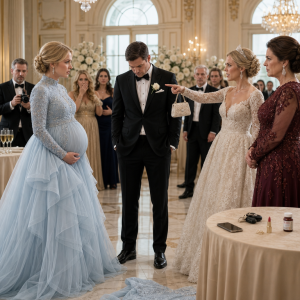
The call ended. A moment later, a digital invitation appeared in my email. Graham and Paige were to be married in six weeks at a grand waterfront estate outside Savannah, Georgia. The design was elegant, the guest list evidently enormous, and the bottom line carried a sponsor’s name: Prescott Meridian Development.
Prescott Meridian had appeared repeatedly in the preliminary audit of the trust my grandmother had left me. The trust owned four apartment buildings and a row of small shops in northern New England. During our marriage, when treatments had made me tired and unfocused, Graham persuaded me to give him narrow authority to approve repairs and negotiate vendor contracts. I had believed I was allowing my husband to replace roofs and boilers.
According to the pages in the leather folder, he had used that authority to make my inherited properties appear responsible for a corporate loan worth nearly eighteen million dollars.
The first major payment was due on his wedding day.
For years, Graham had mistaken my weariness for weakness. That morning, I finally understood how costly his mistake would become.
The Records No One Expected Me to Read
By noon, my hospital room looked less like a place of recovery and more like a temporary office. Bank statements covered the foot of my bed, property deeds stood in careful stacks on the visitor’s chair, and my attorney, Rebecca Sloan, sat near the window with her glasses low on her nose.
“This was not careless accounting,” she said. “It required planning, false valuations, and help from inside the lending company.”
She placed a corporate disclosure in front of me. The loan had been approved by Atlantic Commonwealth Finance, where Graham’s older sister, Meredith Prescott, served as regional credit officer. Meredith had signed the valuation waiver herself, allowing Graham’s company to avoid an independent review of the collateral.
The structure was simple once Rebecca explained it. Graham’s limited authorization had been enlarged on copied pages attached to documents I had never seen. Meredith then accepted those documents as valid, approved an inflated valuation, and released the loan. Most of the money went into luxury coastal developments that were already losing investors. Some paid Graham’s personal expenses. Nearly three hundred thousand dollars had gone toward the Savannah wedding.
“If the projects succeeded, they kept the gains,” Rebecca said. “If they failed, your trust absorbed the loss.”
“There is another matter, Audrey, and it may be harder to hear.”
At my request, she had obtained my complete treatment history from the regional health network. A consulting endocrinologist noticed that my original laboratory results did not match later summaries. Six months after treatment began, my records had been transferred from my first physician to North Shore Reproductive Research, a private clinic partially owned by Meredith’s husband.
The independent review found that my natural fertility indicators had been normal when I entered treatment. Graham’s first analysis, however, had shown a serious condition that made conception unlikely without specialized assistance. Subsequent records reversed the findings. My healthy results were labeled deficient, while his were rewritten as normal.
More troubling still, several compounds prescribed to me were not appropriate for my documented condition. They disrupted the very hormonal patterns the clinic claimed to be improving. Nothing in the files proved that every setback had been intentionally caused, but emails between Graham, Meredith, and the clinic administrator showed that they knew the treatment plan was medically unsound and insisted that it continue.
“I was healthy?” I finally asked.
Rebecca reached across the bed and covered my hand. “Your original results were healthy. The specialist believes your body began returning to its normal rhythm after you left that clinic. Rose is consistent with that recovery.”
Grief does not always arrive as tears. Sometimes it arrives as perfect clarity. I remembered apologizing to Graham after every unsuccessful cycle, asking whether he regretted marrying me, and thanking him for staying when he was the one who owed me an apology. Shame had kept me grateful for scraps of kindness, and while I was measuring my worth by test results, he had been counting on me never to read the trust statements.
Rose opened her eyes and studied the collar of my hospital gown with solemn concentration. She had come into being during the first month in years when no one was telling my body it had failed. The thought did not erase what had happened, but it gave those years a boundary. They were part of my life; they were not the definition of it.
“Does Graham know about Paige’s prenatal test?” Rebecca asked.
I stared at her. “What prenatal test?”
Rebecca had traced a series of unusual payments to a boutique medical service in Georgia. The payment records alone revealed nothing confidential, but they led her investigators to Aaron Bell, Graham’s former business partner. Aaron had recently separated from the company after accusing Graham of hiding losses. When shown evidence that money had been sent from their shared venture to Paige, he voluntarily gave Rebecca’s team a copy of a prenatal paternity report Paige had sent him.
The report identified Aaron—not Graham—as the likely father of Paige’s baby.
Paige had also received six hundred thousand dollars from an account Aaron controlled. Their messages suggested that she intended to marry Graham, gain access to what remained of his business, and leave once the company’s next investment round closed.