PART 1 — THE WOMAN AT MY BLUE DOOR
My mother hadn’t spoken to me in fifteen years, but when she appeared at my front door four weeks after I gave birth, she didn’t apologize.
She smiled at the newborn sleeping against my chest, opened her arms as though I were already supposed to hand my daughter over, and said, “Your father and I have decided we’re ready to forgive you.”
For several seconds, I genuinely thought exhaustion had made me misunderstand her.
Behind me, the dryer hummed in the laundry room, and a cartoon Silas had forgotten to turn off played quietly in the living room. Ren was warm against my shoulder, making those tiny sleeping noises newborns make when they have no idea the adults around them are capable of destroying an otherwise peaceful afternoon.
My mother stood on my porch holding a foil-covered casserole.
Fifteen years of silence, apparently, came with baked chicken.
“Forgive me for what?” I asked.
Her smile tightened. “Colleen, please. We’ve all made mistakes.”
That sentence brought nineteen-year-old me back so quickly that I could almost smell rain.
My father had stood in our foyer fifteen years earlier with my suitcase in one hand and a box of my nursing-school textbooks in the other. He hated my boyfriend, Silas Callahan, because Silas’s father rented half a duplex, fixed his own truck, and worked maintenance jobs while volunteering with the local fire department.
My father called people like that failures.
He called Silas something worse.
“If you want to throw your life away on that boy, do it somewhere else.”
My mother had been halfway up the stairs in her robe.
She heard everything.
When Dad threw my suitcase onto the rain-soaked lawn, she didn’t come down.
When the cardboard box holding my textbooks split open in the grass, she didn’t move.
And when my father shouted, “You want to be a Callahan so badly? Go become one,” she watched me walk out of the house without saying my name.
Silas found me twenty minutes later. He wrapped his jacket around me, loaded my wet belongings into his truck, and said the sentence that became the foundation of the next fifteen years.
“We’ll figure it out.”
We did.
We spent eight months sleeping on his father’s foldout couch. I waited tables while finishing nursing school, and Silas sometimes ate peanut-butter sandwiches for dinner because my tuition payment was due. Eventually I became a NICU nurse, while Silas joined the fire department and worked his way from probationary firefighter to lieutenant and then captain.
We bought a modest white house with a blue front door.
We paid it off.
And after years of hoping, we had Ren.
Now the woman who had watched me lose one family was reaching toward the daughter I’d just brought into another.
“Oh, let me see her.”
Mom stepped forward.
I stepped backward.
Her hands stopped in midair.
“She’s my granddaughter.”
“You’ve known she existed for four weeks.”
“That doesn’t change what she is.”
Her eyes traveled past me and settled on the brass nameplate beside our front door.
SILAS & COLLEEN CALLAHAN.
Something changed in her expression.
Not enough to call it disgust anymore, but enough for me to recognize it.
“Your father has been very sick,” she said.
That caught me.
I didn’t invite her inside, but I stopped trying to end the conversation.
“What happened?”
“His heart. He collapsed at home.”
“When?”
She hesitated.
“A few weeks ago.”
Before she came to see me.
That detail lodged somewhere in my mind.
Mom adjusted the casserole dish against her hip. “Near-death experiences change people. Your father has been thinking about what’s important, and he wants his family together again.”
“He had fifteen years to think about that.”
“People get stubborn.”
I waited for her to say your father got stubborn.
She didn’t.
Instead she sighed. “Everyone made choices, Colleen.”
There it was again.
Shared responsibility for a decision I hadn’t made.
She placed the casserole on the small table beside my door and tucked a card underneath it.
“Call when you’re ready to stop punishing everyone.”
Then she left.
I threw away the casserole.
I kept the card.
Two days later, Aunt Deborah called. Then the pastor from the church I’d attended as a child. Then women I hadn’t spoken to since high school began sending cards.
FAMILY IS FOREVER.
LIFE IS TOO SHORT FOR ANGER.
HONOR YOUR FATHER AND MOTHER.
Nobody asked why my parents hadn’t attended my nursing-school graduation.
Nobody mentioned my wedding.
Nobody asked whether they’d known I was pregnant.
My mother had gotten to them first, and she’d apparently reduced fifteen years of estrangement to me being upset over “something that happened when she was nineteen.”
Then she came to my hospital.
I was carrying Ren through the main corridor after introducing her to several coworkers when I heard my mother’s voice behind me.
“Colleen!”
I turned and saw the pale pink cardigan first.
Then another casserole.
Several nurses glanced toward us as Mom hurried over wearing the trembling smile of a woman who knew she had an audience.
“There’s my granddaughter.”
She reached.
I shifted Ren away.
“No.”
Mom’s face crumpled immediately.
“You won’t even let your own mother hold her?”
That was the moment I stopped wondering whether she’d returned because Dad nearly died.
She hadn’t come to reconcile.
She had come to apply pressure.
And she thought public embarrassment would make me easier to control.
I left without arguing.
That night, after Ren finally fell asleep, I opened the top drawer of my nightstand and removed an envelope I’d kept for eleven years.
My grandmother Ruth had been the only Whitfield who contacted me after Dad threw me out. She did it quietly: birthday cards without return addresses, a little cash at Christmas, flowers when I graduated nursing school.
Before she died, she sent one final letter.
One line had stayed with me.
People who abandon you don’t always come back because they miss you. Sometimes they come back because they need somewhere to put their hands.
I had always thought Nana meant emotionally.
That night, while smoothing the envelope flat, I felt something hard inside its lining.
I carefully opened the seam.
A small brass key dropped into my palm.
No label.
No note explaining what it opened.
Just a key I’d unknowingly kept beside my bed for eleven years.
I was still staring at it when someone knocked downstairs.
Silas was working overnight, so I checked the porch camera before opening the door.
My brother Grant stood beneath the light.
I hadn’t seen him since I was nineteen.
When I opened the door, he didn’t hug me or ask about Ren.
He said, “Whatever Mom asks you to sign, don’t do it.”
I stared at him.
“What are you talking about?”
“The agency is in trouble.”
The Whitfield Insurance Agency had been my father’s pride for most of my childhood. He spoke about it as if our last name had been carved into the building by God.
I let Grant inside.
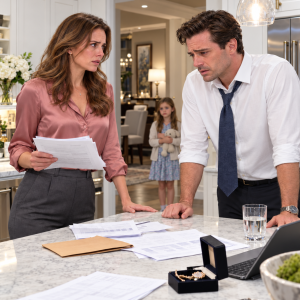
At my kitchen table, he explained that the agency carried nearly nine hundred thousand dollars in debt. The commercial building had been pledged as collateral, and Dad had borrowed against the house.
“What does any of that have to do with me?”
Grant reached into his jacket and placed a thick envelope on my table.
“More than they ever told you.”
The first document contained my full legal name.
COLLEEN WHITFIELD CALLAHAN.
Below it was a personal guaranty for $1.24 million.
At the bottom sat my signature.
Except I hadn’t signed it.
I looked up.
“What is this?”
Grant rubbed his forehead. “Nana Ruth left you fifty-one percent of the agency.”
I laughed once because the alternative was screaming.
“No, she didn’t.”
“She did. Dad buried it.”
According to Grant, Nana had controlled most of the company stock because she and Grandpa founded the agency. After Dad threw me out, she placed fifty-one percent into a trust for me.
Years later, paperwork appeared claiming I had transferred those shares back.
The signature was fraudulent.
Now a bank review had uncovered discrepancies, and the refinancing my family desperately needed couldn’t proceed unless I ratified the old transfer.
Suddenly my mother’s visit made sense.
Almost.
“So she didn’t come because Dad nearly died.”
Grant looked down.
“The bank froze the refinancing four days after his collapse.”
For fifteen years, my parents had lived as though I were dead.
Then my signature became valuable.
Suddenly I was their daughter again.
The brass key lay beside Nana Ruth’s letter.
I pushed it toward Grant.
“Do you know what this opens?”
For the first time that night, my brother looked genuinely startled.
“I’ve never seen that before.”
Three mornings later, I learned something else Grant hadn’t told me.
Silas was making pancakes while Ren slept nearby when I mentioned Dad’s collapse on Sycamore Street.
Silas’s spatula stopped halfway over the skillet.
I knew my husband well enough to recognize that pause.
“Silas.”
He switched off the burner.
“What?”
“Which crew answered that call?”