THE CHRISTMAS MY DAUGHTER CAME HOME ALONE
“Why are you here?”
The question came out much calmer than I felt.
My eleven-year-old daughter, Emma, was sitting at our kitchen table in the same red dress she had been wearing when I dropped her off at my parents’ house earlier that afternoon. Her coat was hanging over the back of a chair, her shoes were beside the door, and every Christmas present she had taken with her was now lined up neatly in our entryway.
For one confused second, I wondered whether my parents had brought her home early.
Then I saw the burnt pan on the stove.
Emma looked at me and said quietly, “They wouldn’t let me in.”
I set my purse down.
“What do you mean they wouldn’t let you in?”
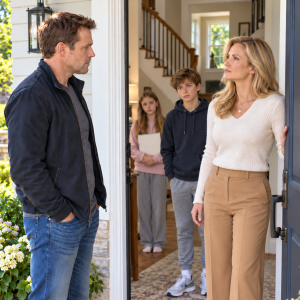
“Grandma opened the door and said there wasn’t enough room.”
“At the table?”
Emma shook her head.
“In the house.”
I stared at her because the answer made no sense. My parents lived in a four-bedroom house with a large dining room and a finished basement. More importantly, it was the house my grandmother Ruth had arranged for them to live in years earlier because she wanted it to remain a gathering place for our family.
That afternoon, my brother and his family were there. Aunt Dana was there with her husband. Several cousins had been invited, too.
Yet somehow my eleven-year-old daughter was the person they had decided there was no room for.
I sat across from her and asked why she hadn’t called me.
“My phone died,” she said. “I asked Grandma if I could use the house phone, but she said no.”
“Why?”
“She said calling you would only make everything harder.”
The explanation disturbed me almost as much as what had happened at the door because it meant my mother had understood perfectly well that I would object. Instead of calling me, she had simply made sure Emma couldn’t.
I asked what my father had done.
Emma looked down at her hands.
“Grandpa told me to walk home. He said it wasn’t far.”
Our house was about twenty minutes away on foot.
Twenty minutes for an adult on a normal day might not have sounded dramatic. But this was Christmas afternoon, it was cold, Emma was eleven, her phone had no battery, and she had been carrying gift bags in both hands.
I pictured her walking past houses glowing with Christmas lights while families sat around dinner tables inside, still carrying presents for relatives who had refused even to let her through the door.
Then I looked at the stove again.
“You tried to cook?”
Emma nodded, suddenly embarrassed.
“I got hungry. I found a video for grilled cheese, but I left the pan on too long.”
She paused before adding, “I wanted it to still feel like Christmas when you came home.”
That was the moment my anger changed.
Until then, part of me had been thinking about getting back into my car and driving straight to my parents’ house. I wanted my mother to explain herself to my face. I wanted my father to explain how his granddaughter could be responsible enough to walk home alone but somehow not important enough to deserve a place at his Christmas table.
But looking at Emma, I realized that if I left immediately, she would spend the rest of Christmas alone again while I went to fight with the people who had already made her feel unwanted.
So I stayed.
“Come here,” I said.
She crossed the small space between us, and the second I put my arms around her, whatever strength she had been using to hold herself together disappeared.
“I’m sorry,” she whispered against my sweater.
I pulled back enough to look at her.
“What are you apologizing for?”
“I ruined Christmas.”
“No, Emma.”
“But Grandma said there wasn’t room, and Aunt Dana looked annoyed when she saw me, and Logan said—”
“Emma, listen to me. You were invited. You showed up with gifts. You did absolutely nothing wrong.”
Her eyes filled again.
“They did.”
For the next half hour, I let her tell me everything from the beginning.
My mother had opened the door and looked surprised to see her. Aunt Dana had glanced over my mother’s shoulder and muttered, “Oh. You actually came.” One of the cousins had laughed at Emma’s red dress and said it looked like a curtain.
Even after that, Emma had tried to give everyone the presents she had brought.
The one for my mother was handmade.
For two weeks, Emma had worked on a small wooden Christmas ornament, painting my mother’s name across it in tiny gold letters. She had been so excited about giving it to her grandmother that she had made me promise not to reveal what it was.
“What did Grandma say when you gave it to her?” I asked.
Emma looked toward the gifts in the hallway.
“She didn’t take it.”
My stomach tightened.
“She just said, ‘Not now, Emma.’ Then she told me they already had too many people inside.”
That hurt Emma more than the walk home.
I could hear it in her voice.
So instead of calling my parents, I made hot chocolate, piled extra marshmallows into Emma’s mug and wrapped her in the thick blanket from our living room. I ordered dinner, and we settled onto the couch together.
That was where we were when my phone rang.
It was my grandmother Ruth.

THE PHONE CALL MY PARENTS NEVER EXPECTED
Grandma Ruth was ninety-two and still sharp enough to notice when someone tried to hide something from her. The moment I answered the video call, she smiled and wished us Merry Christmas.
Then Emma leaned into view.
Grandma Ruth’s smile disappeared.
“Sweetheart, what happened?”
Emma immediately said she was fine.
Grandma Ruth adjusted her glasses and studied her face.
“No, you aren’t. Tell me.”
Emma looked at me, and I gave her a small nod.
I never called Grandma Ruth to complain about my parents. I never asked her to intervene. I simply let my daughter tell her great-grandmother what had happened.
Emma explained that my mother had refused to let her inside, that nobody had accepted her gifts, that her phone had died and that she had been refused permission to call me.
Grandma Ruth listened without saying a word.
Then Emma told her about my father.
“He said I could walk home because it wasn’t that far.”
Grandma Ruth went completely still.
“You walked home alone?”