PART 1: THE CALL FROM THE PRIVATE HOSPITAL
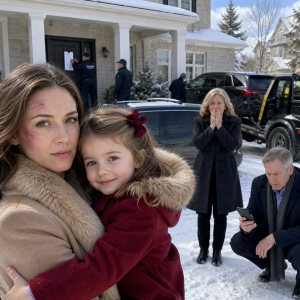
At 1:12 in the morning, I walked into the emergency department of an expensive private hospital outside Alexandria, Virginia, and found my daughter strapped to a transport gurney while two security officers prepared to move her toward a restricted elevator.
My name is Colonel Katherine Mercer, United States Army, and that night I was still wearing my formal military uniform because I had come directly from an official dinner in Washington, D.C. I had expected the evening to end with a long drive home and several hours of sleep.
Instead, I received a broken telephone call from my daughter, Claire Mercer Whitmore, followed by twenty-three seconds of silence and the sound of someone struggling for breath.
Then the line went dead.
By the time I reached the hospital, Claire’s wrists were secured by medical restraints, one side of her face was badly bruised, and a split along her lower lip had already dried.
She saw me before I reached her.
“Mom, please don’t let them take me.”
One of the security officers stepped forward.
“Ma’am, you need to stay back.”
I looked directly at him.
“I am Colonel Katherine Mercer, United States Army, and that woman is my daughter. Before anybody moves her anywhere, somebody is going to explain why she is restrained.”
He reached for my arm.
I redirected his wrist, turned his momentum away from me, and forced him to step backward without striking him.
The second officer immediately stopped advancing.
I moved toward Claire.
“I’m here. Tell me what happened.”
She swallowed painfully.
“The pendant, Mom.”
Her voice was barely audible.
Around her neck hung a small silver heart-shaped pendant that I had bought for her years earlier at a flea market in Savannah, Georgia, when she was ten years old. It had cost less than twenty-five dollars.
Before I could ask why it mattered, a woman’s voice cut through the corridor.
“That is enough theater for one night.”
I turned.
Margaret Whitmore approached with two men beside her.
One was her adult son Charles Whitmore.
The other was Daniel Whitmore, Claire’s husband.
Daniel wore an immaculate charcoal suit.
His right knuckles were red.
One still carried a trace of dried blood.
I looked at his hand, then at my daughter’s face.
Daniel pushed his hand into his trouser pocket.
Margaret opened a leather folder.
“Claire suffered a severe psychiatric episode tonight. Dr. Adrian Keller has approved an emergency involuntary commitment.”
“Then why does she look as though somebody beat her?”
Daniel answered immediately.
“She fell.”
Claire laughed weakly from the gurney.
“Liar.”
Margaret continued as though she had not heard her.
“She is being transferred tonight to Briarwood Behavioral Institute in western Maryland.”
I knew the name.
Briarwood was private, isolated, expensive, and heavily funded by the Whitmore family.
“She is not going anywhere.”
Margaret’s expression remained calm.
“Daniel holds her medical power of attorney.”
Claire tried to sit up.
“I never signed that.”
The words changed the room.
Margaret closed the folder.
“Colonel Mercer, this is a family medical matter. Your rank does not give you jurisdiction here.”
The Whitmores controlled one of the country’s largest privately held defense-medical logistics corporations, Whitmore Meridian Systems. Their companies supplied equipment to the Department of Veterans Affairs and the Department of Defense. They owned properties in Manhattan, Palm Beach, Virginia, and Washington.
Their combined fortune exceeded half a billion dollars.
Margaret had spent decades treating wealth as a form of authority.
She stepped closer.
“Continue interfering, and tomorrow morning complaints will reach the Pentagon before breakfast.”
“Send whatever complaints you like.”
Her smile disappeared.
Then she made the mistake that changed everything.
She reached toward Claire’s neck.
“Give me that ridiculous thing.”
Margaret yanked the silver chain.
It snapped.
Claire screamed.
“No!”
She fought so violently against the medical straps that one wrist began turning red.
The pendant fell to the floor.
Claire twisted sideways, almost sliding from the gurney while reaching for it.
I caught her before she struck the tile.
Margaret laughed.
“Look at this. All this hysteria over a piece of cheap jewelry.”
Claire managed to retrieve the pendant and pressed it tightly against her chest.
Then, while I supported her, she pushed the pendant against my side through the fabric of my uniform.
One tap.
Two quick taps.
One long press.
I froze.
It was a simple signal pattern I had taught her when she was a child.
Objective secured. Operation active.
Claire was not protecting a memory.
She was protecting evidence.
I stood, pulled out my phone, and called a number I had used only once before.
“This is Colonel Katherine Mercer. I need immediate federal law-enforcement assistance at St. Anne’s Private Medical Center. Potential federal contracting fraud, evidence tampering, unlawful confinement, and assault.”
For the first time that night, Margaret Whitmore looked afraid.
PART 2: WHAT WAS INSIDE THE PENDANT
Federal agents arrived less than twenty minutes later.
The team was led by Special Agent Rebecca Sloan, whose calm expression did not change when Margaret began listing senators, attorneys, donors, and government officials she supposedly knew.
Rebecca ignored the performance.
She photographed Claire’s injuries.
Then she examined Daniel’s hand.
“Mr. Whitmore, do not leave this floor.”
Daniel looked at his mother.
Rebecca repeated herself.
“That was not a suggestion.”
Once hospital staff removed the restraints, Claire handed me the pendant.
A tiny seam ran along its edge.
I twisted it carefully.
The casing opened.
Inside sat a miniature encrypted memory card.
Claire had hidden a small adapter inside a decorative clip in her hair.
When the card connected to my phone, the first file was an audio recording.
Claire’s voice filled the room.
“I found the transfers, Daniel.”
A sharp impact followed.
Then Daniel’s voice.
“You have no idea what you are interfering with.”
Claire spoke again.
“Twenty-five million dollars was diverted from the veterans’ prosthetics program.”
Another impact.
Claire cried out.
Then Margaret’s voice entered the recording.
“Take her phone. Dr. Keller has already agreed to document severe psychiatric instability. Tomorrow we say she became suicidal.”
Daniel asked:
“What about the financial files?”
Margaret answered:
“Find them. If Briarwood has to keep her medicated for months while we search, then that is what happens.”
The recording ended.
Nobody spoke.
Daniel had gone pale.
Margaret pointed toward my phone.
“An illegally manipulated recording proves nothing.”
Claire slowly sat upright.
“Then let’s discuss the Veterans Affairs contracts.”
For three years, Claire had worked as a financial analyst inside Whitmore Meridian Systems.
The company managed a large federal program supplying advanced prosthetic devices and rehabilitation equipment to severely injured veterans.
During the previous fourteen months, Claire had noticed irregular transfers moving out of project accounts.
She began reviewing invoices.
Then shell companies.
Then offshore entities.
Money had moved through corporations registered in the Cayman Islands, foreign accounts, and property entities linked to Charles.
The total exceeded twenty-five million dollars.
For four months, Claire quietly copied transaction histories, contracts, approval chains, internal emails, and audit records.
Margaret believed she was merely producing routine budget reports.
Claire had been documenting the entire scheme.
“The complete audit trail is on that card,” she said.
Daniel stared at the pendant.
For several seconds, he seemed unable to process that his mother had physically held the evidence that could destroy them.
Rebecca’s phone rang.
She listened silently, then looked toward us.
“A federal judge has approved emergency preservation and search authority covering Whitmore Meridian’s relevant corporate servers, financial records, and designated offices.”
Charles leaned against the wall.
Daniel stepped backward.
Margaret remained upright.
She simply looked as though she were calculating how much power she still had left.
“This is not finished.”
She was correct.
Six months later, she would attempt one final strategy.
PART 3: THE MAN THEY DECLARED INCOMPETENT

The federal proceedings eventually reached a Manhattan courtroom because several financial transactions and corporate entities were administered through New York.
Claire sat beside me in a dark navy suit.
Her injuries had healed.
A faint line remained along her lower lip.
The repaired pendant was still around her neck.
Across the courtroom sat Daniel, Charles, and Margaret with a defense team large enough to occupy two full tables.
Their lawyers challenged Claire’s records on multiple grounds.
The most important argument involved corporate authorization.
They claimed certain internal files belonged to Whitmore Meridian and could not be properly validated without authorization from the company’s controlling chairman.
That person was General William Whitmore, Daniel’s grandfather and the founder of the company.
William was eighty-nine years old and a retired four-star general.
He had avoided public appearances for nearly a year.
Margaret’s attorney rose and presented medical documentation.
“General Whitmore suffers from advanced dementia and lacks the capacity to testify, consent to corporate disclosures, or exercise governance authority.”