The Letter From Home

The envelope arrived on an ordinary Tuesday afternoon, while I was kneeling beside the flower bed outside my small house in coastal North Carolina, pulling weeds from around the hydrangeas and trying not to think about the ache that had settled permanently into my right knee.
At forty years old, I had learned to appreciate ordinary afternoons.
For most of my adult life, ordinary had been a luxury.
I had spent nearly fifteen years as a Coast Guard rescue officer, moving from one station to another, learning to sleep through storms, alarms, helicopters lifting off before sunrise, and phone calls that meant somebody somewhere needed help immediately. Three years earlier, an accident during a rescue operation had ended the career I thought would last until retirement, leaving me with a rebuilt knee, a medical pension, and far more quiet than I knew what to do with.
So I bought a modest house outside Wilmington, planted flowers, adopted an elderly Labrador named Moose, and tried to build something resembling peace.
Then the mail carrier handed me an envelope from the Superior Court of North Carolina.
Inside was a petition concerning a farmhouse in western Virginia that had belonged to my grandfather.
The petitioners were my parents.
Gerald and Patricia Whitmore.
The defendant was me.
Claire Whitmore.
For a long moment, I simply stood beside the mailbox, reading those names again.
My parents were taking me to court.
We had barely spoken in eleven years.
The distance between us had begun when I chose military service instead of the comfortable corporate career my father had planned for me. He had spent most of his life managing commercial real estate and believed success should look polished, predictable, and respectable. My mother had agreed with him because agreeing with my father had always been easier than challenging him.
When I graduated from officer training, neither attended.
My mother’s only message arrived two days later.
“This isn’t the life we imagined for you.”
I had stared at those words for a long time before deleting them.
Eventually, I stopped trying to become the daughter they wanted.
My grandfather, Walter Hayes, was different.
He owned an aging white farmhouse outside Roanoke, surrounded by eighty acres of fields and oak trees, and although everyone considered him a simple retired mechanic, he understood me better than anyone else in the family.
When I was twenty-two and terrified that I had chosen the wrong life, Grandpa Walter had sat beside me on his porch and said, “A good life isn’t the one everybody understands, Claire. It’s the one you can respect when you’re alone with yourself.”
I carried those words everywhere.
When he passed away years later, he left the farmhouse to me.
I never lived there permanently, but I paid the taxes, repaired the roof, hired someone to maintain the land, and visited whenever service allowed.
Now my parents claimed I had abandoned it.
Worse, attached to their petition was a document titled PROPERTY RELEASE AND TRANSFER.
According to that paper, I had voluntarily surrendered the farmhouse to them three years earlier.
At the bottom was my signature.
It looked almost perfect.
Almost.
I read the page three times before noticing the notarization.
Then my hands became very still.
The name beneath the seal belonged to Chief Petty Officer Andrew Mercer.
My closest friend during my years in uniform.
The man who had once dragged me out of freezing Atlantic water after a training accident and later joked that I owed him coffee for the rest of my life.
The man whose memorial service I had attended six months before the date printed on that document.
Someone had used Andrew’s name to take my grandfather’s house.
That evening, I opened the cedar chest at the foot of my bed.
Inside were old photographs, service ribbons, folded uniforms, and a small challenge coin Andrew had given me after our final assignment together.
I held it for several seconds.
Then I took out my dress uniform.
If my parents wanted me in court, they were finally going to meet the woman I had become.
The Signature That Could Not Exist
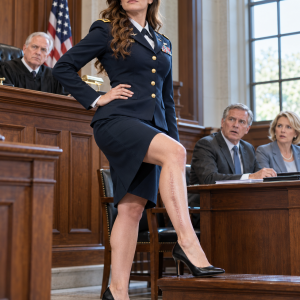
My father smiled when I entered the courtroom.
Not warmly.
It was the small, satisfied smile of a man who believed the difficult part had already been handled.
My mother sat beside him in a pale gray suit, perfectly composed, her hands folded over a leather handbag.
Dad looked at my uniform and murmured, “Still hiding behind that thing.”
Eleven years earlier, those words might have hurt me.
That morning, they simply made me tired.
Judge Eleanor Price reviewed the papers before turning toward my parents’ attorney.
“Mr. Lawson, your clients claim Ms. Whitmore voluntarily transferred her interest in the property?”
“Yes, Your Honor.”
“And this document was notarized on November 6, 2023?”
“Correct.”
Judge Price looked at me.
“Ms. Whitmore, do you dispute the signature?”
I stood.
“Yes, Your Honor, but the signature isn’t the biggest problem.”
My father’s smile faded slightly.
I handed the clerk a folder.
Inside was an official service record and a certified copy of Andrew Mercer’s memorial documentation.
The judge read it carefully.
Then she looked again at the transfer document.
“Mr. Lawson, who provided this document to you?”
The attorney hesitated.
“My clients did.”
“Did you independently verify the notary?”
His expression changed.
“No, Your Honor.”
I could feel my father watching me.
Judge Price placed the two papers beside each other.
“The person whose seal appears on this transfer had already passed away six months before the alleged notarization.”
Silence settled over the room.
Dad shifted in his chair.
“That doesn’t prove Claire didn’t sign it.”
Judge Price turned toward him.
“Mr. Whitmore, I strongly recommend that you allow your attorney to speak.”
I looked at my father.
“Andrew couldn’t have notarized that document.”
Dad’s jaw tightened.
“Maybe someone made an administrative mistake.”
“An administrative mistake doesn’t recreate a man’s signature and official seal.”
My mother lowered her eyes.
That was when I noticed her hands trembling.
Judge Price noticed too.
“Mrs. Whitmore, is there something you would like to tell the court?”
Dad turned toward her immediately.
“Patricia.”
One word.
A warning.
I had heard that tone throughout childhood.
My mother swallowed.
Then, very quietly, she said, “There’s another document.”
Dad closed his eyes.
And for the first time that morning, I understood that the farmhouse was only the beginning.
What Grandpa Had Really Left Me

The second document was not in the courtroom.
It arrived with a man named Charles Bennett, my grandfather’s former estate attorney, who had been contacted after learning about the dispute.
I remembered Charles from childhood as a tall man who always smelled faintly of peppermint and carried too many papers.
Now he was nearly eighty, thinner and slower, but his memory remained sharp.
He placed an old leather folder on the conference-room table.
“Claire, your grandfather didn’t leave you only the farmhouse.”
I frowned.
“That’s all the estate paperwork I received.”
Charles looked toward my parents.
“Because you didn’t receive all the paperwork.”
He opened the folder.
My grandfather, it turned out, had quietly built a manufacturing company decades earlier with two friends. After selling his ownership stake, he invested the proceeds in land, municipal bonds, warehouses, and several small businesses.
He continued driving an old pickup.