PART 1 — THE NIGHT I ALMOST ERASED HER NAME
“I’m sorry, son. Tonight’s supposed to be our last night.”
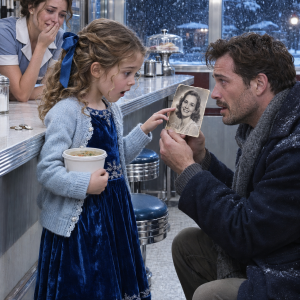
The boy standing in my doorway couldn’t have been more than fifteen. Rain dripped from his sweatshirt onto the tile, and his hands shook as he held out a crumpled dollar bill and a few coins.
“Sir, is this enough for one donut? I haven’t eaten since lunch.”
I was seventy-one years old, and I had a scraper in my hand. I’d been preparing to remove my late wife’s hand-painted lettering from the front window of Benny’s Donuts & Coffee.
Then I noticed the physics textbook sticking out of the boy’s backpack. It was open to a drawing of a bridge, and he’d filled the margins with calculations that looked painfully familiar.
The eviction notice was sitting behind the register. My landlord expected an answer by Monday, and I had no good one to give him.
I thought the boy had come in for something to eat. I didn’t know that, before the week was over, his mother would leave me a letter that made me question the decision I’d spent months trying to accept.
My name is Benjamin Carter, though most folks around our little Ohio town have called me Benny for as long as I can remember. I spent thirty-four years as a civil engineer before retiring and opening a donut shop with my wife, Helen. She was the one with the dream. I was the fellow who knew how to balance a checkbook and fix a broken oven.
Helen had made donuts for church breakfasts and neighborhood gatherings for years. She kept a little spiral notebook filled with recipes, measurements, and comments about what worked. Some pages were stained with vanilla and butter, and she’d written Benjamin likes these too sweet beside her first attempt at maple glaze.
When I retired, she put that notebook on our kitchen table and announced that we were opening a bakery.
“Helen, we’re both in our sixties,” I told her. “Most people our age are thinking about slowing down.”
“Then they can slow down,” she replied. “I’ve spent thirty years making donuts for everybody else. I’d like to see whether somebody will actually pay for one.”
We opened Benny’s Donuts & Coffee six months later, in a narrow storefront on Maple Street. She painted the name on the window herself, standing on a stepladder while I held the paint cans. One of the letters was crooked, and when I offered to fix it, she told me to mind my own business.
We had sixteen good years there. We never became wealthy, but we paid our bills, knew our customers, and went home tired in the pleasant way people do when they’ve spent a day doing something worthwhile.
Then Helen passed away seven years ago.
I kept the shop because it was the only place where I could still hear her voice without trying. Every morning, I opened her recipe notebook to the same page, even though I’d memorized the measurements years earlier. I kept her favorite table by the window, the little round one with a wobbling leg she’d refused to replace.
But a person can’t pay rent with memories.
Over the previous three years, my rent had gone up twice. A polished new coffee shop had opened across the street, and many of the office workers who once stopped by every morning were working from home. The old hardware store had closed, followed by the insurance office two doors down.
I kept baking the same quantities, hoping the customers would return. By noon, I was throwing away donuts that would once have sold before ten.
I’d used nearly all the savings I’d set aside for emergencies. When I fell two months behind on rent, my landlord, Richard Miller, sent a formal notice demanding payment or surrender of the premises.
Richard wasn’t a cruel man. He had bills of his own, and I’d already asked for more time than I deserved.
That Thursday, I’d decided to stop pretending things would improve. I paid Maria, my part-time employee, what I owed her and told her she should start looking for another job.
Then I bought the scraper.
And just as I was about to erase Helen’s lettering, a hungry boy walked through the door.
I set the scraper behind the counter and took a closer look at him. His backpack was soaked, his sneakers squeaked against the floor, and he kept glancing toward the donuts as though he was afraid I’d tell him to leave.
“What’s your name, son?” I asked.
“Jordan Williams.”
“Well, Jordan, you can put that money away. Sit over there by the radiator while I get you something warm.”
He looked at the display case. “I can pay for part of it.”
“I believe you. But I’ve got donuts left over, and I’d rather see somebody enjoy them.”
I put two glazed donuts on a plate and made him a large hot chocolate. He watched me set everything down, then pushed the coins toward me anyway.
“My mom says I shouldn’t take things for free.”
“Your mother sounds like a sensible woman. You can pay me back someday by helping somebody else.”
He considered that before slipping the money into his pocket. Then he thanked me, sat down, and ate the first donut so quickly that I wondered whether lunch had been much of a meal.
I went back to cleaning the counter. After a few minutes, I noticed he’d opened his textbook and was staring at the same diagram I’d seen in his backpack. He wrote a line of calculations, erased them, and started again.
I recognized the problem before I reached his table.
“You’re forgetting the weight of the bridge itself,” I said.
Jordan looked up. “What?”
I pointed to the diagram. “You’ve included the load placed on the bridge, but you’ve left out the structure’s own weight. That changes the forces at the supports.”
He stared at me for a moment, then looked at my flour-covered apron.
“How do you know that?”
“I used to design bridges. Roads, too. I was a civil engineer for thirty-four years.”
His eyes widened. “Seriously? Could you help me? I’ve got a physics test tomorrow, and I don’t understand any of this.”
I glanced toward the counter, where the eviction notice lay beneath a stack of receipts. I hadn’t sat down with an engineering problem in years. Still, I remembered how much I’d enjoyed teaching younger engineers to work through a difficult calculation.
I pulled out the chair across from him.
“All right. But finish that donut first. We can’t have you thinking on an empty stomach.”
For nearly two hours, we worked through the problems together. Jordan was bright, but he’d convinced himself that every mistake meant he wasn’t capable of learning. Whenever he got something wrong, he apologized and reached for his eraser before I’d finished explaining.
Eventually, I took the pencil from his hand.
“Jordan, listen to me. Making a mistake isn’t the same as being stupid. If you already knew everything, you wouldn’t need to be in school.”
He looked down at his notebook. “Everybody else gets it faster than I do.”
“Maybe. But you’re still here working on it. That’s worth something.”
I drew a simpler bridge and asked him to explain what happened when a truck crossed it. Once he could describe the forces in ordinary words, the equations started making sense.
When he solved the next problem by himself, he looked at me with the biggest smile I’d seen in that shop for months.
“Mr. Benny, I actually got it!”
“You sure did. Now let’s see whether you can do another one without me.”
By the time he packed his books, the rain had eased. He told me his mother worked evening shifts at the county hospital and that he’d been waiting at the public library until it closed early. He didn’t want to go home to an empty apartment, so he’d walked around looking for somewhere warm.
I gave him the second donut in a paper bag.
“Get home safely, Jordan. And good luck tomorrow.”
“Thanks, Mr. Benny. Can I come back sometime?”
I hesitated. The shop was supposed to be closing, and I didn’t want to make a promise I couldn’t keep.
“I’ll be here tomorrow,” I finally said.
After he left, I stood beside the window for a long time. The scraper was still behind the counter, but I couldn’t bring myself to pick it up.
Instead, I turned off the lights and went home.
The next afternoon, Jordan returned with a girl who had purple streaks in her hair and a chemistry workbook tucked under her arm.
“Mr. Benny, this is Avery,” he said. “She needs help with science. I told her you used to be an engineer.”
I looked at Avery. “Well, I can probably help with the math. Chemistry wasn’t my strongest subject.”
They bought two donuts and sat at Helen’s old table. I helped them with a few calculations, then went back to the kitchen. Every time I glanced through the serving window, they were still working.
On Monday, three more students came. By Wednesday, there were seven.
They didn’t all need my help. Some studied together, some read quietly, and others simply wanted a warm place to wait until their parents finished work. A few bought drinks. Others counted their change before deciding whether they could afford a donut.
I began baking a smaller batch in the morning and another just before school let out. For the first time in months, the display case was nearly empty by closing.
I should have been pleased. Instead, I was frightened of how much I was beginning to hope.
One afternoon, I heard Jordan speaking to a younger student.
“Just ask Benny. He’ll help you figure it out. He doesn’t make you feel dumb.”
The younger boy glanced toward me. “Does he charge for tutoring?”
“No. But buy something if you can. He makes really good donuts.”
I turned away before they noticed my expression.
That evening, I added up the week’s receipts. Sales were better, but the increase wasn’t nearly enough to clear two months of overdue rent.
On Saturday morning, Richard came by.
He was in his late fifties and had owned the building for twelve years. He looked around the shop, noticed the extra chairs I’d pulled out, and asked whether business had improved.
“A little,” I said. “Some students have started coming after school.”
“I’m glad to hear it, Benny. But we still need to talk about what you owe.”
I poured him a coffee and sat across from him. He took a folder from his briefcase and placed it on the table between us.
“You’ve had extra time already,” he said. “I can’t keep extending the deadline because we’ve known each other a long time.”
“I understand.”
“Do you have the money?”
I shook my head.
Richard sighed. “Then I need the keys by the end of next week, unless we can agree on something concrete before then.”
I looked toward the window. Helen’s lettering was faded, but the crooked letter was still there.
“What if I changed the hours? Cut the morning waste, focused on the afternoon customers, and paid down the balance over time?”
“Do you have numbers to support that?”
“Not yet.”
“Then you don’t have a plan, Benny. You have an idea.”
He wasn’t trying to hurt me. That was what made his words so difficult to hear.
I asked him to give me until Monday afternoon to prepare a proposal. He agreed, but only if I could make an immediate payment toward the overdue balance.
After he left, I sat with my ledger until the coffee in my cup went cold.
The students had given the shop a little life again, but life wasn’t the same thing as solvency. If I used the last of my savings and the business failed anyway, I’d be seventy-one years old with very little left to fall back on.
That evening, while I was cleaning Helen’s table, I found a sealed envelope tucked beneath the sugar container.
My name was written across the front in careful handwriting.
Inside were two twenty-dollar bills and a folded sheet of paper.
Dear Mr. Benny,
My name is Rachel Williams. I’m Jordan’s mother.
I sat down in the chair where Jordan had studied that first night.
Then I began to read.