PART 1 — THE NIGHT MY HUSBAND LOCKED US OUT
At 10:57 on a freezing February night, my husband pushed me through our front door while I was holding our twelve-day-old son against my chest.
The wind struck my face so violently that I briefly lost my balance on the snow-covered porch.
My name is Hannah Mitchell, and until that moment, I believed the man I married would never deliberately endanger our child.
My husband, Derek Mitchell, stood beneath the porch light wearing the navy sweater I’d purchased for his birthday.
Behind him, his mother, Beverly, watched from the staircase with an expression I couldn’t understand.
“Derek, please let us inside! Noah is only twelve days old, and it’s dangerously cold out here!”
He didn’t reach for the baby or offer me a coat.
Instead, he looked toward his mother, waiting for some silent signal.
“You’re acting irrationally again, Hannah, and I won’t let you behave this way around our son.”
I stared at him, trying to understand what he meant.
Only minutes earlier, I’d been sitting in our living room feeding Noah while Derek complained about my refusal to discuss the house.
Beverly had insisted that her son deserved his name on the deed because he was the husband and father.
I’d explained that the property belonged to me before our marriage and that I wasn’t prepared to change its ownership.
The argument became increasingly unpleasant.
Then Derek demanded that I apologize to Beverly for questioning her intentions.
When I refused, he seized my upper arm and pushed me toward the entrance.
Now I was standing outside in a North Dakota blizzard, wearing bedroom slippers, thin leggings, and a cardigan barely substantial enough for autumn.
Noah began crying beneath the receiving blanket wrapped around him.
I pulled him closer, shielding his head from the wind while supporting his neck with one hand.
“You can come back when you’re ready to admit you need professional help,” Derek announced.
The door slammed.
A second later, the lock clicked.
I stood motionless, listening to the wind and my son’s frightened cries.
I had no telephone, winter coat, or car keys.
Our nearest neighbor lived across the street, perhaps seventy yards away.
Reaching his porch through the snow seemed frightening, but remaining outside was even more dangerous.
I tightened the blanket around Noah, kept his face clear, and began moving toward the lights shining from our neighbor’s windows.
At the time, I believed my husband had simply lost his temper.
I didn’t yet understand that someone inside our house had been waiting for exactly this moment.
PART 2 — THE NEIGHBOR WHO OPENED HIS DOOR
The snow reached halfway up my calves as I struggled across the driveway.
Every step threatened to pull my slippers off, and wind-driven ice stung the exposed skin around my face.
I concentrated on keeping Noah sheltered beneath my cardigan without obstructing his breathing.
The neighboring house belonged to Harold Bennett, an elderly retired postal worker who had lived on our street for more than thirty years.
He’d brought us homemade cookies when Noah was born and occasionally cleared our driveway after heavy snowfall.
His porch light was still glowing.
I reached the front steps, pressed the doorbell repeatedly, and tried to call for help.
Harold opened the door almost immediately.
His expression changed when he saw me.
“Hannah, what happened? Why are you outside with that little baby in weather like this?”
I tried explaining, but my teeth were chattering so badly that the words barely came.
He stepped aside and guided me into his warm entrance hall.
Then he retrieved clean blankets and called emergency services.
While we waited, he helped me move away from the wet clothing around my shoulders, keeping Noah warm and carefully sheltered.
Harold didn’t pretend that the baby was safe simply because we’d reached the house.
He followed the emergency dispatcher’s instructions, monitoring Noah’s breathing and responsiveness while avoiding excessive direct heat.
“Your husband’s going to have some serious explaining to do, Hannah, because nobody puts a newborn outside in weather like this.”
I couldn’t stop shaking.
Harold brought me a warm drink and stayed nearby while I held Noah against my chest beneath dry blankets.
The baby gradually settled.
Then Harold asked a question that made me look up.
“Did Derek know you were going to cross the street, or did he think you’d stay on your porch?”
I admitted that I didn’t know.
Harold looked toward the window.
“My doorbell camera caught you coming across the driveway, and the front camera may have recorded more than that.”
He checked the camera’s saved recordings.
I watched myself stumble through the snow, clutching Noah against my body.
Then Harold opened an earlier clip.
The camera’s wide-angle view showed our illuminated porch across the street.
Although the footage was distant, I could see Derek forcing me outside and closing the door.
Harold immediately saved the recordings.
“Don’t worry about explaining everything tonight, Hannah. We have the video, and I’ve already told the dispatcher exactly what I witnessed.”
I began crying.
Not because I was suddenly helpless, but because someone had finally treated what happened as real.
PART 3 — THE HOUSE THAT HAD ALWAYS BEEN MINE

Our home stood in a quiet residential neighborhood outside Fargo, North Dakota.
It was a modest two-story house with cream siding, a narrow front porch, and a nursery overlooking the backyard.
I’d purchased it four years before marrying Derek, using my savings and money inherited from my grandmother.
The deed was recorded solely in my name.
I continued paying the mortgage, property taxes, and insurance from my accounts after we married, although Derek contributed to ordinary household expenses.
For most of our relationship, the arrangement hadn’t troubled him.
Everything changed when Beverly began spending more time at our house during the final months of my pregnancy.
She frequently commented on how unfair it was that Derek didn’t own the property.
“A man should have something permanent to show for supporting his family, Hannah, especially when he’s about to become a father.”
I explained that our marriage didn’t require transferring legal ownership.
Beverly responded with a wounded expression.
“You make it sound as though my son is some stranger who might take advantage of you.”
Derek increasingly repeated her arguments.
He suggested refinancing the house and adding his name to the deed, claiming the arrangement would make future family planning easier.
When I requested time to review the proposal with an independent attorney, he accused me of distrusting him.
After Noah’s birth, Beverly’s criticism shifted toward my emotional condition.
She described ordinary exhaustion as evidence that I was unstable.
Whenever I became upset, she said I was overreacting.
If I asked her to return Noah while he was crying, she insisted I was becoming obsessively protective.
One afternoon, I found her speaking quietly with Derek in the kitchen.
“If Hannah cannot make reasonable decisions, somebody else may have to make them for the baby’s sake,” she whispered.
They stopped talking when I entered.
I tried dismissing the conversation as another example of Beverly interfering in our marriage.
But during the following days, Derek began asking unusual questions about whether I’d forgotten appointments or heard Noah crying when he was asleep.
I hadn’t experienced the hallucinations he described.
My exhaustion was real, but I remained aware of my surroundings and capable of caring for our son.
Still, Beverly kept repeating the same accusations.
Related Posts
“Dad, What Have You Done? There Are People Outside Demanding to See You!” My Daughter Cried Over the Phone. I’m 71, and I’ve Run My Little Diner for Nearly 40 Years. Two Days Earlier, I’d Quietly Given a Hungry Young Delivery Driver a Free Breakfast, Even Though We Could Barely Afford It. My Daughter Had Warned Me, “One Day, Your Kindness Is Going to Cost You This Diner!” Now, a Photo of My Handwritten Receipt Was Spreading Across the Internet, and Strangers Were Gathering Outside My Door. I Stood Behind the Counter, Afraid to Find Out Why.
“Mom, Please Don’t Ask Me to Walk Down the Aisle Without You,” My Daughter Begged the Night Before My Surgery. At 47, I Was About to Lose Part of My Jaw to C@ncer, and I Was Terrified My Husband Would Never Look at Me the Same Way Again. “Raymond, What If You Can’t Bear to Look at My Face?” I Asked. He Went Quiet, and That Silence Frightened Me More Than Anything. But Later That Night, I Found a Folded Note Hidden in Our Old Family Photo Album. It Was Dated Six Months Earlier—and I Wasn’t Prepared for What My Husband Had Written.
My Husband Put His Hands on Me in Front of 50 Guests When I Tried to Rush Our 5-Year-Old Daughter to the Hospital With a 104°F Fever. “Get Out, Evelyn! You’ll Never See a Penny of My Money—or Take Lily From Me!” He Shouted as His Mother Stood Beside Him. I Didn’t Beg. I Just Held My Daughter Close and Walked Toward the Door. Then He Yelled, “Don’t Forget Whose House You’re Walking Out Of!” I Turned Around and Said, “Julian, Are You Sure It’s Yours?” His Face Went Pale. He Had No Idea I’d Already Seen the Papers He’d Tried So Hard to Hide.
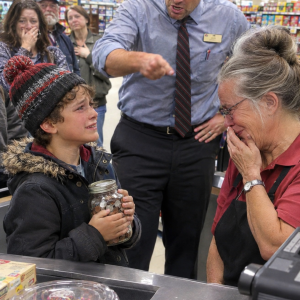
After 23 Years Working at the Same Grocery Store, My Manager Fired Me in Front of a Line of Customers. “You’re Done, Opal. Hand Over Your Badge!” All Because I Paid $9 Toward a Birthday Cake for a 7-Year-Old Boy’s Sick Mother. I Walked Out Humiliated, But I Couldn’t Stop Thinking About the Jar of Old Coins He’d Left Behind. When I Finally Took a Closer Look at One of Those Pennies, I Remembered Something My Late Husband Had Told Me Years Ago—and My Hands Started Shaking.