The Letter at the Hillside

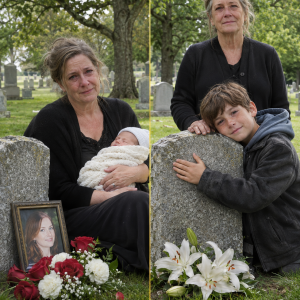
The woman standing beside my daughter’s grave held out an envelope with my name written across the front.
I recognized the handwriting before I could make sense of what I was seeing. The long, sloping letters, the little curl beneath the final a—I had watched that hand write grocery lists and birthday cards, leave notes beside the coffee pot, and fill the margins of school notebooks with small sketches. I had not seen it in ten years.
For a moment, the cemetery seemed to go quiet around me. I could hear the leaves shifting in the breeze and the distant hum of a car on the road beyond the hill, but my thoughts had stopped moving.
“I made your daughter a promise,” the woman said. “Now it’s time you knew the truth.”
My fingers tightened around the bouquet I had brought. The woman looked to be in her late fifties, with silver beginning to show in her brown hair and a face that seemed tired from carrying something for a long time.
“Where did you get that?” I asked.
“She gave it to me.”
“When?”
The woman lowered her eyes.
“The day her baby was born.”
I looked down at the envelope again. My name sat there in my daughter’s handwriting, as clear as if she had just written it.
“You’ve had a letter from my daughter for ten years?”
“Yes.”
I wanted to ask a dozen questions at once, but before I could choose one, my grandson called from the bottom of the hill.
“Grandma! I found it!”
Miles came hurrying up the path, waving the birthday card he had made for his mother. He had spent the afternoon choosing colored pencils and carefully writing a message inside, then asked if we could bring it to her grave. His hand-drawn baseballs and lopsided flowers showed through the folded paper.
The woman glanced toward him.
“Don’t open this in front of him.”
I stared at her.
“Who are you?”
“My name is Nora. I was a nurse at the hospital where Willa had her baby.”
Miles was nearly close enough to hear us. Nora pressed the envelope into my hand, then stepped away.
“My number is on the back,” she said. “Please call me.”
Then she walked down the path without waiting for an answer.
I watched her go, the envelope warm from her hand, and tried to imagine what could be inside that my daughter had wanted me to know but had never found a way to tell me.
The Question I Couldn’t Answer
Willa was eighteen when she told me she was pregnant. She had been standing at the kitchen counter, one hand wrapped around a glass of water, her eyes fixed on the pale blue curtains above the sink.
I remember how carefully she spoke, as though the words might break if she said them too quickly. I remember how I reached for her, and how she took one step back before I could touch her.
At first, I thought I was helping by asking questions. I wanted to know who the father was, whether he knew about the baby, whether he planned to be involved. I worried about money, school, and the way her whole life would change. My questions came from love, but I asked them with such urgency that they began to sound like demands.
“Does he know?” I asked one evening.
Willa gave a tired sigh.
“Mom, please.”
“What’s his name?”
“I can handle this myself.”
“You shouldn’t have to handle it alone.”
“Please stop making this harder.”
We kept circling the same questions until the conversations grew shorter and the silences between us grew longer. I told myself that she would come around when she was ready. I told myself I was giving her space. I did not understand that she might have been trying to tell me something beyond the name of the boy.
On the day Miles was born, I sat in a hospital waiting room with my hands clasped so tightly that my knuckles ached. Every time a door opened, I looked up. I imagined my daughter tired but smiling, holding her baby, and asking me to bring her something warm to drink.
A doctor came and sat beside me.
He spoke softly. He told me the medical team had done everything they could, but Willa had suffered serious complications during childbirth. My mind caught only pieces of what he said. I kept asking him about the baby, because I could not yet bring myself to ask the question I already understood.
“The baby?” I said.
The doctor placed a hand near my shoulder.
“He’s alive. He’s going to need you.”
My daughter never came home.
Miles did.
For ten years, it was the two of us. I learned how to pack lunches while answering questions about planets, how to braid hair on the mornings he wanted to try something different, and how to make pancakes that were always thicker than they needed to be. He learned how to swing a bat, how to tie his shoes, and how to fold his hands before blowing out the candles on his birthday cake.
He also learned that there was one question I could never answer.
“Grandma, who was my dad?”
“I don’t know,” I would say.
That was the truth as I understood it. I had asked Willa, and she had not told me. I had never met the father. He had not come to our home, and no one had come looking for Miles.
Or so I believed.
Now there was an envelope in my coat pocket, with Willa’s handwriting on the front, and for the first time I wondered whether the answer might be more complicated than I had let myself imagine.
A Photograph and a Letter

At home, I slid the envelope into the kitchen drawer beneath the place mats. I did it quickly, as if putting it away could delay what I might learn.
Miles dropped his backpack beside the table and looked at me.
“Who was that lady?”
“Someone who knew your mom.”
His face brightened.
“Really? What did she say?”
“Not much.”
“Did she know my dad?”
I closed the drawer too quickly.
“I don’t know.”
Miles studied me. His eyes were Willa’s—steady, curious, and more perceptive than I sometimes wanted them to be.
“You always say that.”
“Because this is something I truly don’t know, my love.”
He lowered his gaze. I recognized that expression. Willa used to get quiet in the same way when she had decided that talking would only make things worse. Seeing it on Miles made my chest tighten.
After he went to bed, I stood alone at the kitchen counter with the envelope in my hands. I turned it over and over before finally opening it.
A photograph slid onto the counter.
Willa stood beside a teenage boy. He was slim, with a shy smile and a worn baseball glove tucked beneath one arm. I remembered him, though I had barely spoken to him. He had visited our house twice during Willa’s pregnancy, once to return a book and once, I thought, to bring her a school assignment. He had been quiet and polite, and I had been so focused on the questions I could not get her to answer that I had hardly looked at him.
I unfolded the letter.
“Mom,
“I know you think I won’t tell you because I don’t trust you. That isn’t why. He knows about the baby.
“He wanted to stay. But wanting something and being ready for it aren’t the same thing. His family keeps telling him that a baby will ruin everything he has planned. I told him not to come back until he can decide what he wants without letting everyone else choose for him. If he comes back, I need it to be because he chooses us himself.
“You keep asking who he is, but you never ask why I’m scared.”
I stopped reading.
The paper trembled between my fingers, and a memory rose so quickly that it felt as if someone had opened a door in the room.
It was late, and I was sitting at the kitchen table with bills spread in front of me. Willa had appeared in the doorway, one hand resting lightly against her stomach.
“Mom, can I ask you something?”
I had not looked up.
“If this is about avoiding the father question again, I can’t do this tonight, Tee.”
She stood there for a few seconds. Then she said, “Never mind.”
For ten years, I had remembered that moment as proof that Willa had shut me out. Now I could see another possibility: she had come to me because she was frightened, and I had answered the question I was tired of asking instead of listening to the question she had not yet found the courage to say.
I picked up my phone and called Nora.
She answered on the fourth ring.
“You had this for ten years,” I said.
There was a pause.
“I know.”
“Don’t say that as if it’s perfectly all right.”
Nora said nothing.
“Meet me,” I told her.
The Nurse Who Kept Her Promise
Nora was waiting in a booth near the back of a small diner the next afternoon. I placed the photograph between us.
“You took care of Willa?”
“For part of that day.”
“Then why did she give you the letter?”
Nora folded her hands around her coffee cup.
“She was scared. She didn’t think she was going to be gone, Mrs. Rowan. She was eighteen and about to give birth. She wanted to be sure someone would tell you what she couldn’t say herself.”
That mattered. Willa had not been preparing for the worst. She had been a young woman facing a difficult day, with a baby on the way and too many unanswered questions.
“She told me that if something went wrong and he didn’t come, I should give the letter to you,” Nora continued.
I tapped the photograph.
“Is this him?”
“I don’t know his name.”
“Then what do you know?”
Nora took a breath.
“He came to the hospital.”
I went still.
“What?”
“After Willa was gone, I saw a young man near the maternity floor asking for her. I didn’t know who he was at first. Then I remembered her description and the boy in the photograph.”
My pulse began to beat hard in my throat.
“You spoke to him?”
“No. When I realized who he might be, he saw you leaving with Miles.”
I could picture it: me carrying an infant car seat through the hospital corridor, my arms aching, my mind too clouded to notice the people around me. I had been trying to get my grandson out of the building and into a place where I could finally cry.
“And then?”
“He left.”
“You watched him walk away?”
“Yes.”
I looked at the letter between us.