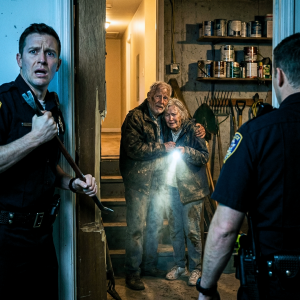
When my 67-year-old neighbor, Mrs. Cartwright, collapsed in her yard while feverishly digging, I hurried over to assist her. Little did I know, I was about to uncover a wooden box that would change everything.

The late afternoon sun drenched our quiet street in a soft golden glow as I stood by my window, folding laundry. Across the street, Mrs. Cartwright, my elderly neighbor, was out in her yard.
She was a petite woman with a gentle smile, often dressed in her signature neat cardigans. Despite her age and delicate health, she always exuded a certain vitality. But today, something seemed off.
She was digging with an urgency I had never seen before. Her frail arms thrust the spade into the ground repeatedly, her blouse damp with sweat. Something didn’t feel right.

I leaned out the window and called, “Mrs. Cartwright! Are you okay?”
She didn’t respond or even look up, continuing her relentless work.
“Do you need help?” I shouted louder.
Still nothing.
Worry gnawed at me as I watched her. Just as I was about to turn away, she suddenly stopped, dropped the spade, and flung her arms in the air.

“Finally!” she exclaimed, only to collapse moments later like a marionette whose strings had been cut.
“Mrs. Cartwright!” I shouted, my voice cracking. I darted out the door and across the street to her yard.
She was sprawled beside the hole she’d been digging, one hand resting on its edge. Kneeling down, I gently shook her shoulder. No response.
My heart raced as I checked her pulse—faint but there. Thank God. Her shallow breaths were slow but steady. Relief flooded through me.
“You’re going to be okay,” I murmured, unsure if she could hear. As I adjusted her head to improve her airflow, something in the hole caught my eye—a wooden box half-buried in the dirt.

I hesitated. Helping her was my priority, but the box seemed to call to me. Against my better judgment, I reached in and pulled it out. It was weathered but intact, its lid creaking as I opened it.
Inside were bundles of old letters tied with faded twine, yellowed photographs, and a sealed envelope. One photograph showed a younger Mrs. Cartwright, beaming beside a man in uniform. Her husband?
I barely had time to process this discovery when a faint groan broke the silence.
“Mrs. Cartwright?” I asked, dropping the photo. Her eyelids fluttered open.
“Where…?” Her voice was barely a whisper.
“You collapsed,” I said softly, leaning closer. “Just stay still. I’ll call for help.”

“No!” Her hand shot up, gripping my arm with surprising strength. “The box. Is it—” She coughed, trying to sit up.
“It’s here,” I reassured her, pointing to it. “But please, you need to rest.”
Ignoring my plea, she reached for the box, her hands trembling as she cradled it like a treasure. Tears slipped down her cheeks.
“Sixty years,” she murmured, her voice quivering.
“Sixty years?” I echoed, confused.