Life Short Tales Moral Stories

My Husband Never Heard Our Twin Boys’ Heartbeats Because He Was Too Busy Building A Future With Another Woman. When I Was Rushed Into The Hospital, He Finally Saw The Pregnancy I Had Hidden For Months. But The Hardest Truth Was Still Waiting: You Let Everyone Blame Me While You Knew The Problem Might Have Been Yours.

Part 1 – The Corridor Where Everything Collided

The last thing Claire Whitmore remembered before the trauma team pushed her through the emergency doors was the hard white glare of ceiling lights sweeping above her in rapid succession. A paramedic kept one hand against the pressure dressing beneath her ribs while another called out numbers that sounded increasingly urgent. Claire understood only fragments: falling blood pressure, placental separation, twin pregnancy, immediate surgical evaluation.

She had known about the twins for almost seven months, yet her husband had never heard their heartbeats.

The ambulance had collected her from a small apartment across town, where she had moved after separating from Grant Whitmore three months earlier. She had been arranging newborn clothes when a sudden pain folded her to the floor. By the time her neighbor found her, blood had spread across the pale rug and Claire could no longer stand without assistance.

The emergency team turned toward the private maternity wing, and the stretcher passed directly between Grant and the woman he had been seeing for almost a year.

Grant stood near the admissions desk in a gray suit, his hand resting against Brianna Cole’s back. Brianna wore a cream coat and held a folder from the hospital’s fertility center. She had spent weeks telling Grant that the doctors expected to confirm her pregnancy that afternoon, although several results remained conveniently delayed.

“Once the physician signs everything, we can finally make the announcement,” Brianna said. “Your mother has already spoken with the foundation board.”

Grant adjusted his cuff and answered with the confidence of a man accustomed to having uncertainty removed by employees. “The board wants stability, and this will give them exactly what they need.”

Then a nurse shouted for them to move.

Grant looked toward the stretcher, saw Claire’s face, and stopped breathing for several seconds. His gaze dropped toward the unmistakable curve beneath the hospital blanket. Every polished line in his expression collapsed.

“Claire?”

Brianna followed his stare. Her fingers tightened around the folder.

“Your wife is pregnant?”

Claire tried to answer, but pain consumed the words before they reached her mouth. The trauma doors closed, separating her from Grant’s disbelief and Brianna’s sudden panic.

Inside the treatment bay, physicians surrounded her with monitors, ultrasound equipment, and clipped instructions. Dr. Hannah Reeves, an obstetric surgeon with calm dark eyes, explained that one placenta had partially separated and both babies were showing signs of distress.

“We are going to stabilize you and try to delay delivery,” Dr. Reeves said. “However, if either baby’s heart rate declines further, we will operate immediately.”

Claire gripped the sheet until her fingers ached.

“Please save them.”

“We are protecting all three of you,” the doctor replied. “Stay with my voice and let us do the rest.”

Sedation entered Claire’s bloodstream, softening the lights and voices. Before darkness returned, she saw Grant through a narrow glass panel outside the room. He stood alone now, one hand against the wall, looking like a man who had discovered that the life he ignored had continued without his permission.

Part 2 – The Marriage That Became a Waiting Room

While Claire remained unconscious, memories surfaced without order. She saw the first apartment she and Grant rented in Philadelphia, where the heater failed every winter and the kitchen table leaned toward one corner. Grant had worked eighteen-hour days building a medical logistics company, while Claire managed hospital contracts and prepared investor presentations after finishing her own job.

Back then, they had laughed easily. Grant burned pancakes every Sunday and danced badly whenever Claire threatened to replace him at the stove. He promised that success would buy them time, privacy, and a family.

Success arrived, but time disappeared.

Whitmore Medical Distribution expanded across several states, and Grant became the public face of an industry he once claimed to dislike. He traveled constantly, purchased an estate outside the city, and began measuring affection through expensive objects. When Claire asked for dinner without phones, he sent jewelry. When she asked whether they could resume fertility treatment together, he scheduled another conference.

For years, Claire believed her body had failed them. Grant’s mother, Lorraine Whitmore, reinforced that belief with polished cruelty.

“Some women are simply not suited to motherhood,” Lorraine once said during a holiday dinner. “It is unfortunate, but Grant should not sacrifice his future because reality feels unkind.”

Grant heard the comment and said nothing. Later, he told Claire that confronting his mother would create unnecessary conflict.

The marriage became a series of rooms where Claire waited for Grant to arrive emotionally. Eventually, Brianna appeared at corporate events wearing the confidence of a woman who already knew his schedule better than his wife did.

Claire discovered the affair through a hotel invoice sent to the family office by mistake. Grant did not deny it. He explained that Brianna made him feel uncomplicated and that their marriage had become defined by disappointment.

Two weeks later, Claire learned she was pregnant.

The first scan revealed twins. The specialist called the pregnancy unlikely but healthy, and Claire cried in the examination room because the news felt both miraculous and unbearable. She intended to tell Grant that evening, yet he arrived at the estate after midnight carrying Brianna’s perfume on his coat.

Claire stood in the library holding two ultrasound photographs.

Before she could speak, Grant loosened his tie and said, “Please do not start another conversation about us tonight. I have already told the attorneys to prepare a separation proposal.”

The photographs remained inside the envelope.

Claire moved out quietly and instructed her lawyer to communicate through formal channels. She attended every appointment alone, declined publicity, and asked the clinic to keep the pregnancy confidential. Part of her feared Grant would suddenly perform devotion because the children represented heirs, not because he had rediscovered love.

She began writing in a dark green journal whenever loneliness became too heavy to carry through the day. The pages contained appointment notes, letters to the twins, memories of the marriage, and truths she could not say aloud.

Grant found the journal hours after Claire entered emergency surgery.

He returned to the estate looking for insurance records because the hospital required background information. In the bedroom Claire had once shared with him, he noticed an empty space beneath the dresser where several boxes had been removed. The journal lay behind one remaining drawer, overlooked during her move.

He read the first page while standing. By the tenth, he was sitting on the floor.

One entry described the night Claire intended to reveal the pregnancy.

“The babies moved together while Grant walked past me carrying another woman’s perfume into our bedroom. I held the pictures behind my back because I realized he would not hear the news as a husband. He would hear it as a man being offered something valuable. If these children survive, I will never teach them that neglect becomes love merely because it arrives wearing regret.”

Grant read the sentence repeatedly until the words blurred. For the first time, he understood that Claire’s silence had not been punishment. It had been protection.

Part 3 – Two Pregnancies and One Manufactured Future

Claire regained consciousness the next morning in a high-risk maternity room. Pain spread through her abdomen and back, but the steady rhythm of two monitors immediately drew her attention.

Dr. Reeves stood beside the bed reviewing a chart. Claire’s oldest friend, pediatric cardiologist Noah Bennett, waited near the window.

“The twins are stable,” Dr. Reeves said. “We controlled the bleeding, and the medication is helping. Our goal is to keep them inside as long as it remains safe.”

Relief left Claire trembling.

“How long was I unconscious?”

“Almost fourteen hours,” Noah answered. “You frightened everyone who still possesses a functioning conscience.”

Claire managed a weak smile before hearing shouting in the corridor.

Brianna’s voice rose above the hospital staff.

“I am Grant Whitmore’s fiancée, and I am carrying his child. You cannot refuse me access to his family’s medical situation.”

Noah’s expression hardened. Dr. Reeves moved toward the door, but Brianna entered before security reached her. She looked exhausted and furious, with the hospital folder still clutched against her chest.

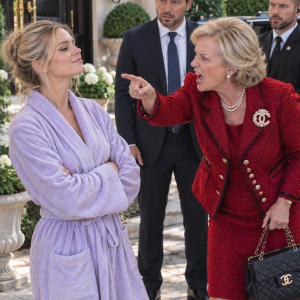
“You staged this,” Brianna said, pointing toward Claire. “You hid the pregnancy until the exact day Grant and I came for our confirmation appointment.”

Claire stared at her, too weak for disbelief to become anger.

Grant entered behind two security officers. He looked as though he had not slept, and the green journal was visible beneath his arm.

“Leave her alone,” he told Brianna.

Brianna turned toward him.

“She concealed two children from you, and you are defending her?”

Noah stepped between Brianna and the bed.

“You need to leave before your behavior becomes part of the medical record.”

Brianna lifted the fertility folder.

“My physician said I was pregnant. Grant and I have been planning our child for months.”
Dr. Reeves took the folder after Brianna thrust it toward her. She reviewed several pages, then looked at Noah.

“These records are not from this hospital,” she said. “The laboratory codes do not match any licensed facility in the state.”

Noah opened the folder beside her. The ultrasound images bore a clinic logo, but the identifying information had been cropped. A compliance officer entered with the results of a digital search and confirmed that one scan had been copied from an educational website.

Brianna’s face changed.

Grant lowered his voice.

“Tell me you did not fabricate this.”

“I experienced symptoms, and the clinic said the early results were uncertain.”

“The clinic address belongs to a rented mailbox,” Dr. Reeves replied. “There is no documented pregnancy in these records.”

Brianna began insisting that stress had caused a medical misunderstanding, but Noah produced an email recovered from the corporate legal department that morning. It showed Brianna instructing an assistant to prepare announcement materials, nursery photographs, and foundation documents before any legitimate appointment occurred.

The deception was larger than a false pregnancy. Brianna had used the promise of an heir to secure Grant’s commitment, influence a foundation succession vote, and position herself beside him during an approaching merger. She believed that once the announcement became public, Grant would protect the story rather than admit humiliation.

Security removed her while she alternated between pleading and accusation.

Grant remained near the doorway. Before he could speak to Claire, his chief operating officer arrived with a tablet.

“The board has suspended you pending investigation,” the officer said. “The hospital footage is circulating online, and reporters are asking why the company prepared a leadership announcement connected to an unverified pregnancy.”

Grant barely looked at the screen.

“Handle the company without me.”

The officer appeared startled because Grant had never spoken as though the company could continue without his control.

Claire watched him place the journal on a chair.

“You had no right to read that,” she said.

Grant nodded.

“I know, and I read every page anyway.”

Part 4 – The Secret He Used as a Shield

Noah and Dr. Reeves left after Claire requested privacy, although a nurse remained within sight of the door. Grant approached slowly and stopped several feet from the bed.

He carried a paper bag from a bakery they had visited during their first year of marriage. The gesture might once have touched Claire. Now it looked like grief searching desperately for an object it could recognize.

“They still sell the cinnamon rolls you liked,” he said.

Claire looked at the bag.

“You remembered breakfast after forgetting an entire marriage.”

Grant absorbed the words without defending himself.

“I read what you wrote about the fertility treatments,” he said. “There is something I should have told you before we ever began them.”

Claire felt the room become smaller.

Grant sat in the chair but did not move closer.

“Before our wedding, a specialist told me that my fertility was severely compromised. The probability of fathering children naturally was extremely low.”

Claire stared at him, waiting for the explanation that would make the confession less devastating. None came.

“You let every physician test me first,” she said.

“I was ashamed, and I convinced myself the diagnosis might be wrong.”

“You watched me undergo procedures, injections, and years of blame.”

Grant’s eyes filled with tears.

“Yes.”

Claire remembered Lorraine recommending specialists who spoke to her as though her body were a disappointing employee. She remembered Grant sitting beside her after failed cycles, accepting sympathy from relatives who assumed he was supporting a defective wife.

“Your mother called me barren in our dining room,” Claire said. “You knew the problem might be yours, yet you allowed her to humiliate me.”

“I was terrified she would see me as weak.”

“So you offered her me instead.”

The words struck him with visible force.

Grant explained that after the affair began, Brianna claimed she had conceived naturally. He interpreted her story as proof that the old diagnosis had been mistaken. Rather than questioning the convenient miracle, he embraced it because it restored the identity he had spent years protecting.

“She said the pregnancy proved I had never been the problem,” Grant admitted. “I wanted that sentence to be true badly enough that I stopped asking sensible questions.”

Claire placed one hand over her abdomen.

“Did you ever wonder whether these babies were yours?”

Grant closed his eyes.

“For several terrible minutes, yes. Then Noah showed me the fertility report your attorney obtained during the separation.”

The twins had been conceived from embryos created during Claire and Grant’s final fertility cycle. A storage review later revealed that two viable embryos remained after the clinic mistakenly recorded the batch as exhausted. Claire chose transfer shortly after leaving the estate, believing the opportunity might never return.

They were biologically hers and Grant’s, although he had contributed nothing to the courage required to carry them.

“Biology does not create entitlement,” Claire said. “You do not become a father because a laboratory report rescued your pride.”

Grant bowed his head.

Noah returned after hearing raised voices in the hallway. He stood beside Claire and looked at Grant with open contempt.

“She needs rest, not another confession designed to make you feel honest,” Noah said.

Grant rose.

“This is between my wife and me.”

“She has spent months alone because you repeatedly chose yourself,” Noah replied. “You no longer get to describe every room containing Claire as your territory.”

The tension sharpened, but Claire raised her hand.

“Both of you need to stop.”

They immediately looked toward her.

“My body is keeping two premature babies alive,” she said. “I do not have the strength to manage Grant’s guilt or Noah’s anger. Neither of you may turn my hospital room into a place where men prove how deeply they care.”

Noah apologized first. Grant followed.

Claire asked them both to leave.

Part 5 – The Work Regret Could Not Replace

The following four weeks became a disciplined routine of monitoring, medication, and cautious hope. Claire remained in the hospital because the risk of another placental separation was too high. Grant visited only after receiving permission through her attorney. He never arrived unannounced, never brought executives, and never asked Claire to comfort him.

The board removed him permanently as chief executive after discovering that he had allowed personal announcements to influence foundation decisions and merger communications. Several directors had ignored warnings about Brianna’s fabricated clinic documents because Grant demanded speed and treated questions as disloyalty.

For most of his adult life, the company had excused his worst instincts by calling them leadership. Losing the position forced him to confront how thoroughly authority had insulated him from correction.

He began meeting with an independent therapist and provided Claire’s attorney with full access to marital accounts. He transferred the estate into a protected trust for the twins without requesting forgiveness in return. When Lorraine attempted to challenge Claire’s custody plans, Grant issued a written statement confirming that his mother would have no decision-making authority.

Claire did not mistake these actions for transformation. They were responsibilities he should have accepted before consequences arrived.

Noah visited often, bringing books, hospital gossip, and quiet company. His affection for Claire had existed beneath years of friendship, but he did not repeat the declaration he made during the confrontation. He seemed to understand that rescuing her from one man’s emotional demands did not entitle him to replace them with his own.

One rainy evening, Claire asked him directly.

“Do you expect something to happen between us after the twins are born?”

Noah considered the question carefully.

“I hope you remain in my life, but I will not turn your recovery into an audition for another relationship.”

Claire felt relief rather than disappointment.

“Thank you for understanding that.”

“I learned it when you ordered both of us out of the room.”

Grant arrived the following afternoon carrying no gifts. He sat by the window while Claire reviewed a parenting proposal prepared by their attorneys.

“I am requesting supervised contact during the first year,” Claire said. “You will attend parenting classes, follow the medical schedule, and communicate through the family coordinator until I decide direct contact is safe.”

Grant’s face tightened, but he nodded.

“I will agree.”

“You are not agreeing as a favor. These are the conditions under which the children will know you.”

“I understand.”

Claire studied him for signs of resentment. She saw grief, shame, and something that might eventually become humility.

“I do not know whether I will ever forgive you,” she said.

“I know.”

“Do not build your recovery around the expectation that I return.”

Grant looked toward the rain-darkened window.

“Then I will build it around becoming someone the children do not need protection from.”

For the first time, his answer did not ask Claire to carry any part of his hope.

Part 6 – The Names That Belonged to the Future

Labor began at thirty-four weeks on a quiet November morning. Claire woke before dawn with contractions arriving in disciplined intervals. Dr. Reeves confirmed that delaying delivery would create greater danger than allowing it.

The operating room filled with warm light, nurses, neonatal specialists, and the low rhythm of monitored heartbeats. Noah remained outside because professional boundaries prevented him from participating in the delivery. Grant waited in the family room until Claire decided whether she wanted him present.

Ten minutes before surgery, she asked the nurse to bring him in.

Grant entered wearing sterile clothing and stopped beside the wall.

“You may sit near my head,” Claire said. “Do not speak unless I ask you something.”

He followed every instruction.

The first baby arrived with a strong cry that filled the room. The second required several frightening seconds of respiratory support before another smaller cry followed. Claire wept as the neonatal team placed each child briefly against her chest.

Two boys, both tiny, alive, and furious at the brightness of the world.

Grant covered his mouth with both hands. He did not reach toward them until Claire nodded.

“They are beautiful,” he whispered.

“Their names are Owen James Carter and Miles Henry Carter,” Claire said.

Grant looked at her, understanding immediately that the twins would carry her family name.

“Carter,” he repeated.

“They will not enter the world carrying a surname that everyone expects them to serve,” Claire explained. “Their identity begins with the family that protected them before they were born.”

Grant lowered his head.

“I understand.”

The divorce became final three months later. Claire moved into a bright townhouse near a public garden, where the nursery windows faced maple trees rather than a corporate skyline. Grant attended supervised visits twice each week, arriving on time and leaving without protest when the coordinator ended them.

He never asked Claire to call his effort redemption. He learned to prepare bottles, identify warning signs, soothe one child while the other cried, and remain present through ordinary exhaustion. Some visits went well, while others exposed how much patience he still needed to develop.

Claire watched carefully without promising more than the moment allowed.

Noah remained part of their lives, but neither of them rushed toward romance. Their friendship became stronger once expectation no longer crowded it. Claire eventually returned to consulting work for community hospitals, choosing flexible projects that allowed her to remain financially and emotionally independent.

Brianna pleaded guilty to fraud related to the false medical documentation and public fundraising plans built around the invented pregnancy. Lorraine resigned from the family foundation after several board members acknowledged that she had encouraged Grant to prioritize an heir over honesty.

The consequences arrived through courts, contracts, and public records rather than dramatic revenge. Claire found that appropriate because the deepest damage had also occurred quietly.

On the twins’ first birthday, sunlight filled the townhouse while paper decorations leaned unevenly across the living room. Grant attended for one hour under the parenting agreement. He brought two wooden trains without engraved initials, family crests, or expectations attached.

After the children fell asleep, Claire found him standing near the front door.

“Thank you for allowing me to come,” he said.

“You earned today by respecting every smaller day before it.”

Grant nodded.

“I used to believe regret proved that I had changed.”

“Regret only proves that you dislike the consequences.”

“I know that now.”

He left without asking whether there was still a future for them.

Claire returned to the nursery and stood between the two cribs. Owen slept with one hand above his head, while Miles pressed his cheek against the mattress and breathed in soft, steady rhythms.

For years, Claire had believed love required endurance. She had confused loyalty with silence and patience with the gradual disappearance of her own needs. The twins taught her another definition before they could speak.

Love required truth before crisis, presence before regret, and respect that did not wait for loss to become frightened.

Claire touched each child’s back, feeling the reliable rise and fall beneath her palm. Their survival did not erase what happened, and Grant’s effort did not rewrite the marriage. Peace arrived because Claire no longer needed the past to become beautiful before she could leave it behind.

The room remained quiet around her, but it was no longer the silence of an estate where one woman waited to be noticed. It was the living stillness of a home she had chosen, containing two children who would never be taught that abandonment became love simply because someone returned carrying tears.

THE END

Related Posts

My Husband Eloped With My Best Friend, Spent Hundreds of Thousands on My Credit Cards, Then Had the Nerve to Report Me to the Police—He Forgot I Was the One Who Built Our Fortune

At 2:07 A.M. At exactly 2:07 a.m., Madeline Pierce’s phone lit up the darkness. She reached for it without opening her eyes, expecting another late-night fraud alert from...

My Husband Texted From Key West, “I Left With Your Best Friend. We’re Never Coming Back.” I Replied, “Good Luck,” Froze Every Card, and Changed Every Lock—But at 7:18 the Next Morning, Police Arrived After He Accused Me of Leaving Him Stranded, Unaware That One Message on My Phone Was About to Turn His Entire Story Against Him

The Message from the Coast The message arrived at 12:43 in the morning, while rain tapped against the windows of the old brick house I had spent seventeen...

Everyone Thought My Daughter Had Betrayed Me When She Chose Her Father in Court and Let Me Lose Custody—Then She Whispered, “Don’t Cry Yet, Mom,” and Slipped Me the Evidence That Destroyed Everything He Had Built

The judge looked over the rim of his glasses before asking the question everyone in the Seattle family courtroom had been waiting months to hear. “Emma, you’ve listened...

“My Husband Called Me an Unstable Pregnant Wife While His Mother Hid My Medicine—But When Dad Pulled Back My Blanket and Saw the Marks They Had Covered for Months, My Husband Went Pale… He Didn’t Know Who Dad Was, or What I Had Hidden Beneath My Pillow

The Morning My Father Saw the Truth The first thing my father noticed when he entered the bedroom was that every curtain had been drawn, even though it...

They Searched My Handbag, Mocked The Money I Had Saved For My Wedding Dress, Then Dragged Me Outside While My Best Friend Watched In Silence. Minutes Later, My Fiancé Arrived With A Convoy And Revealed A Name Everyone Recognized. But His Words Stayed With Me Most: No One Should Need To Know Who You Are Marrying Before Treating You With Dignity.

Part 1 – The Bride They Decided Did Not Belong By the time the security guard escorted Natalie Brooks through the brass-framed doors of Bellamy Bridal House, the...

Để lại một bình luận

Email của bạn sẽ không được hiển thị công khai. Các trường bắt buộc được đánh dấu *