Part 1 – The Chair They Gave to Someone Else
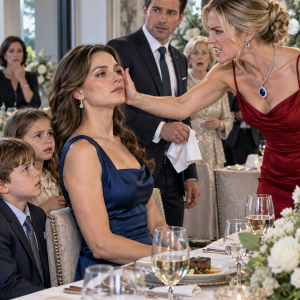
In the center of the Meridian Arts Foundation gala, my husband looked directly at me and suggested that I eat with the catering staff.
For several seconds, the ballroom of the Fairmont Hotel in San Francisco became unnaturally quiet. Crystal glasses reflected the clean white light from the ceiling fixtures, a string ensemble continued playing near the stage, and almost three hundred donors pretended not to watch the humiliation unfolding beside the main table.
I stood there wearing a simple navy evening gown, holding a place card that clearly displayed my name.
At the six-seat table reserved for the Bennett family, every chair was occupied. My mother-in-law, Constance Bennett, sat beside her husband, Richard. My husband, Preston Bennett, occupied the central position facing the stage. His younger sister, Celia, scrolled through her phone while pretending the situation did not concern her.
The final chair, the one assigned to me, had been given to Preston’s chief strategy officer, Serena Vale.
Serena wore a pale silver designer gown with a deep neckline and diamond earrings I immediately recognized. Preston purchased those earrings during a business trip to Geneva and later told me that the jewelry charge on our shared account represented a diplomatic gift for an international adviser.
Serena’s handbag rested on the floor beside my name card.
She looked up at me with carefully arranged embarrassment.
“Julia, I honestly thought the event coordinator had placed you with the community partners,” she said. “Preston mentioned that you preferred quieter tables.”
Preston did not ask her to move.
Instead, he lifted his wineglass and glanced around at the investors seated nearby.
“There is a buffet downstairs for vendors, artists, and support staff,” he said. “You would probably feel more comfortable there than discussing institutional capital with people you do not know.”
A few guests lowered their eyes. Others looked at me with the fascinated discomfort people reserve for accidents that occur inside expensive rooms.
Constance leaned toward me.
“Serena understands private equity, government incentives, and international development agreements,” she whispered. “You spent most of the marriage arranging flowers for nonprofit luncheons. Please do not make this evening more difficult than necessary.”
Her words repeated the family story Preston had allowed everyone to believe.
For four years, the Bennetts treated me as a pleasant but financially insignificant woman from a small town in northern California. They knew I worked with community foundations and occasionally reviewed grant proposals, although they never asked why governors, university presidents, and investment executives sometimes called my private number.
I had deliberately used my late mother’s surname, Hart, rather than the name attached to my father’s business empire.
I wanted a marriage built without inherited influence.
Preston once claimed that was what he loved most about me.
Over time, however, my modest public life became permission for contempt. Constance criticized my clothes, Celia expected me to manage family errands, and Preston used my nonprofit work as proof that I lacked the intelligence required to understand his company.
Three years earlier, when Bennett Urban Systems faced a cash crisis, I quietly sold a portfolio my grandmother left me and transferred the proceeds through an investment vehicle that protected Preston from embarrassment. He believed the rescue came from a regional infrastructure fund.
The fund belonged to my family.
I looked at Serena.
“Would you mind returning my chair?”
She began to stand, but Preston placed one hand against her shoulder.
“Stay where you are,” he said. “Julia, please behave like an adult. This gala determines whether Bennett Urban receives the financing needed for its western expansion.”
“I understand exactly what the financing determines.”
He smiled with the impatience he had developed whenever I spoke about his company.
“Then you understand why Serena belongs beside me tonight.”
Something inside me became quiet.
I placed my untouched champagne on a passing tray and turned toward the front of the ballroom.
At the most prominent table sat Harrison Waverly, founder and chairman of Waverly Global Infrastructure. His company controlled major transportation, renewable-energy, data-center, and public-development investments across North America.
Preston had spent two years attempting to arrange a private meeting with him.
Constance noticed where I was walking and hurried after me.
“Julia, stop immediately. That is Chairman Waverly’s table. Security will remove you before you reach him.”
Preston followed, his embarrassment transforming into anger.
“Do not create a spectacle because you lost a seating argument.”
I continued walking.
When I reached the front table, Harrison Waverly turned away from a conversation with the governor and looked directly at me.
His stern expression softened.
I placed one hand on the back of the empty chair beside him.
“Hello, Dad,” I said. “I think I am finally ready to come home.”
The room fell silent.
My father rose, embraced me, and held me with the careful strength of someone who had waited years without demanding my return.
“You never needed permission to come home, Julia,” he said. “You only needed to decide that you were finished living where respect depended upon secrecy.”
Behind me, Preston stopped moving.
My father looked over my shoulder toward him.
“I believe your husband has been requesting a meeting with me.”
Part 2 – The Name My Husband Never Respected
Preston’s face lost its color.
“Harrison Waverly is your father?”
The question contained disbelief rather than curiosity. During our marriage, Preston had known my father was alive, lived somewhere outside Sacramento, and worked in infrastructure investment. He never asked for further details because he assumed a person who avoided society photographs could not be important.
I turned toward him.
“My full legal name is Julia Hart Waverly.”
Constance reached for the nearest chair.
“Why would you hide something like this from your husband’s family?”
My father answered before I could.
“My daughter did not hide her character, education, work, loyalty, or judgment. She withheld information about wealth because she wanted those qualities to be enough.”
Richard Bennett approached with the cautious expression of a man who understood that every word might affect the company’s financing.
“Mr. Waverly, this appears to be a terrible family misunderstanding.”
My father looked toward the Bennett table, where Serena remained seated beside my abandoned place card.
“The misunderstanding seems remarkably clear.”
Serena stood at last.
“Mrs. Bennett, I never intended to replace you. Preston asked me to sit there because several investors wanted technical explanations.”
“You could have provided technical explanations without wearing the earrings he purchased through our household account.”
Her hand rose instinctively toward them.
Preston stepped closer.
“This is not the place for accusations.”
I looked at him.
“You selected the place when you humiliated me before the same people whose money you wanted.”
My father’s general counsel, Adrian Lowe, approached our table carrying a slim leather folder. He had known me since childhood and greeted me without surprise.
“Julia, the due-diligence team completed the Bennett review this afternoon.”
Preston’s attention immediately shifted.
“Due diligence?”
Adrian opened the folder.
Waverly Global had been evaluating a potential investment of one hundred and eighty million dollars in Bennett Urban Systems. The proposed financing would support modular transit hubs, municipal energy systems, and several public-private developments across the western states.
Preston believed the unidentified lead investor was a European pension consortium.
He never knew my father controlled the process.
I had not requested the investment, but years earlier I asked Waverly Global to protect the emergency credit line that prevented Bennett Urban from collapsing. I told myself that preserving Preston’s company protected employees and allowed him to succeed without feeling dependent upon my family.
My father had honored that request while warning me that secrecy rarely produced equality.
Now Adrian placed the report before Preston.
“Our review identified personal expenses submitted as development costs, payments to consulting entities connected to Ms. Vale, and several vendor contracts lacking documented services.”
Serena’s expression changed.
Preston attempted to laugh.
“Those are preliminary classifications. Every growth company has irregular expenses during expansion.”
“A hotel suite, couture clothing, private travel, and residential furnishings do not become infrastructure expenses because an executive labels them strategic outreach,” Adrian replied.
Constance looked at Serena’s gown.
“You charged that dress to the company?”

Serena straightened.
“Preston approved every expense.”
“Because the purchases supported donor cultivation,” Preston said quickly.
I almost admired the speed with which he converted infidelity into business development.
My father remained seated.
“The investment committee will not announce financing tonight. Bennett Urban’s accounts will undergo an independent forensic audit before any further consideration.”
Richard Bennett’s face tightened.
“Without that investment, several development loans could be called.”
“Then your company’s survival depends upon records that should withstand examination,” my father answered.
Preston turned toward me.
“Tell him to stop this.”
There was no apology in his voice, only the expectation that I would rescue him again.
“Why?”
“Because you are my wife.”
“Five minutes ago, your wife was not qualified to sit at your table.”
Part 3 – The Company I Had Already Saved Once

My father asked whether I wanted to remain at the gala.
I did.
Leaving immediately would have allowed the Bennett family to tell everyone that emotions had overtaken me. I wanted the evening to continue long enough for the truth to occupy the room completely.
The foundation director introduced my father as the event’s principal donor and invited him to speak. Instead of discussing philanthropy, he asked me to join him near the stage.
Preston watched from the Bennett table while Serena stood several feet away, no longer certain where she belonged.
My father addressed the audience.
“Many of you know my daughter through her work with regional housing, public-health, and community-development initiatives. What most people do not know is that Julia designed the social-impact framework used across several Waverly development funds.”
The screens behind us displayed housing projects, transit facilities, and community health centers.
For nearly a decade, I had developed standards requiring infrastructure investments to include affordable access, local hiring, environmental protections, and independent community oversight. I avoided corporate titles because I preferred evaluating projects without being treated differently as the chairman’s daughter.
“Julia did not arrange flowers for nonprofit luncheons,” my father continued. “She helped determine whether billions of dollars in development projects earned the right to call themselves public partnerships.”
A wave of quiet conversation moved through the ballroom.
I saw Constance lower her eyes.
Preston had used my community work as a joke while presenting Bennett Urban as a socially responsible company. In reality, several principles in his investor materials came from documents I drafted before our marriage.
After my father finished, the governor thanked me for restructuring a rural transit grant that preserved service for twelve communities. A university president approached to discuss the housing partnership we had designed for medical students.
None of the praise mattered as much as the expression on Preston’s face.
He was not ashamed that he misunderstood my work. He was calculating how my identity could still benefit him.
During the reception, he cornered me near a quiet corridor.
“We need to speak without your father’s attorneys listening.”
“You are speaking now.”
“You should have told me who you were.”
“I told you who I was repeatedly. You decided my value depended upon a surname and an investment account.”
His jaw tightened.
“Marriage requires transparency.”
“Does that principle include hotel suites with Serena?”
He glanced toward the ballroom.
“Nothing happened that cannot be explained.”
I removed my phone and opened a file containing corporate-card statements, hotel confirmations, private messages, and photographs taken by the investigator my attorney hired two months earlier.
I had discovered the affair before the gala.
The missing chair merely ended my willingness to preserve his reputation.
“The suite was booked under her name, paid through Bennett Urban, and used on nights when you told me negotiations required you to remain in Sacramento.”
Preston’s confidence weakened.
“You investigated me?”
“I verified what you trained me to doubt.”
He reached toward my phone, but I stepped back.
“Our prenuptial agreement contains a marital misconduct clause. It also requires reimbursement when shared assets are used to maintain an outside relationship.”
“You cannot destroy a company employing four hundred people because our marriage became difficult.”
“I am not destroying the company. I am separating its employees from the executives who treated corporate money as personal property.”
Adrian joined us carrying another report.
The audit team had discovered that Serena attempted to access the company’s restricted server from a hotel suite after learning the investment had been suspended. The attempted download involved client proposals, municipal pricing models, and confidential bids.
Serena claimed she was creating a backup.
The access logs showed she was transferring the data to an external account controlled by a consulting company registered to her brother.
Preston closed his eyes briefly.
“She told me that company handled strategic archiving.”
Adrian’s expression remained neutral.
“It also received payments from one of Bennett Urban’s competitors.”
Serena had not merely become Preston’s affair partner. She had positioned herself to profit from the company’s collapse.
I looked toward the ballroom where she was speaking urgently into her phone.
“Preserve every record and notify Bennett Urban’s board,” I said. “Do not allow her access to the servers or hotel room until counsel arrives.”
Preston stared at me.
“You are giving orders inside my company.”
“I am protecting evidence inside a company partly supported by funds you concealed from your board.”
Part 4 – The Marriage Hidden Inside the Balance Sheet
The Bennett Urban board met in an emergency conference room before the gala ended.
My father did not attend. He wanted every action documented as an independent corporate decision rather than retaliation from an angry parent.
I attended only because my investment trust held the emergency debt purchased during the company’s earlier crisis.
That detail surprised Preston more than my surname.
Three years earlier, he told me Bennett Urban needed temporary capital or hundreds of workers would lose their jobs. He insisted the banks had become unreasonable and asked whether I possessed anything valuable enough to sell.
I sold a necklace inherited from my mother, but that amount covered only a fraction of what the company required.
Without telling Preston, I asked my family office to purchase Bennett Urban’s distressed debt through North Harbor Capital. I did not seek voting control or public recognition. I wanted employees protected and my husband given another opportunity to stabilize the company.
Preston spent the next three years boasting that he rescued Bennett Urban through personal brilliance.
At the meeting, Adrian presented the ownership documents.
North Harbor held the senior secured debt, several protective covenants, and the right to appoint an observer during financial distress.
Preston stared at me.
“You were the lender?”
“My trust supplied the capital.”
“You allowed me to believe I negotiated that facility myself.”
“You were informed that an institutional lender approved the rescue. You never asked why the terms were unusually patient because believing they reflected your importance felt better.”
Richard looked physically ill.
The board chair, Margaret Ellis, requested that Preston leave the room while directors reviewed the evidence. He refused until security reminded him that executive authority had been temporarily suspended.
Serena was removed from the hotel by corporate security and later questioned by investigators concerning the attempted data transfer. She initially blamed Preston, claiming he authorized every download and promised her a senior position after their relationship became public.
Preston insisted she had manipulated him.
Both explanations contained enough truth to expose them.
After the board meeting, Constance found me near the elevators.
Her earlier contempt had disappeared beneath fear.
“Julia, families survive mistakes by showing mercy.”
“Did you consider mercy when you encouraged your son to send me downstairs?”
She looked away.
“We believed Serena was more useful to the business.”
“That sentence explains everything.”
Constance reached for my hand, but I moved it beyond her reach.
“I misjudged you.”
“You did not misjudge my bank account. You judged my humanity and decided it required evidence.”
The elevator doors opened.
My father waited inside without interfering.
Preston ran toward us before the doors closed.
“Julia, please come home. We can discuss the affair, the financing, and everything else privately.”
I removed my wedding ring.
“There is nothing private about how you treated me. The affair happened in hotel records, the financial misconduct happened in company accounts, and the humiliation happened before hundreds of witnesses.”
I placed the ring in his palm.
“My attorney will contact yours tomorrow.”
Part 5 – The Cost of Losing Protection

The forensic investigation lasted five months.
Serena had copied municipal proposals, client lists, development models, and confidential environmental reports. Her brother’s consulting company sold portions of that information to a competitor bidding against Bennett Urban.
She accepted a plea agreement and cooperated with prosecutors.
Preston was not charged with economic espionage, but investigators found that he approved false consulting invoices, used company funds for personal travel, and concealed material financial information from the board.
He was removed as chief executive and required to repay substantial compensation.
Bennett Urban did not collapse.
My father’s firm could have acquired the company at a distressed price, but I refused to support that strategy. Employees should not become prizes awarded to whoever possessed the greatest leverage during a scandal.
Instead, North Harbor converted part of its debt into noncontrolling equity while an independent infrastructure fund supplied new capital. The company retained its engineers, project managers, and public contracts under new leadership.
Preston accused me of taking his company.
The legal record showed that I protected it from him.
Our divorce proceeded under the prenuptial agreement. I recovered the marital funds used for Serena, retained my separate property, and waived any claim to Preston’s remaining personal assets beyond what restitution required.
Constance sent letters describing her declining health and the emotional damage caused by public embarrassment. Richard sent one shorter note accepting responsibility for his silence.
I responded to neither.
My marriage had trained me to treat every request for access as an emergency. Healing required discovering that another person’s discomfort did not automatically create an obligation.
Preston appeared outside my father’s residence once, standing in the rain beside the security gate. He requested five minutes.
I agreed to speak through the intercom because I no longer needed a dramatic confrontation.
“Serena lied to me,” he said. “She used me to reach the company.”
“She exploited what already existed.”
“I made mistakes, but I loved you.”
“You loved being cared for by someone you believed had no power to leave.”
His silence confirmed that the sentence reached somewhere he had avoided examining.
“Could we begin again?”
“Beginning again would require pretending the previous marriage lacked sufficient evidence. It did not.”
“What am I supposed to do now?”
“Become someone who respects people before learning what they can offer you.”
I ended the call.
Part 6 – The Table I Built Differently

One year after the gala, Waverly Global opened the Harbor Commons Initiative, a development program combining affordable housing, neighborhood healthcare, public transportation, and small-business financing.
I accepted the role of executive director after negotiating an independent board, transparent compensation, and authority separate from my father’s office.
I no longer wanted wealth hidden, displayed, or used as a test of affection. I wanted it governed responsibly.
At the program’s opening reception, the room contained city planners, community advocates, construction workers, health professionals, tenants, investors, and local business owners. There was no separate basement buffet and no family table protected from the people doing the work.
Every guest received the same meal.
My father noticed the seating plan and smiled.
“You redesigned the entire event around one terrible chair.”
“Around the belief behind it.”
Near the stage, a large circular table had no assigned head position. Community representatives sat beside institutional investors, while executives shared space with apprenticeship graduates and neighborhood organizers.
The arrangement irritated several donors.
That confirmed it was necessary.
Before my speech, Adrian handed me the final divorce judgment.
Preston had signed without requesting another meeting.
Bennett Urban continued operating under its new leadership. Richard resigned from the board. Constance sold the family’s oversized estate after financial guarantees connected to Preston’s management reduced their savings.
I did not celebrate those outcomes.
Consequences were not trophies.
When my name was announced, I approached the stage wearing the same navy dress from the previous gala. I had repaired a loosened seam but changed nothing else.
The dress had never been the source of humiliation.
I addressed the room.
“Development is often described through capital, land, engineering, and scale. However, every institution also reveals itself through something simpler: who receives a place at the table, who is expected to serve quietly, and whose dignity becomes negotiable when money enters the room.”
I looked toward my father.
“For several years, I believed hiding my family name would help me discover whether love could remain separate from wealth. I learned that secrecy cannot create character. It only delays the moment character becomes visible.”
After the ceremony, my father and I stood near the windows overlooking San Francisco Bay.
“Do you regret leaving?” he asked.
“I regret believing endurance was proof of sincerity.”
He nodded.
“Do you regret coming back?”
“Coming back was not surrender. Remaining dependent upon your decisions would have been.”
My father accepted that distinction. Our relationship had improved because he learned to offer support without directing the life it protected.
As guests began leaving, a young community organizer approached me.
“Mrs. Bennett, thank you for the speech.”
I smiled.
“It is Ms. Waverly now.”
The name no longer functioned as a secret weapon or a certificate of worth. It was simply mine, attached to decisions I made openly.
Later that evening, I walked through the empty reception space while staff cleared plates and folded linens. I stopped beside the circular table.
One year earlier, Preston believed removing my chair would establish my insignificance. He expected me to accept humiliation because he thought I had nowhere more important to go.
He misunderstood both the room and the woman standing inside it.
My father’s fortune did not make me worthy of respect. Preston’s betrayal did not make me powerful. The divorce did not create the person who eventually led Harbor Commons.
Those events merely removed the structures that encouraged me to ignore what had always been true.
Love without respect becomes dependency. Generosity without boundaries becomes exploitation. A seat offered only after someone discovers your status is not belonging.
I turned off the final table light and walked toward the exit.
Behind me remained a room designed without servants’ entrances, disposable guests, or chairs reserved according to social value.
It was not a perfect model for the world.
However, it was a table I had chosen to build differently.
THE END