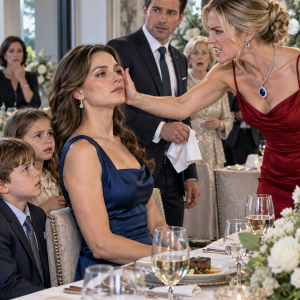
“That sentence explains why Caldwell Systems needs Meridian more than Meridian needs Caldwell Systems.”
Finally, the corporate secretary counted the votes.
Richard was removed as chairman and chief executive by a decisive majority.
For several seconds, he remained completely still.
Then he looked at Evan.
“You voted against your own family.”
Evan’s voice trembled, although he did not look away.
“I voted against the belief that our family name excuses everything done in its protection.”
Richard pushed back his chair.
“Without me, you are nothing.”
“Perhaps,” Evan answered. “At least whatever comes next will belong to me.”
Security escorted Richard from the executive floor he had ruled for thirty-two years.
Nobody applauded.
The silence felt more appropriate because the decision was not a victory celebration. It was an overdue correction that would require years of repair.
Eleanor turned toward me after the doors closed.
“Will Meridian return to negotiations?”
“Yes, provided every governance condition remains binding.”
The revised alliance gave Meridian authority over technology standards while Caldwell Systems retained its manufacturing network. A new independent executive would lead the combined modernization program.
The agreement also established the Harbor Bridge Initiative, a scholarship and apprenticeship fund serving students from the Bronx, Queens, Newark, and other communities excluded from traditional recruiting pipelines.
Eleanor signed the framework.
“Richard spent his life protecting a very small table,” she said. “You appear determined to build a larger one.”
“A larger table is useful only when people are allowed to speak after they sit down.”
Part 6 – Building Without Permission
The months following Richard’s removal were more difficult than the headlines suggested.
Meridian engineers discovered outdated systems, incomplete audits, and departments organized around personal loyalty rather than professional competence. Some Caldwell executives resisted every reform, assuming the board would eventually restore the old structure after public attention faded.
We replaced managers who refused transparent hiring practices, promoted overlooked technical employees, and created review panels that evaluated candidates without names or university pedigrees during preliminary screening.
The first Harbor Bridge apprenticeship received more than nine thousand applications.
One applicant, a nineteen-year-old woman from Mott Haven named Selena Ortiz, had taught herself network defense using donated computers at a community center. She lacked a prestigious degree but identified a vulnerability in a sample system faster than several experienced candidates.
During her interview, she asked whether the program existed only for publicity.
“That depends on what we build together,” I answered. “Publicity disappears. Institutions remain only when people insist on protecting them.”
Selena became the first apprentice hired into Meridian’s threat-response team.
Evan also began rebuilding his life. He rented a modest apartment, joined a nonprofit financial advisory organization, and learned the embarrassment of comparing grocery prices after years of ignoring them completely.
Our relationship survived, although not through romance alone. He attended therapy, confronted relatives who demanded that I forgive Richard, and refused every attempt to make me responsible for restoring peace within his family.
One evening, while we walked beside the Hudson River, he stopped beneath the lights of a public pier.
“I used to think choosing you meant giving something up,” he said. “Now I understand that I was giving up the version of myself that required other people to remain smaller.”
“That version protected you for a long time.”
“It also prevented me from becoming someone I respected.”
He did not ask whether everything had been forgiven. Instead, he asked whether we could continue building our relationship carefully.
I said yes because accountability had changed his behavior, not merely his language.
Richard never apologized publicly. Through attorneys, he challenged the board vote, attacked the apprenticeship fund as wasteful, and predicted that Caldwell Systems would collapse under what he called social experimentation.
The opposite happened.
Within nine months, the alliance completed the delayed compliance platform. Federal regulators approved the system ahead of schedule, Northstar withdrew its acquisition offer, and Caldwell Systems secured contracts that had once seemed impossible to preserve.
The employees Richard considered unsuitable became essential to the recovery he claimed only he could achieve.
Part 7 – A Wedding Without A Dynasty

One year after the dinner at Blackstone House, Evan and I married at a restored orchard in the Hudson Valley.
We invited fewer than seventy people. There were no political donors, financial journalists, or distant relatives selected because their names appeared on hospital wings. My mother sat in the front row wearing a lavender dress she had saved for months to purchase, although I had repeatedly offered to buy anything she wanted.
“I paid for your school shoes when I had twelve dollars left,” she told me. “Let me pay for my own dress when my daughter gets married.”
Nina stood beside me during the ceremony, while Selena and several Harbor Bridge apprentices attended together. Eleanor arrived without an entourage and spent most of dinner speaking with my mother about neighborhood pharmacies and immigrant families.
Richard did not attend.
Three days before the wedding, a wooden case arrived without a card. Inside was a bottle of wine from the same vineyard served during the dinner when he had insulted me. Its market value exceeded what my mother had earned during several months of work when I was a child.
Evan examined the bottle.
“Do you want me to return it?”
I considered the question before shaking my head.
“Donate it to the Harbor Bridge auction.”
The bottle sold for twenty-six thousand dollars after guests learned its history. The proceeds purchased laptops, security software, and transportation passes for twelve apprentices.
During the reception, Evan raised his glass.
“My family taught me that a table represented power because someone controlled who was invited. Maya taught me that power means creating enough room for people who were never expected to arrive.”
I looked across the orchard at my mother, my colleagues, young apprentices, and friends who had known me before financial magazines printed my photograph.
The night Richard insulted me, I had believed dignity required walking away without explanation. I later understood that dignity could also require returning with evidence, leverage, and demands that changed more than one person’s behavior.
Private humiliation had revealed a public weakness inside an institution affecting thousands of lives. Ignoring that weakness would have protected my comfort while leaving everyone else exposed.
Part 8 – The Larger Table
Two years after the alliance began, Harbor Bridge opened its first permanent training center inside a renovated warehouse in the South Bronx.
The building contained laboratories, classrooms, childcare rooms, and a cafeteria serving meals at no cost to enrolled students. Applicants were evaluated through practical work rather than family connections, expensive clothing, or familiarity with elite professional customs.
At the opening ceremony, Selena demonstrated a security platform she had helped design for municipal hospitals. My mother stood beside the stage, crying openly while pretending the wind had irritated her eyes.
A group of high school students gathered around me afterward. One boy asked whether powerful people eventually stopped judging where someone came from.
I considered giving him an encouraging answer, but encouragement without honesty would have repeated the same polished manners that protected Richard for decades.
“Some people will continue judging you,” I said. “The important question is whether their judgment controls your opportunities, your confidence, or the institutions you help build.”
He nodded thoughtfully.
“What should we do when they say we do not belong?”
I looked around the training center, where hundreds of students worked at tables built inside a neighborhood that executives once discussed only as a source of risk.
“Learn everything you can. Keep records. Build alliances. Protect your dignity, but do not confuse silence with strength. Then create places where belonging depends on ability, effort, and character rather than permission.”
That evening, after the guests departed, I remained alone in the main classroom.
The tables were inexpensive, durable, and arranged so every student could see one another. No chair stood at the dominant end. No family portrait watched from the walls, and no person entering the room needed to prove that a grandparent had once occupied the same seat.
I thought about Richard pointing toward my dress beneath the chandeliers of Blackstone House. He believed clothing, address, and ancestry revealed human value because those measurements guaranteed his own superiority.
He never understood that inherited power becomes fragile whenever it refuses to recognize talent outside its own reflection.
I had entered his dining room hoping respect might be offered after enough patience, achievement, and politeness. I left understanding that dignity should never depend on acceptance from people invested in denying it.
When someone insists that you are unworthy of their table, begging for a chair only strengthens the rules they created.
Sometimes the better answer is to leave, gather the people they overlooked, and build something larger than the room that rejected you.
THE END