Part 1 – The Stranger Beneath The Hotel Awning
At twenty-two weeks pregnant, I discovered how quickly fear could erase the distance between dignity and desperation.
Snow had begun falling across downtown Boston before noon, covering the sidewalks in a thin layer of ice that reflected the headlights along Boylston Street. My coat no longer closed comfortably over my stomach, my breathing had become uneven, and the bruising around my wrist still ached whenever I moved my fingers.
Behind me, my former husband shouted my name.
“Claire, stop running and listen to me.”
Aaron Whitlock had used that voice throughout our marriage whenever he wanted cruelty to sound reasonable. He never began with threats. He began by insisting that I had misunderstood, overreacted, or embarrassed him. Only when apologies failed to appear did the gentleness disappear.
I kept moving.
Three months earlier, Aaron had abandoned me after learning I was pregnant. He emptied our joint account, transferred the lease on our apartment, and announced that he was marrying Cassandra Vale, the daughter of one of Boston’s wealthiest investment executives.
According to Aaron, Cassandra possessed the sophistication required for the life he deserved, while I had become a financial burden carrying an inconvenient child.
He also began telling employers, neighbors, and social media followers that I was unstable, dishonest, and obsessed with destroying his new relationship.
That morning, he had followed me from a prenatal clinic and attempted to force me into his car.
I escaped only because a delivery truck blocked the curb.
Now the sidewalk ahead ended at a construction barrier, while traffic rushed past on the opposite side. My legs were shaking, and the child inside me pressed painfully beneath my ribs.
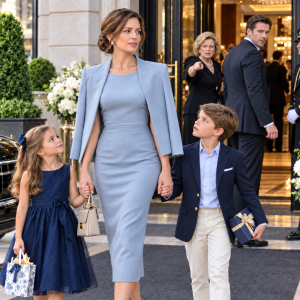
Then I saw a man standing beneath the awning of the Fairmont Hotel.
He was tall, broad-shouldered, and dressed in a charcoal overcoat that looked too precisely tailored for the weather. A black SUV waited beside him, accompanied by two men wearing dark suits and discreet communication devices.
I did not know his name.
I only knew Aaron was getting closer.
I crossed the remaining distance and threw both arms around the stranger.
His body stiffened beneath my hands.
“Please pretend you know me,” I whispered against his coat. “My former husband has been following me, and I am afraid he will hurt me.”
The man did not step away.
Instead, one arm moved carefully around my back, supporting me without pressing against my stomach.
Aaron reached us seconds later.
“Take your hands off my wife.”
“Former wife,” I said, although my voice barely carried.
Aaron seized my shoulder.
The stranger’s expression changed.
“Remove your hand.”
His voice was quiet, but the two security men immediately moved closer.
Aaron laughed.
“You do not know what she is like. She lies, creates scenes, and uses the pregnancy to manipulate everyone around her.”
The stranger looked at Aaron’s hand still gripping my coat.
“I will ask once more.”
Something in his face finally unsettled Aaron enough to release me.
Then recognition appeared.
“Nathan Cole?” he whispered.
The name meant little to me at first. Then I remembered magazine covers, business interviews, and photographs of a private infrastructure billionaire who rarely attended public events.
Nathan Cole controlled Northline Urban Systems, a national technology and real-estate group whose projects shaped transportation networks across several major cities.
Aaron stepped backward.
Nathan opened the SUV door.
“Get inside, Ms. Whitlock.”
I froze.
“How do you know my name?”
His eyes remained on Aaron.
“Because your former husband is engaged to my half sister.”
Part 2 – The Missing Audit Files
The SUV moved away from the hotel while Aaron remained beneath the falling snow.
I sat beside Nathan with both hands pressed around a bottle of water his security director had given me. My heartbeat refused to slow, although the warmth inside the vehicle gradually restored feeling to my fingers.
Nathan studied the bruising around my wrist.
“Did Aaron cause that?”
“He grabbed me outside the clinic.”
“Was a police report filed?”
“I tried twice before today. He always arrived with messages, recordings, and people willing to describe me as unstable.”
Nathan’s expression hardened.
“Cassandra has been repeating the same description.”
I looked toward him.
“You know about me?”
“I know the version of you they created. Cassandra claims Aaron escaped an emotionally abusive marriage and is protecting his unborn child from an unpredictable mother.”
I laughed once, although nothing felt amusing.
“He abandoned me before the first ultrasound.”
Nathan’s gaze shifted toward the front window.
“Cassandra has been attempting to gain control of the Vale Family Infrastructure Trust. Under my grandfather’s estate plan, she receives additional voting rights if she becomes the legal guardian of a direct descendant from a recognized marital line.”
“My child is not part of her family.”
“Not biologically, but the trust language contains an adoption and guardianship provision. If Aaron marries Cassandra, then secures primary custody of your child, they may attempt to classify the child as a dependent of their household.”
The explanation sounded absurd, yet Aaron’s recent obsession with declaring me unfit suddenly gained structure.
Nathan continued.
“That alone would not give them full control. They would also need access to financial authentication records held by your former employer.”
My breath caught.
Before Aaron left, I had worked as a senior forensic accountant for Emerson & Pike, a firm auditing regional development companies. One client had been Vale Transit Holdings, a subsidiary connected to Cassandra’s family trust.
Six months earlier, I discovered unexplained transfers through foreign construction vendors. The payments were too carefully divided to appear accidental. I copied the audit trail into an encrypted review folder and reported it to my supervisor.
Two days later, Aaron claimed our marriage had become unbearable.
During the separation, my laptop disappeared.
“They took the files,” I said.
“They took the visible copies,” Nathan replied. “However, they cannot authorize the final transfer without the secondary credential assigned to the auditor who created the review folder.”
“That credential expired when I left the firm.”
“The encryption certificate did not. Your employer preserved the audit as evidence after receiving a federal inquiry.”
I stared at him.
“What transfer?”
Nathan opened a secure tablet and displayed a series of corporate entities.
Cassandra and Aaron had redirected nearly eighty million dollars through false transit contracts, equipment leases, and overseas consulting firms. A final movement of two hundred forty million dollars remained blocked inside a family investment account.
My encrypted audit folder contained the transaction history linking Cassandra’s companies to the missing money.
Without my credential, they could not permanently delete or alter it.
“Aaron is not following you because he wants reconciliation,” Nathan said. “He believes you still possess the authentication phrase.”
I placed one hand protectively over my stomach.
“I memorized it.”
Nathan looked at me for several seconds.
“Then neither Aaron nor Cassandra can afford to let you speak to investigators.”
Part 3 – The Attack Near The Charles River

Nathan instructed his driver to take us to a secure Northline residence in Cambridge.
We had barely crossed onto the river road when a dark pickup truck struck the rear quarter of the SUV.

The impact threw me sideways.
Nathan caught my shoulders before I hit the door.
“Stay down.”
The pickup struck us again, forcing the SUV toward the frozen edge of the roadway. Through the rear window, I saw Aaron behind the wheel.
He was no longer pretending to be concerned.
His face appeared twisted with panic, and one hand held something dark near the open driver-side window.
A sharp crack sounded.
The rear glass fractured.
Nathan covered my head and stomach with his body while his driver accelerated.
“Call state police and activate the escort,” Nathan ordered.
The security vehicle behind us moved between Aaron’s pickup and our SUV. Aaron attempted to pass on the left, scraping against the guardrail and losing control on the ice.
His truck spun across two lanes before striking a concrete barrier.
Police vehicles were already approaching from the opposite direction.
Nathan lifted his weight carefully.
“Are you hurt?”
“I do not think so.”
A painful tightening moved across my abdomen, then faded.
Nathan’s security officer called an ambulance despite my objections.
As paramedics checked the baby’s heartbeat, police surrounded Aaron’s damaged truck. He attempted to leave through the passenger door but slipped on the road and was restrained before reaching the sidewalk.
An officer recovered a handgun from beneath the seat.
Aaron shouted toward the ambulance.
“Claire stole confidential files. She is the criminal.”
Nathan stood between him and the open ambulance doors.
“You followed a pregnant woman from a medical appointment, struck a protected vehicle, and discharged a weapon in traffic. I suggest you save the financial accusations for counsel.”
Aaron stared at him.
“Cassandra will destroy you for interfering.”
Nathan’s expression remained controlled.
“Cassandra has spent years believing family tolerance was the same as immunity.”
At Massachusetts General Hospital, physicians confirmed that the baby remained stable. The contractions were caused by stress rather than premature labor, but they kept me under observation.
Nathan waited outside the examination room until I asked him to enter.
“Why are you helping me?”
He sat beside the window rather than approaching the bed.
“Cassandra and I share a father, not a childhood. My mother left the family after discovering financial misconduct involving Cassandra’s mother. I spent years protecting Northline from the same people now targeting you.”
“That explains why you oppose her. It does not explain why you trust me.”
“I do not trust anyone completely after one afternoon.”
His honesty reassured me more than an emotional promise would have.
“However, I believe the evidence, the bruising, Aaron’s behavior, and the fact that you protected an audit when remaining silent would have been easier.”
I looked down at my hands.
“I was not trying to be brave. I was doing my job.”
“Those are often the same thing before anyone notices.”
Part 4 – The Code I Refused To Surrender
Federal investigators arrived before midnight.
Special Agent Monica Reyes listened while I described the audit, the missing laptop, Aaron’s harassment, and the authentication phrase I had never written down.
My former employer confirmed that the encrypted review folder remained intact but inaccessible. Cassandra had attempted twelve unauthorized entries during the previous month.
Agent Reyes placed a secured computer on the hospital table.
“We can retrieve the evidence tonight, but once you enter the phrase, your identity becomes formally connected to the investigation.”
“It already is.”
I typed the forty-character sequence from memory.
The system opened.
Thousands of records appeared: payment approvals, vendor contracts, internal messages, trust documents, and account transfers connecting Cassandra, Aaron, and three Vale executives to the missing funds.
One message from Cassandra read:
Once Aaron controls the child, the trustees will accept the family-continuity argument. Claire only needs to appear incapable long enough for the emergency order.
Aaron replied:
She doubts herself whenever enough people repeat the same story.
Another exchange discussed the missing laptop.
Cassandra asked whether Aaron had found the audit key.
He answered:
No, but pregnancy has made her easier to pressure. If public humiliation fails, I will handle it privately.
I stopped reading.
Agent Reyes closed the message window.
“You do not need to review every detail tonight.”
“I need copies of anything related to custody.”
“Your attorney will receive them.”
Nathan arranged for attorney Julia Bennett, a family-law specialist experienced in coercive-control cases, to represent me. Julia immediately filed for an emergency protective order and submitted Aaron’s arrest records, online harassment, financial motives, and recovered messages.
The court suspended his unsupervised contact rights concerning the unborn child pending a full hearing.
Cassandra responded publicly.
She released a statement describing Aaron as a traumatized man manipulated by an unstable former spouse and accused Nathan of manufacturing a scandal to seize the family trust.
Nathan’s communications director recommended an aggressive response.
He refused.
“We release verified documents only after investigators authorize disclosure. Claire is not a campaign asset.”
I heard him say that from the hospital doorway.
For months, Aaron had treated my pain as material for his narrative. Nathan’s refusal to use me, even in my own defense, made me trust him more than any promise could have.
Part 5 – Cassandra’s Engagement Party

Cassandra did not cancel her engagement celebration.
She moved it from a private club to the Vale family estate outside Newport, claiming that Aaron’s arrest resulted from a misunderstanding that would soon be corrected.
Nearly two hundred investors, politicians, trustees, and society reporters attended.
Federal agents allowed the event to continue because Cassandra planned to present emergency trust resolutions transferring financial authority to herself and designating Aaron as future guardian of her household.
She believed his release on bond was inevitable.
Instead, Aaron remained detained.
Nathan attended as a voting trustee.
I accompanied Julia and Agent Reyes, not as a guest but as a witness prepared to identify the recovered records.
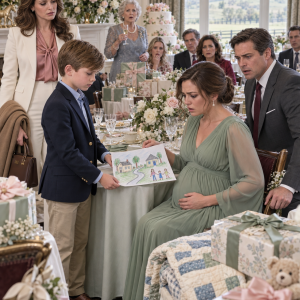
Cassandra stood beneath a glass pavilion wearing a silver gown and her engagement ring despite the absence of her fiancé.
When she saw me, her smile changed.
“You should not be here.”
“The trust documents mention my child, so I believe I have earned an explanation.”
She lowered her voice.
“Aaron told me you were difficult, but I underestimated how desperately you need attention.”
“He told me you represented freedom. Apparently, both of us received useful versions of the truth.”
Her eyes moved toward Nathan.
“You brought her here to embarrass me.”
“No,” Nathan answered. “Your transaction records accomplished that without assistance.”
The trustees assembled inside the pavilion. Cassandra’s attorney began presenting the emergency resolutions, claiming that legal uncertainty threatened the family’s assets.
Nathan requested that the independent compliance officer speak first.
Agent Reyes entered with two investigators.
She distributed certified copies of the recovered audit records and informed the trustees that federal warrants had frozen accounts connected to Vale Transit Holdings.
Cassandra’s composure fractured.
“These documents were stolen by a terminated accountant.”
I stepped forward.
“I created the audit while employed and reported the irregularities through authorized channels. Aaron removed my laptop afterward, but the evidence remained on the company server.”
The compliance officer displayed the approval chain.
Cassandra had authorized false contracts. Aaron established intermediary companies, while three executives disguised the transfers as transit-equipment purchases.
The final blocked transaction would have moved two hundred forty million dollars into accounts controlled through Cassandra’s private foundation.
One trustee asked why my child appeared in the strategy messages.
Nathan answered.
“Cassandra intended to marry Aaron, obtain emergency custody of Claire’s baby, and use the trust’s family-continuity provisions to expand her voting rights before the missing funds were discovered.”
Cassandra turned toward me.
“You were never supposed to understand any of this.”
The admission silenced the pavilion.
Agent Reyes stepped closer.
“Ms. Vale, you are under arrest for wire fraud, conspiracy, money laundering, obstruction, and attempted financial exploitation through fraudulent guardianship proceedings.”
Part 6 – The Husband Who Chose The Wrong Alliance
Aaron attempted to negotiate after Cassandra’s arrest.
He offered testimony against her in exchange for reduced charges and asked his attorney to arrange a private meeting with me.
Julia refused.
His written statement blamed Cassandra for the financial scheme, the online harassment, and the plan to use our child. He claimed he had married me for love but became trapped after Cassandra offered money and influence.
The recovered records contradicted him.
Aaron had searched my work files months before beginning the affair. He intentionally encouraged me to take the Vale audit home, then photographed documents while I slept.
After I became pregnant, he realized the child could support Cassandra’s trust strategy.
Their relationship began as an alliance before becoming an affair.
At sentencing hearings, prosecutors also introduced evidence from the roadway attack. Aaron had purchased the handgun illegally, tracked my medical appointment through a shared insurance portal, and followed me for more than an hour before I approached Nathan.
He pleaded guilty to conspiracy, attempted aggravated assault, stalking, unlawful firearm possession, identity theft, and obstruction.
Cassandra proceeded to trial and was convicted on multiple federal financial charges.
Several Vale executives also received prison sentences, while the family trust entered independent supervision.
My name was publicly cleared, although clearing a name did not restore the months spent wondering whether strangers believed every lie.
Nathan offered to purchase an apartment for me.
I declined.
“I need help with security and legal expenses, but I cannot rebuild my life inside another person’s generosity.”
He nodded without appearing offended.
Northline hired me as an independent forensic consultant after the company’s ethics committee reviewed the arrangement. I received market compensation, separate counsel, and complete authority to refuse any assignment involving the Vale family.
Nathan never referred to the position as a favor.
That distinction mattered.
Part 7 – A Child Born Without A Bargain

My son, Benjamin, was born in early June after fourteen hours of labor.
Nathan waited at the hospital with Julia and my closest friend from college, but he did not enter the delivery room until I invited him.
When he held Benjamin for the first time, his expression carried wonder rather than possession.
“He has your serious forehead,” Nathan said.
“He is six hours old. He does not have a professional expression yet.”
“I disagree. He appears deeply concerned about hospital management.”
I laughed, then cried because laughter had once felt impossible.
Aaron requested information about the birth through his attorney. The court permitted updates concerning Benjamin’s health but prohibited direct contact until a future assessment determined whether any relationship could occur safely.
I did not promise forgiveness on my child’s behalf.
Nathan became part of our lives gradually.
He attended pediatric appointments when invited, brought groceries without rearranging my kitchen, and learned that support sometimes meant leaving after asking whether I needed rest.
Several months after Benjamin’s birth, he told me that his feelings had changed.
We were sitting beside the Charles River while autumn leaves moved across the path.
“I do not want to become another man who decides what your life should look like,” he said. “However, I would like the opportunity to build something with you, at whatever pace leaves your choices intact.”
I looked toward Benjamin sleeping in the stroller.
“I am not ready for promises involving forever.”
“Then I am asking only for honesty involving next week.”
That answer made me smile.
We began with dinner.
Then another dinner.
Our relationship grew through ordinary decisions rather than rescue, wealth, or gratitude.
Nathan never asked me to call survival romance.
Part 8 – The Foundation Built From Evidence
Two years later, I became director of the Emerson Center for Financial Safety, a nonprofit created through restitution recovered from the Vale conspiracy.
The center provided forensic accounting, legal referrals, digital-security support, and emergency grants for people experiencing financial abuse during divorce, pregnancy, disability, or caregiving crises.
I designed the program around everything I had lacked when Aaron emptied the accounts and rewrote my reputation.
Clients did not need to appear perfect before receiving help. They did not need to explain why they stayed, why they doubted themselves, or why leaving required several attempts.
Nathan served on the fundraising committee but held no authority over client decisions.
Benjamin grew into a curious toddler who believed every computer belonged to him and every security badge was an invitation.
One winter afternoon, we passed the Fairmont Hotel where I had thrown myself into Nathan’s arms.
Snow covered the same pavement, although the construction barrier had disappeared.
“Do you ever think about that day?” Nathan asked.
“I think about how frightened I was.”
“I think about how quickly you trusted a stranger.”
“I did not trust you. I calculated that you looked less dangerous than Aaron.”
Nathan laughed.
“That is considerably less romantic than the version I remember.”
I looked at Benjamin walking between us, holding one finger from each hand.
The most important thing Nathan gave me was not protection, housing, employment, or access to powerful attorneys.
He gave me room to remain the author of my own recovery.
Aaron and Cassandra had viewed my pregnancy as leverage, my professional knowledge as property, and my fear as evidence that I could be controlled.
They were wrong about all three.
My son was not a key to anyone’s trust. My work did not belong to whoever stole the laptop. My fear did not make me weak; it told me when survival required reaching toward someone I had never met.
That first afternoon beneath the hotel awning, I believed I was running toward safety.
In reality, I was running toward the moment when I would finally stop allowing other people to explain who I was.
THE END