The promotion created immediate resentment. Several managers whispered that I had received the position because Arthur felt grateful for being rescued.
I answered through results rather than speeches.
I arrived before sunrise, reviewed every major route, terminated shell-vendor agreements, and introduced tracking systems that required separate operational and financial approvals. Employees who had followed improper instructions under pressure were retrained instead of automatically dismissed, while anyone who knowingly falsified records faced investigation.
Within eight months, losses declined sharply, customer complaints decreased, and the company recovered two major contracts. For the first time in years, lenders and partners received transparent reports verified by independent auditors.
The criminal proceedings continued for nearly a year.
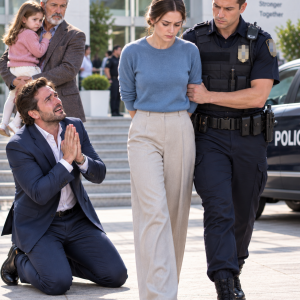
Marcus received the longest sentence after prosecutors proved that he created false vendors, altered contracts, and personally diverted funds. Howard and Lorraine faced charges involving elder abuse, financial exploitation, unlawful confinement, and misuse of trust authority.
Camille was prosecuted for conspiracy, fraud, abandonment of a dependent adult, and participation in the diversion of corporate assets.
At sentencing, she turned toward me.
“When this ends, I can still rebuild my life.”
“I hope you do,” I replied. “Begin by accepting responsibility instead of finding another person to carry it.”
She had expected hatred, but my calm response seemed to injure her more deeply.
Part 5: The Inheritance of Character

One year later, I stood inside the main operations office and watched refrigerated trucks leave the yard beneath the early California sun. Arthur’s first adjustable wrench rested inside a glass case on my desk.
He had formally retired, although he still visited every Wednesday to inspect equipment, question drivers, and criticize coffee.
On Saturdays, we worked together on an old pickup truck he had purchased decades earlier.
One afternoon, Arthur pointed toward a stubborn bolt.
“Tighten it firmly. Steel is not porcelain.”
“I do not want to damage the threads.”
“Fear damages more than pressure when given enough time.”
I tightened the bolt, and Arthur nodded.
“I once assumed my son would inherit this company, followed by my granddaughter. Instead, responsibility remained with the man who entered my locked room carrying soup rather than documents.”
“Sometimes I still feel like a warehouse supervisor sitting in an executive chair by mistake.”
“That feeling is called conscience. Incompetent people rarely question whether they deserve power.”
The company established an elder-care policy allowing employees paid leave to care for dependent relatives. We also created a confidential reporting program for financial exploitation and unsafe treatment of vulnerable adults.
I insisted on those reforms because abuse often survives behind respectable walls, family names, and locked doors that outsiders assume should remain private.
Arthur approved every proposal.
“A company should reveal what its leaders value when nobody is looking,” he said.
The divorce became final without further argument. Camille received no company ownership because the shares transferred to me after our separation and were protected through Arthur’s trust structure. Joint accounts were reviewed, and stolen funds were redirected toward restitution.
I kept no photographs from the marriage except one taken during our earliest years, when Camille still appeared kind and I had not yet learned how easily affection could become entitlement. I did not keep it because I wanted her back. I kept it as a reminder that deception often succeeds by first imitating something genuine.
The estate itself changed after the legal proceedings ended. The greenhouse was repaired, the locked room became a guest suite, and every outside latch was removed.
Arthur requested that the original metal bolt remain mounted inside the hallway.
“Why preserve it?” I asked.
“Because comfort makes people forget how quickly ordinary objects can become instruments of control.”
We placed a small plaque beneath it.
“No door protecting a vulnerable person should lock from the outside.”
Part 6: The Man Who Stayed
Two years after I found Arthur dehydrated behind the greenhouse, Caldwell Agricultural Transport expanded into Oregon and Arizona. Revenue increased, but Arthur remained more interested in employee retention, safety records, and whether drivers received proper rest.
One afternoon, a journalist interviewed us for an article about the company’s recovery. She asked Arthur why he transferred substantial ownership to someone outside his bloodline.
Arthur looked toward me before answering.
“Blood can explain where someone began. It cannot guarantee where loyalty, courage, or integrity will appear.”
The journalist asked whether his experiment had been cruel.
Arthur did not avoid the question.
“Yes. Remaining silent for so long carried risks, and I regret allowing the situation to endanger my health. However, I needed evidence because wealth attracts convincing performances.”
After the interview, he admitted privately that he wished he had trusted me sooner.
“You would have believed me,” he said.
“I would have listened.”
“That distinction is why I should have spoken.”
His admission mattered because it prevented the story from becoming a celebration of secrecy. Arthur had survived, but both of us understood that vulnerable people should never be required to create elaborate tests before receiving basic protection.
The company later partnered with an elder-law nonprofit to train employees and community members on warning signs of neglect, coercion, and financial exploitation.
During the first seminar, a driver approached me afterward and explained that his widowed father had recently changed bank accounts after pressure from a distant relative.
We connected him with legal assistance.
Several weeks later, he told me the intervention had prevented the loss of his father’s home.
That moment meant more to me than the ownership certificate framed in my office.
Part 7: The Door That Stayed Open

On the third anniversary of the arrests, Arthur and I sat on the porch overlooking the fields beyond the estate. He moved more slowly, but his mind remained sharp.
“Do you regret marrying Camille?” he asked.
I considered the question carefully.
“I regret ignoring contempt because I wanted the marriage to succeed. I do not regret learning what loyalty should look like.”
Arthur nodded.
“Pain becomes useful only after it stops choosing your future.”
The sun lowered behind the hills, and the trucks in the distant yard appeared as dark shapes moving toward the highway.
We were not related by blood, but the bond between us had been built through ordinary acts performed when no reward seemed possible: a bowl of soup, a clean blanket, a conversation with someone believed unable to answer.
My life did not improve because Arthur gave me shares or a title. It improved because the truth removed the people who had trained me to confuse exploitation with belonging.
I no longer worked to prove that I deserved a place within the Caldwell family. I worked because the company carried responsibilities toward drivers, customers, and communities that trusted us.
Before going inside, Arthur looked toward the greenhouse.
“You broke that latch with your bare hands.”
“I was afraid you were dying.”
“Most people would have called someone else and waited.”
“Waiting was not acceptable.”
He smiled.
“That answer still explains everything.”
We walked toward the house together, moving slowly because Arthur required the cane and because I had finally learned that progress did not need to be hurried to remain real.
The hallway behind the greenhouse was bright now. The former locked room stood open, filled with books, sunlight, and a wide chair beside the window.
The metal latch remained mounted on the wall as a warning.
Everyone else had fastened it from the outside and walked away.
I had returned, broken it open, and stepped inside without knowing there was anything to gain.
Arthur later taught me that family is not determined by who expects an inheritance when you die. Family is revealed by who still recognizes your humanity when they believe you have nothing left to offer.
From that day forward, no door in the Caldwell estate was ever locked from the outside again.
THE END