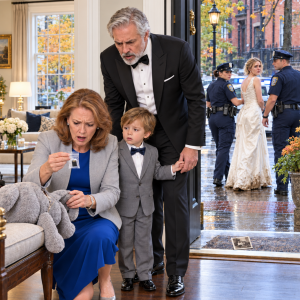
Adrian seized the report and searched desperately for language that could soften an absolute conclusion.
“Caroline paid someone to falsify this because she controls every financial institution involved.”
The laboratory representative indicated the official seals and collection record.
“All samples were witnessed, coded, and independently processed twice. Mr. Bennett’s genetic markers are incompatible with biological paternity.”
Vanessa attempted to leave, but Laura placed photographs, bank records, property documents, and investigative findings across the table. Derek was not her cousin; he was her longtime partner and Noah’s likely biological father.
Their plan began when Vanessa met Adrian at an agricultural technology conference. She quickly recognized his insecurity concerning infertility, his resentment toward his more capable wife, and his obsession with producing a male successor.
Vanessa claimed she became pregnant after their secret relationship began, knowing he would avoid testing because the pregnancy appeared to restore his wounded pride. Once Adrian began spending freely, she and Derek expanded their demands.
Leonard, the chief accountant, eventually surrendered emails showing that Adrian had ordered him to disguise payments as vendor expenses. He had also preserved messages from Derek threatening to expose the arrangement if the transfers stopped.
Adrian looked toward Vanessa with trembling disbelief.
“You used my son to steal from me.”
Her carefully cultivated softness vanished.
“He was never your son, Adrian. You deceived yourself because believing me allowed you to feel superior to Caroline. A confident man would have requested evidence, but you preferred purchasing an illusion that flattered you.”
Adrian rose abruptly, but courthouse security officers stepped between them before the confrontation became physical.
Margaret remained seated, clutching the silver cross.
“Then he is not my grandson?”
Vanessa gave a cold, exhausted laugh.
“You wanted a male heir so desperately that you accepted any baby placed in your arms. I merely understood how useful your obsession could become.”
Investigators detained Vanessa and Derek for questioning regarding financial fraud, fabricated documents, and movement of misappropriated funds. Noah was placed temporarily with a qualified maternal relative while child-welfare professionals evaluated permanent arrangements.
I felt no triumph while watching the family’s fantasy collapse. Noah had been used as leverage, Adrian had destroyed his marriage to protect his pride, and Margaret had transformed a child’s existence into proof of dynastic importance.
The laboratory had answered the narrow question of paternity, but the larger betrayal had already been established by their choices.
Part 4: What Silence Had Protected
Margaret experienced an acute emotional crisis after the disclosure and entered a private treatment facility. Some relatives expected me to visit immediately because I had once been her daughter-in-law.
I refused without cruelty.
For three years, she had treated my body like defective company property, repeated private speculation at public events, and presented my childlessness as a moral failure. Wishing for her recovery did not require returning to the position where she could harm me again.
Adrian’s authority collapsed rapidly. The independent audit confirmed that he had approved fraudulent contracts, concealed conflicts of interest, and diverted corporate resources for personal use. Authorities recovered the condominium, vehicle, jewelry, and several investment accounts purchased with misappropriated money.
During a settlement conference, Adrian appeared older and smaller than the confident executive who had ignored me at the celebration.
“I never intended to destroy the company,” he said. “I believed Vanessa loved me, and I thought Noah gave our family what you could not.”
“I offered fertility treatment, donor options, adoption, and a life that did not depend upon parenthood,” I replied. “You rejected every honest path because none allowed you to blame me while presenting yourself as powerful.”
He lowered his eyes toward the table.
“If I had defended you from my mother, perhaps none of this would have happened.”
“Defending me would have required admitting the truth, while betraying me allowed you to keep every advantage until the deception became expensive.”
The divorce proceeded efficiently because the financial documentation was extensive. I recovered my legal share of our marital property, while disputed assets remained subject to corporate restitution and criminal proceedings.
Bennett Agricultural Systems suffered immediate consequences. French suppliers suspended shipments, lenders threatened to reduce credit facilities, and several major customers delayed contracts. More than two hundred employees faced uncertainty because their chief executive officer had confused a family corporation with his private account.
The board asked me to return for thirty days and lead an emergency restructuring. I initially refused because repairing Adrian’s company felt dangerously similar to protecting him again.
Then employee representatives requested a meeting. Machine technicians, warehouse supervisors, administrative assistants, and plant workers described mortgages, medical insurance, and children depending upon stable paychecks.
Their livelihoods had not participated in Adrian’s deception.
I accepted the assignment under three written conditions: Adrian would be permanently removed from management, every financial record would undergo independent review, and employee salaries and benefits would receive priority over shareholder distributions.
Walter approved the conditions without negotiation.
“Are you returning to protect the Bennett name?” one director asked.
“I am returning to protect the people whose work gave that name value long before Adrian treated it as his inheritance.”
For the next month, I renegotiated bank covenants, contacted suppliers in fluent French, canceled unnecessary expansion plans, and recovered deposits connected to fraudulent contracts. Because the Toulouse partners knew me from years of negotiations, they agreed to resume limited shipments after receiving transparent audit reports.
On the final Friday of the restructuring period, payroll cleared completely and employee healthcare coverage remained uninterrupted. Leonard entered my office holding the confirmation report, with tears gathering behind his glasses.
“I should have reported Adrian when the first false invoice appeared. I kept telling myself that following the chief executive’s instructions protected my job.”
“Speaking late is still better than signing your name beneath a lie forever,” I answered. “However, accountability requires more than regret, so you will cooperate fully with every remaining investigation.”
He agreed and handed over the last encrypted archive Adrian had ordered him to delete.
Part 5: The Apology That Changed Nothing

During her treatment, Margaret sent me a handwritten letter. She admitted valuing an imaginary heir more than the woman who had stabilized both her son and the family business. She requested one meeting without attorneys or cameras.
I agreed because closure served my peace, although reconciliation was never part of the arrangement.
Margaret appeared fragile when I entered the facility’s quiet garden room. Her clothing remained elegant, but the authority that once filled every conversation had disappeared.
“I made you responsible for something you never caused,” she said. “I protected my son’s pride by attacking your dignity, and when Noah arrived, I treated you as though you had already been replaced.”
I listened without comforting her.
“You did not misunderstand a medical condition, Margaret. You repeatedly chose humiliation because it preserved the family story you preferred.”
Tears moved slowly across her face.
“Can you forgive me after everything I said?”
“I can release the anger because carrying it would keep me connected to you. Forgiveness does not restore trust, erase consequences, or require me to return.”
She asked whether I might someday resume a relationship with Adrian if he accepted responsibility. The question confirmed that even genuine remorse had not completely changed her instinct to preserve the family structure.
“Your son did not lose me because another woman deceived him,” I explained. “He lost me when he decided my loyalty was useful but my humanity was disposable.”
Before leaving, I wished her recovery and established that future communication must occur through counsel. She nodded, finally understanding that tears could express regret without purchasing access.
The divorce judgment became final several weeks later. Adrian faced criminal and civil proceedings connected to financial misconduct, while Vanessa and Derek were charged separately for their roles in the fraudulent transfers. I followed those cases only when my testimony or company records were required.
The board offered me Adrian’s former position as permanent chief executive officer. Financially, the promotion was attractive, and several directors argued that leading the recovered company would represent the perfect public victory.
I declined.