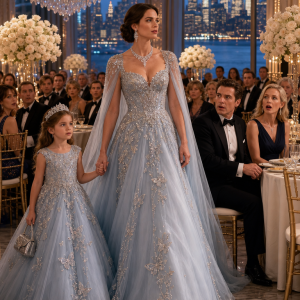
Olivia left.
Noah remained with Adrian.
I learned most of that through court filings rather than family gossip.
Then, one rainy afternoon after a speaking event at Lincoln Center, I saw Adrian waiting beneath the awning.
He looked thinner.
His suit was gone.
His shoes were worn.
He held a hospital folder against his chest.
“Rebecca, please listen to me for two minutes.”
I almost kept walking.
Then he said:
“Noah has congenital heart disease.”
I stopped.
Adrian opened the folder.
Doctors recommended surgery.
Insurance would cover much of the cost, but significant expenses remained, including specialized postoperative care.
He had exhausted his savings.
“I am not asking you to forgive me.”
His voice broke.
“I am asking you to help my son.”
The desperation in his face reminded me of myself during Margaret’s final year, calculating bills at two in the morning while somebody I loved slept in a hospital bed.
That recognition did not restore love for Adrian.
It created compassion for a child.
“I am not giving you money.”
His face collapsed.
“Rebecca—”
“Noah is your responsibility.”
I walked away.
Adrian believed that was the end of the conversation.
Fifteen minutes later, sitting inside a taxi, I called Natalie.
“Verify the medical records.”
She did.
The condition was real.
The surgery was necessary.
Through the hospital foundation, I anonymously covered the remaining qualified medical costs.
I required one condition.
My identity could not be disclosed to Adrian unless hospital accounting procedures made confidentiality impossible later.
I was not rescuing him.
I was protecting a child who had never chosen the adults surrounding him.
The surgery succeeded.
8. The Name on the Donor Form
Two months later, the hospital contacted me to complete final documentation connected to the charitable payment.
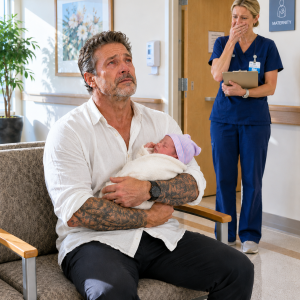
I was finishing the paperwork when Adrian entered the financial-services office carrying Noah in a small carrier.
A staff member handed him a copy of the completed assistance record.
My name remained on an internal line that should have been redacted from his version.
He saw it.
The paper slipped from his hand.
“You?”
I removed my glasses.
“The hospital verified the surgery was medically necessary.”
Adrian looked at Noah.
Then back at me.
“After everything I did, you still saved my son.”
“I helped a child.”
He began lowering himself as though he intended to kneel.
“Please do not.”
He stopped.
I continued.
“Do not turn compassion into a bridge back into my life.”
His eyes filled.
“I understand.”
“I hope you do.”
I looked toward Noah.
“Your son should never grow up believing his medical care created a debt to me. Raise him well. That is enough.”
For once, Adrian did not argue.
9. Margaret’s Real Inheritance

One year later, The Hours Between Morning received a national illustration award.
I used part of the royalties to expand Margaret House into a nonprofit program offering temporary workspaces, emergency grants, and creative services for unpaid family caregivers.
Another portion funded pediatric cardiac assistance through the same hospital network that treated Noah.
People occasionally asked whether helping Adrian’s son meant I had forgiven him.
I always answered carefully.
Forgiveness and access are separate decisions.
Humanity does not require reconciliation.
Adrian continued living in a modest rental apartment while raising Noah and repaying debt. I never returned to the marriage, and we never became friends.
Margaret’s house eventually became busier than it had been while she was alive.
Caregivers arrived carrying laptops, insurance folders, medication schedules, and exhaustion.
Some cried in the kitchen.
Some worked quietly.
Some simply slept for an hour while a volunteer watched their family member nearby.
I kept Margaret’s old coffee cup on a shelf in my studio.
Not because the house belonged to me now.
Because she taught me something more important than property ownership.
Family is not always the person who inherits your name.
Sometimes family is the person who stays after staying becomes difficult.
One afternoon, I found the last note Margaret had written before her handwriting became too weak.
It said:
Rebecca keeps giving pieces of herself away because she believes love means never counting the cost. I hope someday she learns that love should not require disappearing.
I sat beside the window for a long time after reading it.
Three years earlier, I believed loyalty meant sacrificing until nothing remained.
Adrian believed generosity made me easy to exploit.
Olivia believed money guaranteed safety.
We had all misunderstood something.
Kindness without boundaries becomes depletion.
Loyalty without reciprocity becomes abandonment of the self.
Forgiveness without accountability becomes permission.
I never regretted caring for Margaret.
I never regretted helping Noah.
Those choices reflected the person I wanted to remain.
What changed was my understanding that compassion could exist without reopening a door.
I could help an innocent child without rescuing the father who betrayed me.
I could honor Margaret without carrying responsibility for the son who abandoned her.
I could forgive parts of the past without inviting them back into my future.
The house in Queens was not Margaret’s greatest gift.
Neither was the will.
Her real inheritance was the lesson she left inside those final pages.
Love is proven by who stays.
Self-respect is proven by knowing when to leave.
THE END