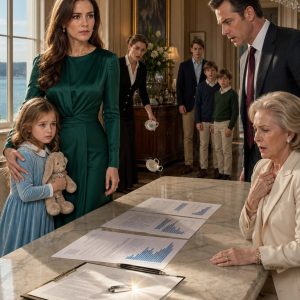
“Why is Whitmore-Cole still active?”
Adrian shifted.
“It technically never dissolved.”
Jordan continued.
“Meredith owns fifty-one percent. Adrian owns forty-nine.”
I looked at Adrian.
For the first time that morning, he appeared genuinely nervous.
“You told me all of my business interests were resolved during the divorce.”
“I believed they were.”
“Whitmore-Cole was never listed separately.”
“Then your divorce attorney should have raised it.”
“My attorney was never told it still held active intellectual property.”
Camille looked at Adrian.
“You told me she transferred everything.”
His expression hardened.
“This is not the place.”
I almost laughed.
“Actually, a financing meeting where your valuation depends on those patents seems exactly like the place.”
Jordan explained the consequences. If Whitmore-Cole still controlled licensing rights, the capitalization table, lender collateral package, and company valuation might all require correction.
Adrian rubbed his forehead.
“We can fix this.”
“Maybe.”
He asked for forty-eight hours.
Camille quietly said:
“He does not need forty-eight hours.”
Adrian slowly turned toward her.
PART 5 – THE ENVELOPE CAMILLE REFUSED TO DESTROY

Camille opened her portfolio and removed a yellowed envelope.
Adrian’s face changed instantly.
“Camille, do not.”
She placed it on the table.
“I found this six months ago when legal archives were reorganized.”
“That document is obsolete.”
“Then why did you tell me to destroy it?”
The room became very quiet.
My name was handwritten across the front.
Inside was a technology-licensing agreement dated almost five years earlier, roughly one year before Sophie was born.
The signature looked like mine.
I did not remember signing it.
The agreement did not permanently transfer my forecasting algorithms to Cole Dynamics. It granted conditional licensing while I remained an active strategic adviser.
If I stopped participating without separately assigning ownership, the technology reverted to Whitmore-Cole Systems.
I looked up.
“I stopped working with Cole Dynamics before Sophie was born.”
Adrian answered carefully.
“Not officially.”
“Explain that.”
“You remained listed as an adviser.”
“For how long?”
He looked down.
“Until the divorce.”
Understanding arrived slowly.
“You kept my name attached because the license required it.”
“We were raising capital. Changing the IP structure would have complicated financing.”
Camille spoke again.
“He tried to complete the transfer last year.”
Adrian looked furious.
“Stop helping.”
“I am not helping you.”
She explained that one attorney refused to finalize the transfer because both owners of Whitmore-Cole had to approve it independently.
That attorney was Evelyn Hart.
I remembered her immediately.
She had worked on an early financing round and repeatedly asked whether I understood documents Adrian placed in front of me.
At the time, I found her irritating.
Now I understood why.
“Where is she?”
Adrian said he did not know.
Camille answered:
“I do.”
She had found Evelyn three months earlier.
More importantly, Evelyn had been trying to locate me for nearly two years.
PART 6 – THE LETTER THAT NEVER REACHED ME
Camille removed a second envelope.
This one remained sealed.
My name was typed across the front.
“Evelyn sent this to Cole Dynamics last winter because the company remained a forwarding address on several old records.”
I stared at her.
“You kept a letter addressed to me for six months?”
Her gaze lowered.
“Yes.”
“Why?”
“Because I was afraid contacting you would make everything worse.”
Adrian muttered:
“Unbelievable.”
Camille turned toward him.
“You do not get to say that.”
Her voice remained calm.
“For years, I accepted your version of every story. You told me Meredith abandoned the company because motherhood mattered more than work. You told me the marriage was finished before I entered it. You said she wanted money and threatened the business.”
I looked at Adrian.
He looked at the table.
Camille continued.
“I believed you until the records stopped matching the story.”
There was no satisfaction in hearing it.
Camille had still entered my marriage.
She had still stood beside Adrian while I recovered from surgery with a newborn.
Being deceived did not erase her choices.
It simply made the truth more complicated.
She pushed the letter toward me.
“I am sorry.”
I studied her.
For years, I imagined how I might respond if she ever apologized.
Reality offered no satisfying speech.
“I do not know what to do with that apology yet.”
She nodded.
“That is fair.”
Then she added one more fact.
She and Adrian had ended their relationship eight months earlier.
She remained at Cole Dynamics because more than four hundred employees still depended on the company.
That answer sounded painfully familiar.
I had once stayed because I believed leaving meant abandoning everyone else.
PART 7 – THE TRUST FOR A CHILD HE ABANDONED

I suspended the investment review until ownership could be clarified.
Then I opened Evelyn’s letter privately in my office.
The first page stated that she believed I had not received complete information during my divorce.
She retained copies of early corporate records because several disclosures during Cole Dynamics’ second financing round had never been completed correctly.
My ownership interest in Whitmore-Cole might therefore remain substantial.
Then one sentence changed everything.
There is also a separate irrevocable trust associated with your daughter’s beneficial interest in Whitmore-Cole Systems that I believe you may not know exists.
Sophie.
My three-year-old daughter.
The attached notarized amendment was dated one month before her birth.
Adrian had transferred twenty percent of his own Whitmore-Cole interest into an irrevocable trust.
Beneficiary: Sophie Grace Cole.
I read it three times.
The man who later called our daughter an expense had created a protected asset for her before she was born.
My phone rang.
Helen’s voice came through.
“Someone downstairs is requesting to see you.”
“Who?”
“Evelyn Hart.”
Five minutes later, the attorney from my old life entered my office carrying a canvas bag instead of a briefcase.
I held up the trust document.
“Why would Adrian create this?”
Her expression changed.
“You did not know?”
“No.”
She sat down.
“It was his idea.”
Six weeks before Sophie’s birth, Adrian visited Evelyn alone.
He asked how to place an asset beyond the reach of investors, creditors, and even himself.
“Why?”
Evelyn looked toward the window.
“He said he wanted his daughter to possess one thing nobody could use as leverage.”
I almost became angry because the statement seemed incompatible with the man I remembered from the hospital.
Evelyn did not defend him.
“I can explain documents, Meredith. I cannot explain the person who signed them.”
That distinction mattered.
PART 8 – THE CALL I HAD FORGOTTEN
Evelyn showed me another file.
During my seventh month of pregnancy, I had called her myself.
I remembered none of it clearly until she described the conversation.
I had been worried Cole Dynamics was becoming too dependent on Adrian’s decisions and wanted to know whether my intellectual property could be preserved for my unborn child.
A memory returned gradually.
Rain across a windshield.
My hand on my stomach.