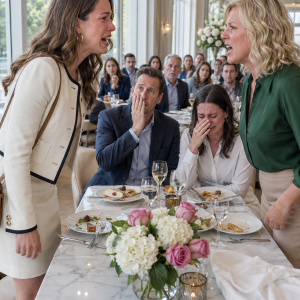
I did not thank him.
Ending an affair was not a gift to his wife.
It was the minimum honesty he had postponed for almost a year.
Part 6 – What His Father Wanted Him to Hear
Nora’s house stood two blocks from the Washington coast and looked wonderfully ordinary, with mismatched coffee mugs, books along every wall, and family photographs displayed without any effort to create an impressive history.
One photograph showed Thomas and Samuel standing together as young men beside their first machine.
Another showed the original brass company plaque.
CALDWELL BROTHERS PRECISION.
THOMAS CALDWELL — SAMUEL CALDWELL.
Matthew held it carefully.
“Our company website says my father founded Caldwell Precision by himself.”
Nora nodded.
“That is the story your grandfather preferred after Samuel left.”
“And Dad allowed it.”
“Because correcting his father would have required admitting that both brothers contributed to destroying their relationship.”
Nora played an old recording Thomas had made for Samuel near the end of his life.
His voice sounded older than I remembered.
“I let people believe I built everything because correcting them became harder every year. Eventually everyone believed me, and that was the moment I finally understood what winning had cost.”
Matthew closed his eyes.
Thomas admitted that he and Samuel had allowed pride to turn every disagreement into an accounting exercise where somebody had to leave owing the other an apology.
Then he added one line intended specifically for his son.
“If Matthew ever hears this, tell him I hope he learns earlier than I did that being right and being alone can begin to feel dangerously similar.”
Matthew did not speak for several minutes.
Nora then gave him another sealed letter written by Thomas.
It warned him that maintaining the appearance of success could become an addiction more expensive than failure.
Thomas had watched Matthew borrow money to impress investors, agree to obligations because he enjoyed being admired for generosity, and conceal financial weakness rather than admit he needed to slow down.
“None of those things make you a bad man,” Thomas had written. “But they can make you a lonely one if you continue building the appearance of a life instead of the life itself.”
I thought about Brooke.
She had known the successful Matthew.
The relaxed Matthew.
The generous businessman visiting resorts between important deals.
I had known the frightened man beneath that performance, which perhaps explained why he had escaped toward someone who could admire a version of him that required no explanation.
On our drive home, Matthew asked the question I knew was coming.
“Are you leaving me?”
“I do not know.”
He nodded.
“Does not knowing frighten you?”
“Less than staying simply because twenty-three years makes leaving frightening.”
He looked ahead.
“What do you need from me?”
I considered the answer carefully.
“The truth, even when the truth makes staying less likely.”
“And if telling you everything destroys our marriage?”
“Then at least I will know which marriage I am actually deciding whether to leave.”
For once, Matthew did not negotiate.
“All right.”
That was the first promise from him I believed, not because trust had magically returned, but because he looked frightened by the cost and agreed anyway.
Part 7 – The Door Margaret Left Open

The next morning, I woke to the smell of badly made coffee.
Matthew stood beside the machine surrounded by spilled grounds and two empty mugs.
For twenty-three years, I had prepared his coffee because I knew exactly how he liked it.
“Move over,” I said instinctively.
He shook his head.
“No, because apparently I have outsourced knowing how my own kitchen works for most of our marriage.”
I almost laughed.
It was not forgiveness.
It was only coffee.
That distinction mattered.
Later, Arthur called with one final detail concerning the trust.
Margaret had created a path allowing Matthew to apply for a future advisory role, initially without administrative authority. He would need full financial transparency, no undisclosed debts, independent fiduciary training, and at least twelve months of demonstrably consistent judgment.
Then Arthur explained the final condition.
The current trustees would have to approve.
I was one of them.
Matthew looked at me.
“So you have to decide whether I have changed.”
“No. I have to evaluate whether your decisions meet the trust requirements. You are not a project Margaret left for me to repair.”
Something like relief crossed his face.
“She really did make sure nobody could save me again.”
“Including me.”
He nodded.
That afternoon, I returned alone to the house Matthew and I shared.
For years, I had unconsciously called it Matthew’s house even though my name appeared on the mortgage and I had chosen nearly everything that made the rooms feel like home.
I stood inside our bedroom without packing.
I was not ready to choose divorce.
I was equally unwilling to promise reconciliation.
The silver key rested in my palm.
At first, I believed Margaret had given me power over Matthew.
Then I believed she had given me the truth about him.
Only now did I understand that she had given me something more useful.
Permission.
Permission to stop arranging my life around someone else’s avoidance.
Permission to love Matthew without protecting him from consequences.
Permission to let twenty-three years mean something without allowing those years to dictate what happened in the twenty-fourth.
That evening, Nora called.
Her voice sounded uneasy.
“Laura, I found something after you left.”
I sat on the edge of the bed.
“What did you find?”
“The wooden box had a second compartment underneath the lining.”
My stomach tightened.
“Another letter?”
“Yes, but it is not for Matthew.”
I looked toward the silver key on my dresser.
“Who is it for?”
Nora hesitated.
“You.”
For several seconds, I stopped breathing.
Thomas Caldwell had died twelve years earlier, and I had always believed my father-in-law barely noticed me beyond holidays, polite conversations, and the occasional question about Margaret’s health.
“When did he write it?”
Nora read the date aloud.
I knew that date immediately.
It was the day before Thomas unexpectedly asked me to drive him alone to a specialist appointment in Portland, a trip I had never mentioned to Matthew because Thomas made me promise not to discuss what happened there.
For twelve years, I believed that promise had died with him.
Apparently, Thomas had known otherwise.
“Do you want me to open the letter?” Nora asked.
I looked around the bedroom, at Matthew’s clothes beside mine and at the life I had spent decades helping other people keep orderly.
Then I answered differently than the woman I had been before Margaret pressed a silver key into my hand.
“No. I am coming to read it myself.”
For once, I would not wait for somebody else to decide when I was ready for the truth.
THE END