PART 1 — The Last Empty Chair
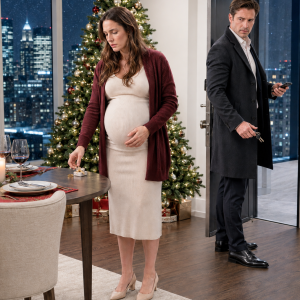
At 8:42 on Christmas Eve, thirty-one-weeks-pregnant Madeline Avery watched her husband fasten a charcoal overcoat while the dinner she had prepared cooled beneath the lights of their Boston penthouse. Snow drifted across Back Bay, softening the streets below their windows, while an eight-foot Christmas tree illuminated two place settings and a small wrapped ornament engraved with the words “Baby’s First Christmas.”
Madeline had spent eight years married to Grant Ashford, the celebrated CEO of Ashford Heritage Hotels, a family-owned hospitality company managing luxury properties throughout New England. She had once admired his ability to remain composed during emergencies, although that same control had gradually become a wall separating him from every uncomfortable conversation.
“The Providence property has lost power across an entire guest wing,” Grant explained while checking his phone. “The backup system failed, and I need to supervise the relocation personally.”
Madeline studied his expression, recognizing the unnecessary precision he added whenever he wanted a lie to sound professionally unavoidable.
“Your regional director cannot manage a power outage without the company CEO driving through a snowstorm?” she asked.
“Investors judge leadership by how executives behave during a crisis,” Grant replied. “I cannot spend Christmas dinner pretending nothing is happening while hundreds of guests are waiting for answers.”
Three hours earlier, Grant had left his laptop open on the kitchen counter while taking a shower. A message appeared from a woman named Olivia Dane, the creative director overseeing renovations at several Ashford hotels.
“Dinner is ready, the fireplace is burning, and I moved your presents into the guest room in case you stay tomorrow.”
Madeline had photographed the notification but resisted opening the remaining correspondence. She no longer needed months of messages to validate what missed prenatal appointments, unfamiliar perfume, and unexplained overnight meetings had already revealed.
Grant reached for his car keys without acknowledging the carefully arranged table or the gift beneath the tree.
“You should sleep instead of waiting, because the baby needs you rested,” he said.
The false concern finally broke through Madeline’s hesitation. “Go spend Christmas with Olivia, since she has apparently prepared everything you wanted.”
Grant remained motionless before turning with carefully manufactured confusion. “Olivia is coordinating emergency contractors, and your hormones are transforming an ordinary message into something inappropriate.”
Madeline felt grief harden into clarity. He had not apologized, asked what she had seen, or attempted to reassure her truthfully. Instead, he used her pregnancy to question her judgment.
“Pregnancy has changed my body, but it has not damaged my ability to read complete sentences,” she answered.
Grant stepped toward her, lowering his voice as though calmness could make deception respectable. “We can discuss your insecurity tomorrow, although I will not participate in an emotional performance tonight.”
Madeline removed her wedding ring and placed it beside the ornament intended for their unborn daughter. “If you leave through that door, you should not expect to find the same marriage when you return.”
For several seconds, she hoped that eight years together might overcome whatever waited at Olivia’s home. Grant looked from the ring to his telephone, then opened the penthouse door without another word.
After the elevator descended, Madeline sat beside the tree with one hand against her stomach. She allowed herself to cry, although the baby’s steady movement reminded her that she could not remain inside shock indefinitely.
She went into Grant’s private study to locate her passport, medical records, and copies of their insurance documents. While opening a lower cabinet, she discovered an antique leather portfolio that had belonged to Grant’s deceased father, Harrison Ashford. Grant had brought several boxes from Harrison’s estate into the penthouse six months earlier but refused to discuss their contents.
Inside the portfolio lay a silver fountain pen, a numbered key issued by a private document vault, and an envelope addressed in Harrison’s handwriting.
“To Madeline, if Grant refuses to correct what I allowed.”
Madeline unfolded the letter and found an apology written during the final months of Harrison’s life. He admitted that fear of scandal had kept him from publicly recognizing his first child, a daughter named Rebecca Lane. Harrison claimed that Grant knew the truth, possessed instructions concerning Rebecca’s inheritance, and had repeatedly delayed implementing them.
The letter included an address for a small bookstore in Portsmouth, New Hampshire, along with a warning that company money had been used to silence someone who never accepted it.
Madeline read the final sentence twice.
“Rebecca must not disappear merely because my son finds her existence financially inconvenient.”
By four o’clock Christmas morning, Madeline had arranged a professional car, packed her maternity bag, and sent copies of the letter to a secure account. When she left the penthouse, she was no longer escaping Grant’s affair. She was following evidence that suggested his betrayal extended far beyond their marriage.
PART 2 — The Woman Behind the Bookshop Counter
Grant returned shortly after six o’clock expecting an argument he believed he could control. Instead, he found the Christmas lights glowing above an untouched dinner, Madeline’s ring beside the tree, and an absence that made the penthouse feel unfamiliar.
Her winter coat, prenatal vitamins, medical folder, and hospital bag were missing. When repeated calls went directly to voicemail, irritation gave way to panic because Madeline was heavily pregnant and the roads remained dangerous.
The building concierge confirmed that a professional driver had collected her before dawn, but privacy rules prevented him from revealing the destination.
Grant entered his study and immediately noticed the open cabinet. Harrison’s leather portfolio remained on the desk, although the fountain pen, vault key, and letter had disappeared.
He called the corporation’s general counsel, Martin Cole, before removing his overcoat.
“Tell me whether my father ever documented a relationship with someone named Rebecca Lane,” Grant demanded.
Martin’s silence lasted long enough to confirm that the name carried legal consequences.
“Why are you asking about Rebecca on Christmas morning?” the attorney replied.
“Because Madeline found my father’s portfolio, and she has apparently gone searching for her.”
More than sixty miles away, Madeline arrived in Portsmouth as morning light appeared over the harbor. The address led to Lantern House Books, an independent bookstore with a café occupying the ground floor of a restored brick building. A handwritten sign promised free coffee and warm pastries to anyone spending Christmas alone.
Behind the counter stood a dark-haired woman with silver strands near her temples. She appeared approximately sixty and wore a forest-green cardigan over a simple cream blouse.
“You must be freezing after traveling in this weather,” the woman said. “Please sit near the radiator while I make some tea.”
Madeline hesitated before asking, “Are you Rebecca Lane?”
The woman’s welcoming expression changed immediately. “Most people call me Becca, although that is my legal name.”
Madeline placed Harrison’s fountain pen upon the counter. Rebecca covered her mouth before carefully lifting it with both hands.
“I bought this for Harrison with my first bookstore paycheck,” she whispered. “He promised that he would use it when he finally wrote my name into the family records.”
Madeline introduced herself and explained that Harrison’s letter had directed her there. Rebecca closed the café for an hour, then led Madeline upstairs to a modest office filled with books, invoices, and framed photographs.
“Harrison Ashford was my biological father,” Rebecca explained. “My mother worked at his first hotel before he married Grant’s mother, and he remained involved privately throughout my childhood without ever acknowledging me publicly.”
Harrison had paid educational expenses and visited occasionally, but he introduced himself as a family friend whenever other people were present. Rebecca never demanded ownership of the hotel company, although she wanted written recognition before his death.
Several years earlier, Harrison began preparing amendments to the Ashford family trust. The proposal granted Rebecca a modest minority interest, established scholarships for hotel employees, and formally recorded her as his daughter.
Grant learned about the amendment while Harrison was experiencing the early stages of vascular dementia. Rather than honoring his father’s instructions, Grant sent corporate attorneys to Rebecca with a nondisclosure agreement and an offer of six hundred thousand dollars.