That evening, he stared at my number on his phone.
He did not call.
For the first time, Andrew understood that becoming sorry did not automatically entitle him to regain the woman he had hurt.
Sometimes remorse meant changing even when nobody rewarded you for it.
Evelyn’s adjustment took longer.
Eventually she accepted an administrative position at a neighborhood bakery and sold much of her designer jewelry and handbags to settle personal debts.
One rainy morning, an older woman wearing dark glasses entered the bakery carrying a white cane.
Evelyn froze.
“Excuse me,” the woman asked politely, “could you tell me where the ordering counter is?”
Evelyn slowly walked around the display case.
“About ten feet ahead and slightly to your right. If you’d like, I can walk beside you.”
The woman smiled.
“Thank you. That would be very kind.”
Evelyn gently guided her toward the counter.
Then she went into the employee restroom and cried.
Not because the woman was Eleanor.
She was a complete stranger.
That was why Evelyn cried.
For the first time, she understood that a blind woman did not need to be married to a billionaire to deserve ordinary human consideration.
Part 6 — My Mother’s Piano
Meanwhile, I resigned from the marketing company and joined the Beacon Independence Center full time.
Dad offered to fund an executive role for me.
I declined.
“I want to earn my place here from the beginning.”
I organized employment workshops, developed partnerships with local companies, and accompanied visually impaired adults to interviews when they requested support.
I also spent time with Maya, the pianist whose music had stopped Mother in the hallway.
One Saturday, Maya handed me several sheets of Braille music.
“These are for your mother.”
I ran my fingers over the raised dots.
“Do you honestly think she could play again?”
Maya smiled.
“She did not lose music when she lost her sight. She only needs another way to reach it.”
That evening, I opened the piano in my parents’ living room.
The cover had remained closed for almost three years.
Mother heard the mechanism.
“Lauren, please don’t.”
I sat beside her.
“Just five minutes.”
She resisted until her voice finally broke.
“Whenever I think about that piano, I remember the day my vision disappeared. I kept believing doctors would fix everything and I would eventually return to normal.”
I put one arm around her.
I did not promise a miracle.
“Then don’t play like the woman you were before.”
Mother turned toward me.
“Play like the woman you are now.”
Eventually, her fingers reached for the keys.
She missed middle C.
Then she laughed softly.
“I haven’t done this in years.”
“We have the entire evening.”
Fifteen minutes later, a fragile melody moved through the room.
My father stood silently in the hallway wiping his eyes.
Three months later, Mother performed a piano duet with Maya at a charity concert benefiting assistive-technology grants.
The performance was imperfect.
It was also extraordinary.
When the final notes faded, the audience stood and applauded.
Mother could not see them.
She could hear everything.
She smiled more brightly than I had seen since before her illness.
Part 7 — Forgiveness Without Returning

Exactly one year after the engagement dinner, a handwritten letter arrived at the Beacon Center.
Andrew had written it.
He did not ask to see me.
He did not ask for another chance.
He wrote that he once believed loving someone meant feeling strongly about them, but he now understood that love also meant standing beside someone when doing so became uncomfortable.
At the restaurant, he had consciously chosen to remain seated.
That decision, he wrote, would remain one of his greatest regrets.
I read the letter twice.
Then I folded it and placed it inside my desk.
That evening, I visited my parents.
Mother was playing piano when I entered.
She stopped briefly.
“Your voice sounds lighter today. Did something happen?”
“Andrew wrote to me.”
Dad emerged from the kitchen carrying coffee cups.
“What does he want now?”
I smiled.
“Nothing. He only apologized.”
Mother reached for my hand.
“Have you forgiven him?”
I thought carefully.
“I think I have.”
She tilted her head.
“Would you go back?”
“No.”
Mother smiled.
“Then you have learned something important.”
“What?”
“Forgiving someone does not mean giving them another key to your door.”
Dad placed the coffee on the table.
“I may have that engraved above the entrance to the center.”
We laughed.
Mother returned to the piano.
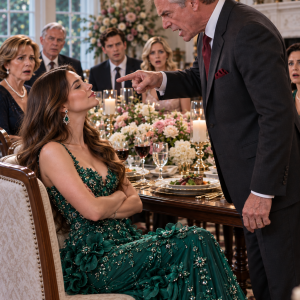
For a long time, I had considered that engagement dinner the evening when my future collapsed.
Now I understood that it was the evening when I escaped the wrong future.
I lost a diamond ring, but I learned who Andrew became when choosing between principle and comfort.
Evelyn revealed her character when she believed she was dealing with powerless people.
Robert discovered that wealth supported by favors and appearances could disappear rapidly.
Andrew learned that silence in the presence of cruelty was not neutrality.
And my mother, the only person at that table who could not physically see anyone, had understood everyone more clearly than the rest of us.
Real dignity was never contained in luxury restaurants, designer jewelry, prestigious surnames, or enormous houses.
It lived in the woman who had wine thrown across her face and still walked away without becoming cruel herself.
It lived in the man who possessed enough power to destroy another family but chose instead to enforce only the legal standards that had already existed.
It lived in the people who learned humility after privilege disappeared.
Most importantly, it lived in the ability to recognize another person’s humanity before knowing what they owned, who they knew, or what they could someday do for you.
Money could buy a beautiful table.
It could buy an enormous home.
It could even buy entry into rooms where everyone appeared important.
It could never purchase character.
And it could never substitute for basic human kindness.
THE END