The series received national attention.
I disliked it when strangers called me heroic.
I had entered that house with training.
Legal preparation.
Emergency communication plans.
A newsroom monitoring my safety.
Federal authorities ready to intervene once the evidence became strong enough.
Teresa, June, and Sofia had survived without those protections.
They were the courageous ones.
One afternoon, Martin stopped near my desk.
He looked at the stained kitchen rag now preserved inside a glass case.
It still carried the discoloration from the wine Marissa poured over me.
“Why did you keep that?”
I looked at it.
“Because powerful people often mistake silence for weakness when that silence benefits them.”
Martin nodded.
Then he asked another question.
“What does it remind you about money?”
I studied the frayed fabric.
“Money can buy a mansion in Newport.”
I continued.
“It can buy a ballroom, an enormous necklace, expensive wine, and a hundred guests willing to laugh at another person’s humiliation.”
I looked toward him.
“It cannot buy the right to turn someone’s dignity into entertainment.”
The assignment also changed how I understood investigative work.
Before entering the estate, I assumed the greatest danger would involve photographing documents without being discovered.
Afterward, I realized the deeper difficulty was watching vulnerable women suffer while being unable to immediately reveal who I was.
Whenever Marissa shouted at Teresa, I wanted to intervene.
Whenever Gregory discussed money, I wanted to expose the entire operation.
When June cried after losing another paycheck, I wanted to end the assignment that night.
But moving too soon could have allowed the Caldwells to destroy evidence.
Relocate workers.
Close shell companies.
Or disappear behind attorneys and money.
That hidden camera button became a promise.
Patience was not the same thing as passivity.
Eventually, patience would become protection.
Part 7: When the Evidence Reached a Courtroom

At the federal trial, attorneys for Marissa and Gregory argued that every worker entered employment voluntarily.
They claimed the debts were legitimate placement expenses.
Prosecutors answered with confiscated passports.
False wage statements.
Recorded threats.
Employment documents.
And written instructions demonstrating what happened whenever workers attempted to leave.
Marissa testified that she had never intended to harm anybody.
Then prosecutors played the recording from the hallway.
Her own voice filled the courtroom.
“Other women have tried acting clever with me, and later nobody could find them anywhere.”
The room became completely silent.
There were no designer gowns surrounding the statement.
No charitable speeches.
No society reputation.
Only her voice.
Gregory attempted to separate himself from Harbor Crest.
He argued that he had merely processed financial transactions for a company associated with his wife.
Financial investigators followed the money.
Placement fees moved into hedge-fund accounts.
Then into offshore trusts.
Then into shell entities Gregory personally controlled.
His emails showed that he understood how the system operated.
He approved payment structures.
He discussed workers as financial assets.
The jury eventually convicted both defendants on multiple federal charges.
Marissa received a lengthy prison sentence for offenses involving trafficking, forced labor, unlawful confinement, and intimidation.
Gregory received a separate sentence involving trafficking conspiracy, money laundering, and financial facilitation.
The court ordered forfeiture of their Newport estate.
Vehicles.
Jewelry.
Offshore accounts.
Other seized assets entered a victim-compensation program intended to restore wages and provide support to the women exploited through the network.
Sofia testified for two days.
Teresa spent one afternoon on the witness stand.
June submitted a written victim statement because facing Marissa inside the courtroom remained too emotionally painful.
I testified about my undercover identity.
The button camera.
The office records.
The locked bedroom.
And the conversations during afternoon tea.
Marissa’s attorney asked whether entering the estate under a false identity had provoked her conduct.
I answered carefully.
“I used an assumed employment identity because I was investigating allegations of forced labor.”
I looked toward the jury.
“I did not invent the debts, confiscate passports, lock women inside rooms, threaten them, or create the decision to treat human beings like property.”
The evidence spoke for itself.
When the verdicts were announced, Marissa stared directly at me.
Her expression contained fury.
Disbelief.
And finally, the realization that money could no longer purchase a more convenient version of what had happened.
Part 8: Newport After the Caldwells
Months after the trial, I returned to Newport.
This time, there was no hidden camera.
No fake employment history.
No servant uniform.
The Caldwell estate had changed completely.
Federal authorities had repurposed the property as a temporary recovery center for trafficking survivors waiting for stable housing or employment placement.
The crystal chandeliers remained inside the ballroom.
The champagne towers were gone.
On the marble terrace, folding tables had replaced Marissa’s elegant entertaining arrangements.
Counselors sat with women and helped them understand legal documents.
Open bank accounts.
Apply for jobs.
Recover identification records.
Teresa stood near the kitchen doorway.
She wore a bright blue blouse she had purchased with her own money.
June helped a newly arrived survivor complete an application.
Sofia spoke with a social worker near the garden.
Nobody called anyone “the help.”
A plaque stood on the terrace.
It explained that the property had been seized through a federal trafficking prosecution and repurposed to support victims.
Beneath the formal language was one sentence.
No person’s freedom may be treated as a luxury service.
Martin joined me beside the plaque.
After several moments, he asked a question.
“Do you ever wonder what would have happened if Marissa had never invited you to the birthday gala?”
I smiled slightly.
“I would have kept recording until we had enough evidence.”
I looked toward the old ballroom.
“But I suspect she would eventually have exposed herself some other way.”
Martin raised an eyebrow.
“You sound certain.”
“People who believe wealth makes them untouchable eventually become careless.”
I watched survivors moving across the terrace.
“They start speaking as though everyone around them is deaf, invisible, or too powerless to remember.”
The stained kitchen rag remained inside a small case beside my newsroom desk.
But I no longer needed to look at it every morning.
Its meaning had changed.
At first, it represented humiliation.
Eventually, it became evidence of transformation.
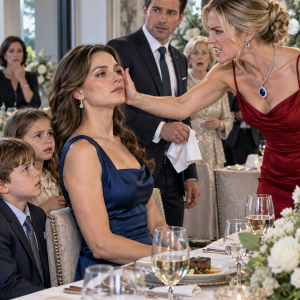
Marissa wanted to display my degradation at her birthday celebration because she believed humiliating poor women demonstrated control.
Instead, her gala displayed something else.
The fear beneath her authority.
The hidden records.
The women she thought could never return.
And the collapse of a household built on exploitation.
Gregory believed financial sophistication would hide the money.
His financial records became the map that investigators followed to the shell companies, properties, and accomplices.
Many gala guests believed designer clothes and charitable donations automatically made them respectable.
Photographs from the event later became evidence of how easily privilege could stand beside cruelty without questioning it.
I returned to investigative journalism with a different understanding of what happened after exposure.
Publishing an article was not the end.
Neither was making an arrest.
Justice also meant helping survivors recover wages.
Documents.
Housing.
Education.
Financial independence.
And the ability to make ordinary choices without fear.
The Caldwell network attempted to reduce women to debts, placement fees, employment contracts, and household roles.
Its collapse restored something no criminal sentence could completely measure.
The right of those women to speak their own names without asking another person for permission.
I had entered the Caldwell estate as a servant named Harper.
Outside those walls, I was Harper Vale, investigative journalist.
Marissa believed a uniform defined who I was.
The uniform had only hidden the person who was observing her.
When I left Newport that evening, the estate looked nothing like the place where women had once been threatened behind locked doors.
Light filled the windows.
Counselors walked freely across the property.
Survivors passed through the entrance without lowering their eyes.
The Caldwells had purchased silence for years.
They could not purchase permanence.
Their money built the mansion.
Their cruelty filled its rooms.
And ultimately, their own words opened its doors to justice.
THE END