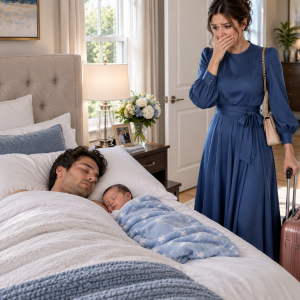
The house revealed something before we opened any document.
The twins’ clothes remained neatly folded inside drawers. Their toothbrushes were still in the bathroom cup, and their winter boots stood beside the back door.
Melissa had packed only for herself.
A drawing remained attached to the refrigerator. Four stick figures stood beneath a blue sun, while one figure had wings.
Underneath, Sophie had written in uneven letters, Dad is in heaven.
Lucas eventually called from the basement.
Beneath a workbench covered with aircraft manuals sat an ordinary cardboard box sealed with gray tape.
Across the top, Michael had written:
FOR SOPHIE AND CALEB.
Inside were letters, photographs, two wrapped presents, a USB drive, and an old silver eagle insignia.
Lucas handed it to me.
A scratch crossed the left wing.
I remembered immediately.
During that deployment, I had given Michael a spare colonel insignia after he joked that anybody taking orders from a colonel deserved a souvenir.
I had forgotten.
Michael had not.
Beneath it was a letter addressed to me.
Michael wrote that if I ever received those pages, his children were probably in danger. He apologized for involving someone he barely knew, but reminded me of something I once told him: good people build bridges before the flood arrives.
He had tried to build one.
He described Melissa as someone who rarely appeared openly cruel. She smiled around other people, kept records carefully, and could make questionable decisions sound perfectly reasonable. However, as Michael became sicker, he grew increasingly worried about her impatience with children who were not biologically hers and her interest in the money intended for them.
There was a trust.
Melissa knew only part of it.
Michael had hidden the remaining trail.
His final requests were painfully simple.
Keep my children together.
Tell them I wanted more time.
Find the red bird.
Among the photographs was one showing Michael beside a restored red biplane at the Cascade Aviation Museum, where he had volunteered before becoming too sick to continue.
We decided to go there the following morning.
Part 4 – The Man Michael Chose
Before visiting the museum, I returned to Rosa’s house exactly as promised.
Sophie ran toward me when I entered, then stopped inches away as though uncertain whether she was permitted to hug me.
I opened my arms slightly.
She crossed the remaining distance herself.
Caleb approached more cautiously.
“You really came back.”
“I said I would.”
At the museum, an elderly curator named George Bell remembered Michael immediately.
“Best volunteer mechanic we ever had. If an engine could be saved, Michael usually found a way.”
George opened Michael’s old locker.
Inside was a faded work jacket and a metal lunchbox decorated with a red bird.
The lunchbox contained another USB drive, an envelope addressed to attorney David Price, and a small velvet pouch holding a bank key.
Then George told us something unexpected.
Four months earlier, Michael had asked him to witness a document concerning temporary guardianship.
Lucas asked who had been named.
George looked directly at me.
“Colonel, I thought he had told you.”
The notarized document listed:
Temporary Guardian Nominee: Colonel Jonathan Reed, United States Army.
I had signed orders involving hundreds of soldiers without hesitation.
Seeing my name on that page left me speechless.
Michael had not simply hoped I would notice his children.
He had chosen me.
Attorney David Price later confirmed that the nomination could influence emergency placement, although a judge would determine any permanent arrangement.
Michael’s estate documents showed Melissa received household property and a modest insurance payment. The main trust belonged entirely to Sophie and Caleb.
Melissa had recently petitioned to become its trustee.
The court had not approved her request.
When I asked what the bank key opened, Price explained that Michael believed the safe-deposit box contained information revealing whether his children had any biological family left.
Part 5 – The Woman Who Had Not Disappeared

The following morning, Price met us at the bank with appropriate court authorization.
Inside the safe-deposit box were a sealed letter for the twins, a copy of a birth certificate, and a photograph.
The photograph showed Michael beside a woman holding two newborn babies in a hospital room.
Their biological mother.
On the back, somebody had written:
Emily, Sophie, Caleb—and Rebecca, who promised never to forget.
Price removed his glasses.
“Emily had a twin sister named Rebecca Lawson. Michael believed Rebecca wanted no further contact.”
Attached to the birth certificate was a note in Michael’s handwriting.
Find Rebecca. Melissa lied.
Authorities began searching while I returned to the foster home with an approved copy of the photograph.
Sophie touched her mother’s face.
“Is that our first mommy?”
“Yes.”
Caleb leaned closer.
“She looks exactly like Aunt Rebecca.”
Every adult in the room became still.
“You remember Aunt Rebecca?”
Caleb nodded.
“She used to sing the red-bird song.”
Sophie added, “Melissa said we dreamed her.”
Then Caleb pulled at a loose seam inside his bear’s sweater.
“Dad fixed this after Melissa got angry.”
From inside the bear, he removed a folded paper containing an address on Bainbridge Island.
Underneath was a short handwritten warning:
Melissa is not the woman she pretends.
We drove there that evening.
A woman opened the door of a modest apartment above an old bookstore near the ferry terminal.
She possessed the same gray-blue eyes and delicate features as Emily in the hospital photograph.
“Are you Rebecca Lawson?”
Her body stiffened.
“Who sent you? If Melissa sent you—”
“Michael sent me. My name is Colonel Jonathan Reed, and Sophie and Caleb are safe.”
Rebecca covered her mouth.
“Where are they?”
“With a licensed foster family. Melissa abandoned them at the airport yesterday.”