He flinched.
“I can fix this.”
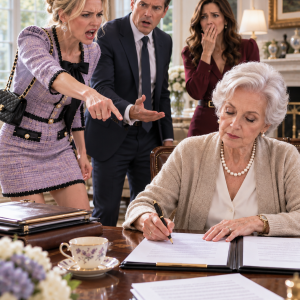
“Can you explain why you watched your sister throw Lily’s belongings onto the floor?”
He said nothing.
“Can you explain why your own six-year-old daughter was crying while you told me Heather would live here for years?”
His eyes filled with shame.
“I felt responsible for Heather.”
“You are also responsible for Noah and Lily.”
My father stood in the doorway but did not interfere.
Brian finally whispered:
“I thought you were strong enough to handle it.”
The sentence was almost worse than an excuse.
“So because I am capable, I was expected to absorb whatever damage everybody else created?”
He had no answer.
That evening, after Heather and her children left, I changed the access code to the condominium and contacted a divorce attorney recommended by Rebecca.
Brian moved temporarily into a hotel.
Within several weeks, we formally separated.
The divorce took several months rather than ending with one dramatic confrontation. The condominium remained outside the marital estate because the trust structure and pre-marital documentation were clear. Financial review also uncovered money Brian had transferred from a joint account to help Heather manage debts without telling me, and the settlement required proper accounting for those withdrawals.
I did not try to punish him.
I simply stopped protecting him from the consequences of choices he had made without me.
PART 5: What Happened After Everyone Left

Heather’s situation deteriorated quickly once free housing disappeared.
The proceeds from the Eugene property had already been heavily reduced by business debts, credit cards, and spending. Eventually, she rented a small apartment and accepted a retail sales position.
For the first time in years, she had to organize her life around income rather than whichever relative was willing to rescue her.
Brian rented a one-bedroom apartment not far from the twins’ school.
He began therapy and gradually admitted that his relationship with Heather had always depended upon feeling indispensable to her.
When Heather created a crisis, Brian became the rescuer.
When I handled my own problems, maintained a career, and managed our home without constant assistance, he sometimes interpreted my independence as evidence that I needed less consideration.
The realization did not save our marriage.
It did make him a more thoughtful father.
We eventually established a parenting schedule that gave him regular weekend time with Noah and Lily once the immediate conflict settled.
I returned fully to my interior-design practice.
Within a year, I expanded into projects in Seattle and San Francisco while maintaining my Portland clients.
The damaged walnut coffee table went to a furniture conservator.
He could have removed every trace of Logan’s carving, but I asked him to leave one faint line visible beneath the refinished surface.
Not because I blamed a ten-year-old child.
I wanted to remember how long I had watched other people cross boundaries while convincing myself that patience was kindness.
PART 6: The Home My Children Remembered
Several months after the divorce became final, Brian arrived to collect the twins for a weekend.
He looked thinner and quieter than the man who once told me to adapt while his sister emptied our children’s bedroom.
He stood near the doorway after Noah and Lily ran to get their backpacks.
“You were right about something I did not understand then.”
I waited.
“I kept telling myself I was helping Heather because she was family, but I also liked being needed. You never needed rescuing, Natalie, and instead of respecting that, I started treating your independence like permission to ask more from you.”
I folded my arms.
“That does not excuse the agreement you prepared.”
“I know. There is no excuse for that.”
For once, he did not add a qualification.
Lily appeared carrying her stuffed rabbit.
The same rabbit Heather had once thrown into the hallway.
Brian looked at it, then at me.
“I am ashamed that I let them feel unsafe here.”
“Then make sure they never feel responsible for managing your relationship with Heather.”
He nodded.
“I will.”
Noah called from the elevator.
Brian left with both children.
I watched the doors close and felt neither satisfaction nor grief.
Only calm.
The condominium looked different after the divorce, although most of the furniture had not changed.
My studio returned to being a studio.
Noah and Lily chose new colors for their bedroom walls, and I allowed them to help arrange the furniture because I wanted the room to feel unmistakably theirs again.
The walnut table remained in the living room.
If sunlight struck it from the right direction, the repaired mark was still visible.
One evening, Lily noticed it.
“Mommy, why did you leave that little scratch?”
I sat beside her.
“Because sometimes marks remind us to protect things before they become badly damaged.”
She considered the answer.
“Like furniture?”
I smiled.
“Furniture, homes, feelings, and sometimes boundaries.”
She seemed satisfied and returned to coloring.
Watching her, I finally understood that my greatest victory had nothing to do with removing Heather from the condominium or proving Brian had lied.
I had protected something more important than property.
My children had watched adults behave as though family relationships gave people unlimited permission to invade, manipulate, and take.
Then they watched me say no.
They saw that generosity could have limits without becoming cruelty.
They saw that loving relatives did not mean surrendering bedrooms, homes, finances, or dignity simply because somebody else called their demands an emergency.
Years earlier, my parents had placed the condominium into a trust because they wanted me to have long-term security.
For a while, I thought security meant ownership papers, legal documents, and the ability to prevent someone from taking the property.
I eventually learned that a home could remain legally yours while becoming emotionally unrecognizable.
Real security meant my children could walk into their bedroom without wondering whether an adult had decided someone else deserved it more.
It meant I could conduct a client meeting without strangers occupying my studio.
It meant nobody could prepare a five-year agreement behind my back and assume my signature belonged to them.
Most importantly, it meant Noah and Lily would grow up knowing that kindness was a choice rather than a debt.
On a quiet Sunday evening, after the twins returned from Brian’s apartment, Lily climbed onto the sofa and leaned against me while Noah built an elaborate Lego structure on the floor.
No one was shouting.
No suitcases blocked the hallway.
No relative was demanding that my children surrender space so somebody else could avoid the consequences of poor decisions.
The apartment was not perfect.
Neither was my life.
But the peace inside it no longer depended upon my silence.
For the first time in a long while, home belonged not only to me on paper.
It belonged to us in every way that mattered.
THE END