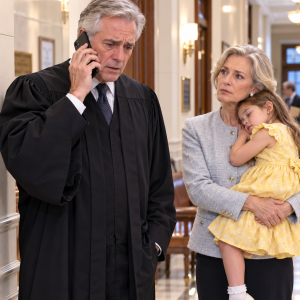
Julian stared at Oliver’s face.
For several seconds, he said nothing.
Then:
“He looks like me.”
“He does.”
Later, Julian requested formal visitation through his attorneys.
I did not stop it.
My child was never going to become an instrument of revenge.
I wanted Julian to understand something far more difficult.
Fatherhood required presence.
Not biology.
Part 5 — When the Empire Lost Unilateral Control

Formal DNA testing confirmed that Julian was Oliver’s father.
The next six weeks became a relentless mixture of depositions, financial disclosures, corporate hearings, and arguments over a contract my father had written fifteen years earlier.
Whitmore Global was now worth almost forty billion dollars.
The board became nervous.
Investors began watching closely.
Julian’s attorneys argued that Thomas Bennett’s succession restriction was outdated and should be interpreted narrowly.
Rebecca agreed.
That surprised them.
Then she demonstrated that Julian’s conduct satisfied even the narrowest interpretation.
There was a direct heir.
There was documented marital deception.
Corporate resources had been used in connection with hidden personal misconduct.
The proposed settlement contained a waiver broad enough to interfere with future heir rights.
Most importantly, the entire pattern created the precise succession risk my father had intended the clause to prevent.
During cross-examination, Julian’s attorney asked whether I was simply trying to punish my husband for infidelity.
I answered,
“I want him to stop believing consequences are something that only happen to other people.”
The attorney continued.
“Would you have invoked this provision if Mr. Whitmore had remained faithful?”
“No.”
For half a second, satisfaction crossed his face.
Then I continued.
“Because if he had remained faithful, remained reachable, used corporate assets honestly, and treated our marriage and potential heirs responsibly, this clause would never have been triggered.”
The satisfaction disappeared.
Two days later, the court issued its ruling.
The protected controlling voting shares would transfer into the Oliver Thomas Whitmore Irrevocable Heir Trust.
Julian did not become poor.
He still owned enormous economic interests.
He remained on Whitmore Global’s board.
He remained one of the wealthiest men in the country.
What he lost was unilateral control.
For the first time, Whitmore Global contained a protected future interest Julian could not dismiss.
Could not intimidate.
Could not remove.
His own son.
Part 6 — The Apology That Could Not Repair the Past
During the legal proceedings, Julian began visiting Oliver regularly.
At first, he seemed more frightened by an infant than he had ever looked facing hostile boards.
During one visit, I carefully placed Oliver into his arms.
“Support his head.”
Julian sounded defensive.
“I know.”
I adjusted his hand.
“You are not doing it.”
He immediately corrected his position.
“Like this?”
“Yes.”
Oliver stared up at him.
Julian looked genuinely uncertain.
“He is so small.”
“He was born at thirty-five weeks.”
Julian’s eyes lifted sharply.
“Was he all right?”
I paused.
“Eventually.”
His next question surprised me.
“And you?”
“I survived.”
Julian looked down at Oliver.
Then back at me.
“That is not what I asked.”
There was no irritation in his voice.
For once.
So I answered truthfully.
“I was not all right.”
Julian swallowed.
Then said the words that should have been obvious.
“I should have answered the phone.”
“Yes.”
Several weeks later, before the final divorce hearing, Julian apologized.
No qualifications.
No excuses involving business pressure.
Alcohol.
Loneliness.
Stress.
My shortcomings.
He simply admitted what he had done.
For years, I had imagined that apology.
In some versions of that fantasy, I forgave him.
We rebuilt the marriage.
Reality was much quieter.
I listened.
Then said,
“I accept that you are sorry.”
Hope appeared briefly on Julian’s face.
I continued before he misunderstood me.
“That does not mean I want our marriage back.”
He nodded.
“I know.”
That answer surprised me more than the apology itself.
The Julian I married would have interpreted my boundary as the opening position of another negotiation.
This version of him simply accepted it.
Regret could not travel backward through time.
It could only arrive late.
Part 7 — The Divorce I Chose
The final divorce hearing lasted less than thirty minutes.
After three years of marriage, months of betrayal, a dangerous pregnancy, the birth of a premature child, and a corporate succession fight involving billions of dollars, the legal ending felt strangely ordinary.
The judge reviewed the parenting arrangement.
Child-support provisions.
The separate resolution concerning Whitmore Global.
Then she looked at me.
“Mrs. Whitmore, do you believe this marriage is irretrievably broken?”
I looked at Julian.
He did not look away.
“Yes, Your Honor.”
The judge continued.
“Are you entering this agreement voluntarily?”
“Yes.”
She asked whether anyone had threatened or coerced me.
“No.”
Julian gave the same answers.
And then our marriage ended.
Outside the courtroom, Rebecca handed me a thin folder.
The trust transfer had been formally recorded that morning.
The protected legacy voting block no longer belonged to Julian.
It did not belong to me either.
It belonged to the irrevocable Oliver Thomas Whitmore Trust.
I ran one finger across my son’s name.
Thomas.
My father’s name.
I had chosen it in the hospital before I remembered the succession provision.
I simply wanted Oliver to carry something from the grandfather he would never meet.
Now the name felt like a bridge.
Thomas Bennett saved Whitmore Global fifteen years before Oliver was born.
A protection he inserted into that rescue agreement had eventually protected his grandson.
Rebecca stood beside me.
“You did it.”
I shook my head.
“We protected him.”
I closed the folder.
“That is different.”
Several months later, I returned to corporate law.
Not immediately.
And not because I wanted to prove anything publicly.
I returned because I missed the woman who could read a four-hundred-page contract and know exactly where the power was hidden.
Fear no longer belonged in my life.
Neither did waiting.
Humiliation.
Silence.
Oliver belonged there.
My work belonged there.
My name belonged there.
My judgment.
My voice.
Julian continued seeing his son under the parenting arrangement we had established.
I did not pretend he had magically become an entirely different person.
Fatherhood did not erase what he had done.
What changed was that Julian learned presence could not be purchased afterward.
It had to be practiced.
Again and again.
I eventually stopped wondering whether he regretted losing me.
His regret no longer determined anything important about my future.
Once, Julian Whitmore had looked directly at me and said I was never enough for him.
For a long time, I carried those words as if they were a legal judgment against me.
Eventually, I understood they had never been a judgment at all.
They were only the opinion of a man who had spent so much time looking elsewhere that he failed to recognize the woman standing directly in front of him.
By the time Julian finally turned around and saw me clearly, I had already walked away.
This time, I did not look back.
THE END