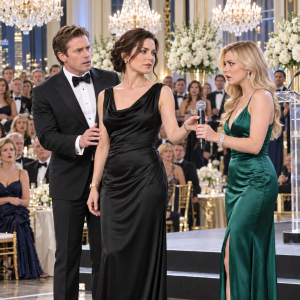
“You cannot make governance decisions in the middle of dinner.”
Margaret raised an eyebrow.
“I did not make the decision. You triggered a contractual consequence you personally agreed to.”
“I signed hundreds of pages.”
“A contract does not become optional because you were too arrogant to read it.”
Several people laughed openly.
Then Allison stepped forward.
“The hospital recognizes the Whitaker Family Foundation as the sole donor entity holding naming authority for this wing. No alternative Mercer naming proposal has been approved.”
The public correction was complete.
Celeste removed the diamond bracelet Harrison had given her and placed it on the table.
“I am leaving.”
Harrison moved toward her.
“We need to talk.”
“You had eleven days to talk.”
He lowered his voice.
“Do not make this worse.”
Celeste smiled bitterly.
“Do not be so bitter, Harrison.”
Someone near the rear of the ballroom coughed to hide laughter.
Then she looked at me.
“I should never have said that wives become the past.”
“No,” I replied. “You should not have.”
“I believed you already knew about us.”
I stared at her.
Harrison closed his eyes.
Celeste explained that he had described our marriage as a long-standing arrangement maintained only because of foundation politics. He claimed I already knew about the affair and had agreed to announce our separation after the dinner.
She was not innocent.
She knew he was married.
She had attended my mother’s funeral and still entered the affair.
Yet Harrison had created separate realities for both of us.
To Celeste, I was a ceremonial wife refusing to leave.
To me, Celeste was an affair I was expected to tolerate quietly.
To donors, Harrison was a family representative.
To his mother, Patricia, the pregnancy offered an inheritance narrative.
Only Harrison possessed every version.
Celeste left alone.
Before Harrison could follow, I removed my wedding ring from my evening bag and placed it beside her bracelet.
“My attorney will contact yours.”
His entire face changed.
“No.”
It was the most honest word he had spoken all evening.
“You cannot end eleven years because you are hurt.”
I looked at him.
“You ended them eight months ago. You simply expected me to handle the paperwork quietly.”
PART 6: THE NAME THAT REMAINED
After Harrison left, Allison asked whether we should postpone the dedication.
I looked toward the covered plaque.
“No. My mother waited long enough for this.”
The evening had never belonged to Harrison.
I refused to let him own its ending.
When the cloth came down, the bronze plaque read:
ELEANOR WHITAKER MATERNAL RECOVERY CENTER.
A nurse named Marisol, who had cared for my mother during her final months and later joined the maternal recovery program, helped me unveil it.
The applause that followed was quieter at first, then grew.
I stepped toward the microphone.
“My mother disliked speeches because she believed people generally started talking after the useful work was already finished.”
A soft laugh moved through the room.
“She also believed our character is revealed most clearly by how we treat people when they are vulnerable.”
I looked at the plaque.
“This center exists because people recovering from pregnancy loss, traumatic births, surgical complications, and grief deserve more than survival. They deserve dignity.”
My voice almost broke.
“My mother did not build this center for the Whitaker family. She built it for families who will never know ours.”
That was why her name belonged there.
The following morning, the hospital issued a concise correction.
No Mercer renaming proposal had ever been approved.
Harrison’s honorary campaign position had ended pursuant to the agreement.
The Whitaker Foundation’s relationship with the center remained unchanged.
The hospital said nothing about Celeste or the paternity report.
There was no reason to humiliate an unborn child.
Harrison called seventeen times over the next three days.
I answered once.
He complained that Celeste would not speak to him, Patricia was furious, and several nonprofit boards had asked him to step back from upcoming public events.
Each problem, I told him, belonged to the relevant person or organization.
Finally he said:
“You destroyed me.”
I stood beside the library window overlooking the roses my mother had planted twenty years earlier.
“No, Harrison. You received the paternity report before the governance meeting. You lied to Celeste, lied to the foundation, and then stood beneath my mother’s name announcing authority you did not possess.”
“I was trying to build a future.”
“You were trying to steal one.”
I ended the call.
He never called again.
Celeste contacted me once, two months later.
She did not ask forgiveness.
I respected that.
She said she left Harrison the night of the dinner and had spent weeks reconsidering the sentence she spoke beside my chair.
Wives become the past.
She wrote that Harrison had convinced her another woman needed to disappear before her own future could matter.
I replied with three words.
“Take care, Celeste.”
Forgiveness is not the same thing as reopening a door.
Harrison and I divorced.
There was no dramatic reconciliation, no second proposal, and no discovery that eleven years of history somehow outweighed eight months of deliberate betrayal.
Some relationships end because they should.
The legal process was private.
I preferred it that way.
No chandeliers.
No microphones.
Only lawyers, signatures, disclosures, and the paperwork Harrison had always believed too boring to read carefully.
The maternal recovery center opened that winter.
I arrived before the journalists on its first morning.
Allison walked me through private recovery suites, counseling rooms, family kitchens, quiet spaces for people receiving devastating news, and a small garden on the western side of the building.
Near the entrance was my mother’s plaque.
Nothing enormous.
Nothing theatrical.
Exactly what she would have wanted.
I placed my bare left hand against the cool bronze.
For years, I had measured my life according to absence.
Two pregnancies.
My mother.
My marriage.
The version of Harrison I once believed existed.
The future I expected to have.
Eventually, I learned that loss was not always an empty space.
Sometimes it was the room truth required before it could stand upright.
Harrison believed that by bringing a pregnant woman into that ballroom, he was presenting himself as a man moving toward the future.
Instead, everyone saw what he had been willing to discard in order to manufacture one.
Trust.
Credibility.
A marriage.
A legacy he had been invited to share but mistakenly believed he owned.
People later asked me when I knew he had lost.
It was not when Celeste demanded my chair.
Not when I mentioned DNA.
Not when File One played.
Not when she opened the report.
Not when Margaret invoked Clause Fourteen.
Not even when I placed my wedding ring on the table.
Harrison had lost much earlier.
He lost when he saw grief and mistook it for weakness.
He lost when he assumed my mother’s death left an opening he could fill with his own name.
He lost when he signed a binding agreement he considered too boring to read.
He lost when he learned the truth about Celeste’s child and decided an image was more useful than reality.
Most of all, he lost when he assumed I would continue protecting him from consequences simply because I had protected our marriage before.
My mother taught me better.
Dignity is timing.
Sometimes dignity means remaining silent.
Sometimes it means leaving.
And sometimes it means allowing a man to complete his entire lie beneath chandeliers and cameras before opening the document he never bothered to read and letting the truth reclaim the place he tried to take from you.
THE END