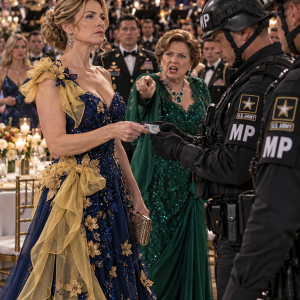
Part 1 — The Passport That Exposed Everything
My husband told me he was taking three investors to Jackson Hole on our company jet for what he described as a private strategic retreat.
At exactly 8:17 the next morning, someone from the aviation company called my Manhattan apartment with a question that made absolutely no sense.
They wanted to know why a woman traveling as Mrs. Catherine Bennett had boarded my husband’s aircraft using a passport number that was not mine.
For several seconds, I assumed the company had mixed up two passengers or made some embarrassing administrative error. The explanation seemed so obvious that I almost laughed.
Then the account manager sent me the passenger manifest.
Passenger: Mrs. Catherine Bennett.
Emergency Contact: Nathan Bennett.
The passport number was not mine.
Neither was the date of birth.
There was also a special request attached to the booking: chilled Dom Pérignon and white roses waiting on board before departure.
I knew only one woman who cared enough about white roses to make them part of a travel request. Once, at a charity dinner, she had told me that red roses looked embarrassingly desperate.
Her name was Sienna Brooks.
Sienna was twenty-nine and worked as Communications Director at Bennett Aldridge Capital, the investment firm Nathan publicly described as the business he had built through sheer intelligence, courage, and relentless ambition.
For the previous six months, Sienna had sat across from me at charity dinners, smiling warmly while telling people how fortunate I was to have such a devoted husband.
The aviation company had included a photograph with the report.
I opened it.
Sienna was standing at the bottom of the aircraft stairs in a cream cashmere coat I recognized immediately. Several weeks earlier, I had noticed that same coat hanging inside Nathan’s office.
His hand rested casually against the small of her back while she laughed toward the camera.
Nathan was looking at her with an expression I remembered.
Years ago, he had looked at me exactly that way.
When he finally called me that afternoon, I did not accuse him, cry, or demand an explanation.
I asked one question.
“Who is Mrs. Catherine Bennett?”
Silence.
Then Nathan laughed.
It was the effortless, dismissive laugh of a man who had spent years believing that any problem could be neutralized if he sounded sufficiently calm while explaining it.
At forty-one, Nathan was still exceptionally handsome. He was photogenic, polished, articulate, and so practiced at controlling a conversation that he could make arrogance sound almost reassuring.
“Catherine, sweetheart, it’s clearly some kind of booking mistake.”
I looked at the manifest again.
“No, it isn’t.”
The warmth disappeared from his voice.
“You’re turning paperwork into some ridiculous conspiracy.”
Perhaps Nathan believed his affair was the discovery that could destroy him.
He was wrong.
Six hours after that conversation, I requested every flight record associated with Bennett Aldridge Capital’s corporate aviation account.
There had been six trips over the previous fourteen months.
Aspen.
Miami.
Napa Valley.
Charleston.
Palm Beach.
Jackson Hole.
Every trip had been submitted as legitimate corporate travel.
Every passenger manifest listed a woman identified as Mrs. Catherine Bennett.
I had not taken a single one of those flights.
By midnight, I understood that my husband’s betrayal extended far beyond another woman.
Nathan had created a financial paper trail while using my legal identity.
Unfortunately for him, there was another part of that identity he had spent twelve years encouraging everyone around us to forget.
Before I married Nathan, my name was Catherine Prescott.
And Catherine Prescott remained the beneficiary and voting authority associated with the family trust that controlled fifty-two percent of Bennett Aldridge Capital.
The same company Nathan liked telling people he had built entirely on his own.
Part 2 — Before I Became Just His Wife
I met Nathan while I was working in my father’s family asset-management business.
My father, Henry Prescott, had built an impressive investment operation without magazine covers, televised interviews, celebrity photographs, or extravagant charity appearances.
He preferred results to attention.
Nathan was the opposite.
He loved visibility.
When I first met him at a restaurant in Boston, he was ambitious, charming, intelligent, and hungry enough to make ambition seem romantic instead of dangerous.
My father never shared my enthusiasm.
One evening he asked me a question that made me furious.
“Does Nathan love you, Catherine, or does he love everything the Prescott name brings into a room?”
I immediately defended Nathan.
“He doesn’t even know how much control the trust holds.”
My father watched me quietly for several seconds.
“Then make certain he never needs to know.”
Three years later, my father died unexpectedly after suffering a stroke.
Under the succession structure he had established, control of Prescott Meridian Holdings eventually passed to me.
By that time, Nathan and I had already created Bennett Aldridge Capital together.
The ownership structure had been designed intentionally.
Nathan received substantial common equity and considerable authority over daily operations because, whatever else I eventually learned about him, he was genuinely talented at attracting capital and building relationships with institutional investors.
My family’s holding company retained fifty-two percent of the voting power through preferred shares.
Nathan became the public face of the firm.
I remained mostly behind Prescott Meridian, working quietly on governance, institutional strategy, risk systems, and the long-term relationships that had made Bennett Aldridge’s early expansion possible.
In the beginning, Nathan introduced me as his partner.
Over time, that description disappeared.
At conferences I became “my wife, Catherine.”
At dinner parties, Nathan confidently explained markets and investment structures I had once taught him to understand while I sat beside him and smiled.
I allowed it because correcting my husband publicly felt petty and humiliating.
Eventually, however, I learned something about men who become accustomed to being treated as powerful.
Sometimes the quickest way to discover what a man truly believes about you is to stop reminding him what you are capable of.
Sienna joined Bennett Aldridge three years before that aviation company called me.
She was polished, observant, intelligent, and unusually attentive to Nathan.
She memorized everything.
She knew which whiskey he preferred, which journalists he disliked, which cuff links he wore before difficult negotiations, and even which side of his face he preferred photographers to capture.
Two months before the Jackson Hole trip, she placed her handbag on my chair at the company holiday dinner.
I arrived approximately fifteen minutes late.
Sienna looked up and smiled pleasantly.
“Oh. I thought you weren’t coming.”
Only after a long pause did she move her bag.
Later, Nathan leaned toward me and whispered:
“Don’t turn a chair into a scene.”
A week after that dinner, I discovered a receipt for six dozen white roses delivered to a luxury apartment in Tribeca.
Nathan told me the flowers had been sent to celebrate a client’s successful closing.
I stopped asking questions after that.
Nathan mistook my silence for surrender.
Part 3 — The Moment Infidelity Became Financial Evidence

At 1:14 in the morning, I laid all six flight manifests across the walnut table in my home office.
Then I began matching each journey against Bennett Aldridge’s corporate expense reports.
Jackson Hole had been classified as investment due diligence.
Aspen was listed as an investor conference.
Miami had been categorized as pension strategy.
Napa Valley appeared under client entertainment.
Charleston supposedly involved philanthropic advisory work.
Palm Beach had been described as family-office development.
The expenses attached to those trips were extraordinary.
Private aircraft.
Penthouse hotel suites.
Luxury drivers.
Spa treatments.
Private chefs.
Expensive restaurants.
During the Napa trip, someone had purchased a diamond bracelet through the hotel concierge for $28,600.
The expense report described it as an Investor Appreciation Gift.
I recognized the bracelet immediately.
Sienna had worn it at the holiday dinner.
I had even complimented her on it.
She had smiled at me and said:
“Nathan has extraordinary taste.”
At two o’clock that morning, the sentence sounded different.
It sounded like what it had always been.
A confession.
I called Dana Sullivan, my longtime attorney.
“Nathan has been putting his mistress on the corporate aircraft under my legal name.”
Dana’s voice changed instantly. Whatever sleep remained in it vanished.
“Corporate aircraft?”
“Paid for through Bennett Aldridge.”
“What about the expenses?”
“They were submitted as investor travel.”
She was silent for a moment.
“Do you have documentation?”
“I have everything.”
Before sunrise, Dana connected me with an independent forensic-accounting firm.
Using the oversight rights attached to Prescott Meridian’s controlling voting position, I formally authorized an audit.
The first findings appeared almost immediately.
Investigators identified eleven approval documents carrying versions of my signature.
I had signed none of them.
Over approximately fourteen months, roughly $417,000 in travel, hotels, entertainment, gifts, consulting, and other expenses had been approved through authorizations supposedly issued by me.
Some of the forged signatures were impressively convincing.
But there was one detail the person copying me did not know.
When I was a teenager, I complained to my father that writing my full first name took too long. He taught me to form the opening letter of Catherine with an unusually narrow stroke.
I had signed my name that way ever since.
The fraudulent signatures used a wider opening curve.
I had seen that handwriting before.