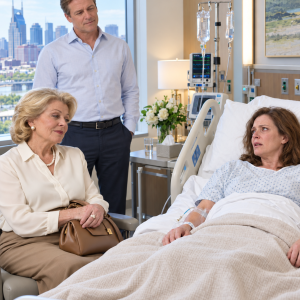
The concentrated neurological compound Samuel had placed in the bottle quickly interfered with her motor control.
Elaine tried to crawl toward the telephone.
Her arms stopped cooperating.
She attempted to scream.
Only a strained rasp emerged.
Then she heard something behind her.
A foot touching hardwood.
Then another.
Slowly, painfully, Charles rose from the wheelchair.
His legs shook violently beneath him.
Every step required immense concentration.
But after months of secret practice, he could support his own weight.
Elaine stared at him in absolute terror.
The man she had mocked as a breathing corpse was standing behind her.
Charles crossed the room one careful step at a time.
He did not shout.
He did not threaten her.
Instead, he picked up their framed wedding photograph from a side table and placed it where she could see it.
Then he lifted the house telephone.
His voice was rough.
But understandable.
“My name is Charles Harrington. I need police and medical assistance immediately. I am reporting an attempted murder conspiracy and the death of a physician inside my home.”
He gave the address.
Then told the dispatcher that evidence connected with the conspiracy was stored in a bank deposit box under Samuel Cross’s name.
Elaine could only stare at him.
For the first time in months, Charles was deciding what happened next.
Part 6 — Everything Elaine Had Planned
Police secured the house that night.
Elaine was transported to the hospital.
The concentrated neurological medication left her alive but temporarily unable to control much of her body.
Investigators recovered Samuel’s hidden syringe.
The poisoned glass.
The remaining wine.
And, eventually, the evidence from his bank deposit box.
The recordings were devastating.
Elaine could be heard discussing the brake sabotage.
The insurance payment.
The sale of the house.
Her plan to gain control of Charles’s investments after his death.
Forensic examination of Charles’s SUV confirmed deliberate cutting and manipulation inconsistent with normal mechanical deterioration.
Ryan Cole immediately hired an attorney.
When investigators confronted him with Elaine’s messages, he began cooperating quickly.
He turned over communications proving their affair while insisting he had never known Elaine intended to murder Charles.
The man she had planned to escape with abandoned her the moment criminal liability became real.
The pending sale of the Greenwich house was canceled.
Accounts connected with disputed assets were frozen.
Charles entered intensive neurological and physical rehabilitation.
Recovery was far harder than he had imagined.
Learning to stand safely took weeks.
Walking took months.
Holding a coffee cup became a milestone worth celebrating.
Patricia cried the first time she visited and watched him lift one without help.
“I knew somebody was still in there,” she said.
Charles smiled.
“I was beginning to wonder whether anyone would ever find out.”
Samuel’s role complicated everything.
Investigators established that he had irresponsibly provided information that Elaine later used to sabotage Charles’s vehicle.
But they also found extensive evidence showing that once Samuel realized what she had done, he had spent months trying to preserve Charles’s life and document the conspiracy.
Samuel had made a catastrophic ethical mistake.
He had also died trying to correct it.
Charles never tried to romanticize that contradiction.
Samuel had helped create the danger.
Samuel had also made Charles’s survival possible.
Both things were true.
Part 7 — The Life He Chose to Keep

Months later, Elaine went to trial.
Prosecutors built their case around attempted murder, deliberate vehicle sabotage, financial fraud, conspiracy, and her responsibility for Samuel’s death.
The recordings were powerful.
So were the financial records.
The forensic examination of the SUV.
And the physical evidence recovered from the dining room.
Together, they created a case far stronger than Elaine had expected.
She was eventually convicted on multiple serious charges.
Her sentence ensured that she would spend most of the rest of her life in custody.
Before being transferred to begin serving that sentence, Elaine requested one final meeting with Charles.
He entered the secure mediation room using a cane.
Elaine looked smaller than he remembered.
The confidence she once carried had disappeared.
What remained was exhaustion and fear.
For several moments, neither of them spoke.
Then she began to cry.
“Do you hate me, Charles?”
He considered the question carefully.
There had been months when hatred kept him alive.
Hatred had given shape to the darkness when he could neither move nor speak.
But survival eventually demanded something larger.
“I did,” he said. “For a long time, hatred was probably the only emotion strong enough to keep me fighting.”
Elaine lowered her eyes.
Charles continued.
“But I don’t want to spend whatever years I have left carrying you with me. I have more important things to do.”
She started to speak again.
Charles turned toward the door.
“Goodbye, Elaine.”
Then he walked away without looking back.
One year after the night he stood from the wheelchair, Charles returned permanently to the Greenwich house.
He changed almost every room.
Not because the furniture was damaged.
Because too many objects belonged to a life he no longer wanted to preserve.
He reopened the woodworking shop behind the house.
On warm spring mornings, sunlight poured through the windows while Charles worked slowly at the bench.
His recovering hands relearned familiar movements.
One afternoon, he began building a small wooden chair for a future grandchild.
The project took far longer than it would have before the crash.
That no longer bothered him.
Every controlled movement of the sandpaper represented something Elaine had tried to take away.
Every step across the workshop floor was proof that the limits once placed on his recovery had not been final.
Sometimes Patricia visited for coffee.
Sometimes Charles’s brother joined him in the workshop.
Most days were quiet.
Charles had once feared silence because silence had been the prison in which he listened to his wife plan his death while everyone believed his mind had disappeared.
Now silence sounded different.
It sounded like sawdust falling onto a workbench.
Birds outside an open window.
His own breathing remaining steady while his hands shaped another piece of wood.
He had lost a thirty-year marriage.
He had nearly lost his body.
His house.
His fortune.
His life.
What he regained mattered more.
He regained choice.
He regained dignity.
Most importantly, he regained the ability to stand inside his own life without waiting for someone else to decide whether he deserved to remain there.
For months, everyone around Charles Harrington believed he was gone.
In reality, he had been listening.
Remembering.
And slowly, painfully, while the people plotting against him celebrated too soon, he had been learning how to stand again.
THE END