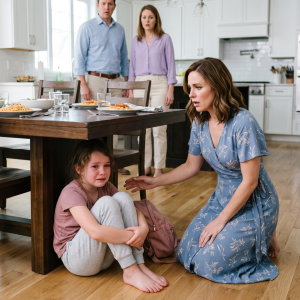
Maisie looked down at her dress.
Then back at the photograph.
“Mommy made my dress?”
I nodded.
Claire had sewn it years earlier and stored it carefully with Maisie’s name attached.
I had found it after she was gone and saved it until our daughter was big enough to wear it.
What I had never seen was the photograph.
Maisie touched the fabric gently.
“Then it isn’t cheap.”
I pulled her close.
“No, sweetheart.”
She looked up at me.
“How much is it worth?”
I looked at Claire’s photograph.
“There isn’t enough money in the world to put a price on it.”
The Room Wasn’t Laughing Anymore
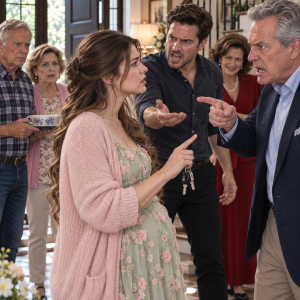
When we returned to the dining room, everyone was waiting.
Paige noticed the little crown pendant in Maisie’s hand.
“What’s that?”
Grandma answered.
“Something her mother left her.”
Then she looked at Maisie’s blue dress.
“Just like that dress.”
My mother frowned.
“Claire made it?”
I nodded.
Paige’s face changed.
“I didn’t know.”
I looked at her.
“Exactly. You didn’t know. But you still decided to make a seven-year-old girl feel embarrassed about something she loved.”
My father tried to redirect the conversation.
“Nolan, we need to discuss the company.”
For the first time that evening, everything became very clear.
Fifteen years of hidden letters.
My work used without my knowledge.
Claire carrying a secret because she wanted to protect the peaceful life we had built.
And now my father wanted to discuss shares.
“No.”
He stared at me.
“What do you mean, no?”
“I mean tonight is over.”
“I’m your father.”
I took Maisie’s hand.
“And she is my daughter.”
Paige stepped forward.
“Wait. I want to apologize to her.”
Maisie moved behind me.
I didn’t force her to listen.
“When she’s ready, she can decide whether she wants to hear it.”
Then we left.
What Claire Had Really Left Us
Over the following weeks, messages arrived.
My parents wanted to talk.
My father wanted to explain himself.
Paige sent Maisie an expensive designer dress.
I returned it.
Not because I wanted revenge.
Because Paige still didn’t understand.
Maisie didn’t need a more expensive dress.
She needed relatives who understood that her value had never depended on what she wore.
Over the next several months, I learned more about Claire’s hidden life.
Much of the money she received from Whitaker Medical had never been spent on herself.
She had helped fund medical equipment for rural clinics.
She supported engineering scholarships.
She contributed to programs helping families afford specialized care.
One scholarship program even carried my name.
The Nolan Mercer Young Innovators Fund.
I stared at the paperwork for a long time.
“She never told me.”
Grandma smiled.
“That was the point.”
What Being Rich Really Means
When Maisie turned eight, she asked to have her birthday party in our backyard.
She wanted balloons, chocolate cake, and a magician.
Nothing extravagant.
Grandma Evelyn arrived carrying a book about American inventors.
Inside the cover, she had written:
“For Maisie, who already understands that the most valuable things are built with love.”
Maisie ran upstairs.
A few minutes later, she returned wearing the blue dress.
It was getting a little short.
She spun around.
“Daddy, do I still look like a princess?”
I knelt in front of her.
“Always.”
She pulled the little silver crown from her pocket.
For a moment, she studied it.
Then she placed it in Grandma Evelyn’s hand.
“Mommy said I don’t need a crown.”
Grandma laughed through her tears.
Later that night, after everyone had gone home, Maisie gave me a drawing.
She had drawn our house.
Herself.
Me.
And Claire.
Underneath, in large uneven letters, she had written:
“THIS IS BEING RICH.”
I stared at those words.
My family had spent decades believing money determined who deserved respect.
Yet the wealthiest person among us had chosen an ordinary home, dinners around a small kitchen table, an old car that still worked, and a blue dress sewn by hand for her daughter.
That night at my parents’ house, everyone thought Maisie’s life changed when they discovered what she would inherit.
They were wrong.
Her financial future had been protected long before that dinner.
What changed was everyone else’s perception of her.
But I didn’t need my family to understand how much my daughter was worth.
I only needed Maisie to never forget it.
Because her value never began with a company.
It never began with a trust fund.
And it certainly never began with millions of dollars.
She had been priceless long before anyone at that table knew her name was written on a single legal document.
A child should never be taught that expensive clothes determine whether she deserves kindness, because the way we make children feel about themselves can stay with them far longer than anything they wear.
The people who seem to have the least may be carrying stories, sacrifices, and quiet accomplishments that cannot be seen from the outside.
Before judging someone by a house, a car, a job, or an outfit, remember that none of those things can tell you how deeply that person loves, gives, or matters to others.
Real wealth is not simply having enough money to buy beautiful things; it is having enough wisdom to understand which beautiful things money can never replace.
Parents cannot protect their children from every unkind comment, but they can build a home where those children always know they are loved, respected, and enough.
An apology becomes meaningful only when we understand what we did wrong, because replacing a simple dress with an expensive one cannot repair the belief that caused the hurt in the first place.
Some of the greatest gifts parents leave behind are not written into wills or bank accounts, but into the values, memories, traditions, and love their children carry forward.
Humility becomes even more powerful when someone has every opportunity to show off but instead chooses to use what they have to make other people’s lives better.
Never make someone feel small just so you can feel important, because true confidence does not need another person’s embarrassment in order to exist.
In the end, the greatest inheritance Maisie received was not ownership of a successful company, but the certainty that her mother had loved her before she understood money, status, or what the world might one day say she was worth.