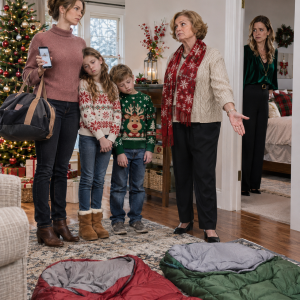
“They are my family.”
“And I was your wife.”
He said nothing.
I continued carefully.
“You knew my answer, so you manufactured an emergency involving two older women supposedly escaping a burning house. You used my compassion because respecting my decision would not give you what you wanted.”
Daniel rubbed his forehead.
“I was trying to help my mother.”
“You persuaded your mother to sell her home, transferred her retirement security to an unverified stranger, planned to use my property as free housing, and considered quitting your job before the investment produced one dollar. That is not help.”
His face tightened.
“I believed the opportunity was real.”
“That explains the investment mistake. It does not explain lying to me.”
For several seconds, neither of us spoke.
That distinction was the reason reconciliation became impossible.
Daniel’s financial recklessness was frustrating.
His deception was corrosive.
I could tolerate someone making a terrible mistake.
I could not build a life with someone who believed my consent was an obstacle to manipulate.
PART 5: WHAT THE INVESTIGATION FOUND

The official investigation moved slowly.
Fraud cases involving interstate transfers, false identities, and cryptocurrency rarely produce dramatic overnight recoveries.
Investigators collected screenshots, bank documentation, website records, and communications from other victims.
The name Victor Hale was almost certainly fictional.
The company identity was fabricated from pieces of legitimate real-estate businesses.
Photographs had been copied from actual developments.
Investment projections were invented.
The supposed ownership documents would never arrive.
Elaine struggled to accept the finality.
Judith was angrier.
Part of the $428,000 represented money she had expected to share through the investment arrangement, and she demanded Daniel somehow repay what was gone.
He could not.
For the first time, his family stopped treating his enthusiasm as intelligence.
The phrases that once impressed them—passive income, exclusive access, pre-construction appreciation, insider allocation—became reminders of what they had lost.
Elaine and Judith eventually rented an older apartment in the suburbs using the limited retirement income still available to them.
Elaine began baking cakes, pastries, and pies for neighbors to supplement her budget.
She had spent years criticizing how I used money.
Now every expense mattered.
I did not celebrate that.
Consequences are rarely satisfying when they involve elderly people losing decades of security.
But I also refused to replace what had been lost.
Helping would have been voluntary.
Being expected to finance the consequences of deception was something entirely different.
PART 6: THE DIVORCE
My divorce from Daniel was handled efficiently.
The condominium remained mine because I had purchased it years before our marriage and maintained clear documentation regarding ownership and expenses.
Daniel did not seriously contest that fact.
Perhaps he finally understood that another grand scheme would not rescue him.
A month later, he rented a small room closer to his workplace.
Occasionally, messages arrived in which he apologized, then drifted into explanations about how anyone could have been fooled by the investment.
I stopped responding.
Anyone could be deceived.
Not everyone creates a fake residential fire to manipulate a spouse.
That remained the point he struggled to understand.
Elaine sent one message several months later.
I should never have agreed to lie about the fire.
I read it twice.
Then I replied:
“No, you shouldn’t have.”
I did not add reassurance.
An apology does not require the injured person to erase the consequence immediately.
PART 7: THE APARTMENT BECAME HOME AGAIN
By autumn, my condominium felt different.
There were no discussions about miracle investments.
No videos playing loudly about becoming wealthy before forty.
No packages containing products for abandoned online businesses.
No arguments about why caution supposedly meant I lacked ambition.
One evening, I returned home after a long audit meeting and made tea.
Chicago lights shimmered beyond the windows while the city moved beneath me.
My orange cat, Milo, jumped onto the sofa and immediately curled against my lap as though reclaiming territory.
I scratched behind his ears and looked around.
For years, I had assumed protecting a marriage meant absorbing a certain amount of chaos.
Daniel was always chasing the next idea.
I was always evaluating risk, paying bills, keeping records, and quietly ensuring the consequences never became catastrophic.
Perhaps that arrangement had encouraged him.
He took increasingly larger risks because someone responsible always remained nearby.
Until I stopped.
The most important thing I learned from the $428,000 disaster was not about real-estate fraud.
I already understood financial fraud professionally.
What I had failed to recognize was emotional fraud inside my own home.
Daniel fabricated a crisis because he understood exactly which version of events would make me ignore my boundaries.
He knew I would question an investment.
He knew I would object to supporting three adults indefinitely.
He also knew I would never leave two older women homeless after a fire.
So he invented the fire.
That was why changing the locks mattered.
The lock was not punishment.
It was a boundary made physical.
For years, I had believed kindness required opening the door whenever family needed something.
Now I understood that kindness without judgment could become a resource other people learned to exploit.
Elaine and Judith had somewhere to live.
Daniel had work and the ability to rent a room.
Nobody had been abandoned on the street.
They simply had to live with decisions I refused to finance.
Milo stretched across my legs while I watched lights move along Lake Michigan.
I thought about the first night Daniel brought Elaine and Judith toward my door expecting automatic access.
He had called my condominium their new home before asking whether they could enter it.
That assumption revealed everything.
He believed my stability belonged to the family whenever their choices failed.
It did not.
I lifted my tea and smiled.
The apartment belonged to me long before Daniel arrived.
After he left, it became mine in another way.
Not because the deed changed.
Because I finally stopped allowing guilt, urgency, and fabricated emergencies to function like spare keys.
Sometimes closing a door is not abandonment.
Sometimes it is the first honest act of self-respect after years of letting other people enter without permission.
That night, the smart lock clicked quietly behind me.
For the first time in a long time, the sound felt like peace.
THE END