He stepped back at first.
Then I knelt so we were at the same height.
“You did not create any of this, Oliver. The adults around you made terrible choices, but none of those choices are your fault.”
His lower lip trembled.
“Dad told me not to hug you because you were crazy and might hurt me.”
Daniel went completely still.
For years, I had wondered why Oliver avoided my touch.
Daniel had trained him to fear me.
That manipulation explained the coldness I mistook for instinct.
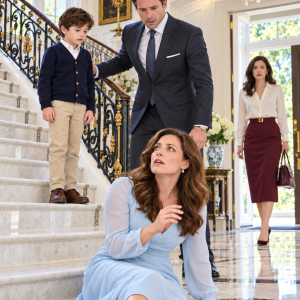
It also explained why a frightened six-year-old could eventually push me away with enough force to send me down the stairs.
Oliver began crying.
“I didn’t mean for you to get hurt.”
I wanted to promise him everything would be fine.
But adults had already lied to him enough.
Instead, I said:
“What happened on the stairs was wrong, but you are still a child, and the adults who taught you fear are responsible for helping repair what they damaged.”
He looked toward Daniel.
Then toward Lauren.
Neither could meet his eyes.
PART 7: THE YEARS THEY COULD NOT KEEP

The following weeks became a succession of attorneys, investigators, court hearings, accountants, medical specialists, and restored records.
The Bennett family properties were traced.
Transfers were challenged.
Fraudulent companies were examined.
Assets were frozen and progressively returned under court supervision.
Daniel and Lauren faced serious allegations involving financial fraud, falsified records, exploitation of a disabled person, and related misconduct.
Oliver was temporarily placed under child-protection supervision before being transferred to appropriate maternal relatives while the courts reviewed long-term custody.
Before leaving, he asked to see me.
He stood in the entry hall holding a small backpack.
For a moment, we simply looked at each other.
Then he ran toward me.
His arms wrapped around my waist.
“I’m sorry I pushed you.”
I held him carefully.
For years, I had dreamed of this child willingly embracing me.
Now I knew he was not biologically mine.
That changed the truth.
It did not erase the years in which I had loved him.
“You are not responsible for the lies adults taught you, Oliver. I hope someday you understand that.”
He cried against my coat.
So did I.
The source’s ending similarly places the child with appropriate relatives after legal intervention, while allowing a final embrace and apology between him and the woman who had believed herself to be his mother. Văn bản đã dán (1)
PART 8: LEARNING TO SEE AGAIN
Two months later, I returned to my family’s brownstone in Boston.
Autumn had turned the trees along Commonwealth Avenue gold and copper.
I stood beneath them and allowed myself to cry without hiding anything.
I cried for the baby I had carried and never met.
I cried for seven years of darkness.
I cried for the father who spent those years searching for a daughter who believed he was dead.
I cried for the architect I had once been.
I also cried because I could finally see the house where I grew up.
My vision continued improving under the care of neurological and ophthalmic specialists at Massachusetts General Hospital.
What began as blurred light gradually became recognizable faces, then readable text, then almost complete functional vision.
The doctors could not return the years I lost.
They returned enough of the world for me to choose what happened next.
I slowly began reviewing architectural drawings again.
At first, lines trembled.
Depth perception exhausted me.
Computer screens caused headaches.
Yet the discipline returned.
One afternoon, my father placed an old sketchbook on my desk.
The first page contained a drawing I completed before the crash.
A narrow townhouse façade.
Balanced windows.
Stone detailing.
Light flowing through an open doorway.
I ran one finger along the page.
“I thought I had lost this person.”
Thomas sat beside me.
“You did not lose her. She just had to survive before she could come back.”
For once, I believed him.
PART 9: THE LAST TIME I LOOKED AT DANIEL

The final divorce hearing took place months later.
By then, Daniel looked nothing like the man who once controlled my wardrobe, finances, doctors, and entire understanding of reality.
He entered wearing detention clothing, thinner and visibly exhausted.
I wore a navy tailored suit and walked into the courtroom without assistance.
Daniel watched me cross the room.
His eyes filled.
When proceedings ended, he asked through counsel whether he could speak briefly.
I agreed.
He looked directly at me.
“Evelyn, I am sorry. Whatever else happened, I really did love you once.”
For years, hearing those words would have destroyed me.
Now they felt almost irrelevant.
I considered him quietly before answering.
“The worst thing you did was not sleeping with Lauren, and it was not stealing money.”
Daniel’s eyes lowered.
“The worst thing was using my blindness to convince me that you were the only light left in my world.”
He closed his eyes.
I continued calmly.
“You made dependence feel like love because you knew I could not see the walls you were building around me.”
The courtroom remained silent.
Daniel whispered:
“I know.”
I shook my head.
“No. You understand the consequences now. That is not the same thing as understanding what those seven years felt like.”
Then I turned away.
I walked through the courthouse doors into brilliant afternoon sunlight.
The brightness still made my eyes ache slightly.
I welcomed it.
Outside, my father waited near the steps.
Rachel stood beside him holding the final documents.
Neither rushed toward me.
They allowed me to cross the distance on my own.
That mattered.
Because real love did not seize my elbow and decide where I should walk.
It did not hide information and call that protection.
It did not isolate me and describe dependence as devotion.
Real love waited beside the path and trusted that I could choose my own direction.
I reached my father.
He smiled.
“Ready to go home?”
I looked across the city.
Seven years earlier, I believed losing my sight had ended my life.
The truth was more complicated.
Blindness did not destroy me.
The person I trusted used my blindness to take my choices away.
Now those choices belonged to me again.
I smiled.
“Yes. But I’m driving someday.”
My father laughed.
We walked toward the car beneath a clear Boston sky.
I did not look backward.
For the first time in seven years, I had an entire horizon in front of me.
And nobody else was allowed to decide what I could see.
THE END