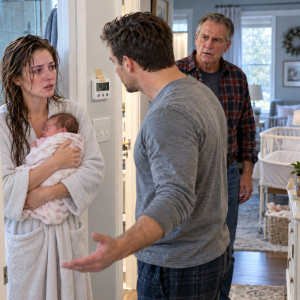
He blamed panic, pressure, our deteriorating marriage, and eventually Elise.
“She pushed me to make decisions.”
“Then you trapped me instead.”
Nathan insisted he believed I would stay with somebody else.
I asked him to name that person.
He could not.
For years, he had criticized friends until maintaining those friendships became exhausting.
He knew my mother was dead.
He knew I had no siblings.
He had known exactly how isolated I had become.
Then he finally reached the reason for his visit.
Briarwood.
“My family has lived there for twelve years.”
“I lived there for six.”
“My father negotiated that agreement.”
“With my grandfather’s company.”
He asked me to stop the revocation.
“No.”
Nathan stared at me.
“You are throwing me out.”
“I am terminating a contractual arrangement with thirty days’ notice under terms your family accepted.”
His expression hardened.
“This is not you, Caroline.”
That phrase unlocked years of memories.
When I considered returning to work after marriage, Nathan told me business ambition was not who I was.
When I objected to Elise joining a weekend trip, he told me jealousy was not who I was.
When I asked why my name appeared on so few household accounts, he told me caring about money was not who I was.
For years, he had used an imaginary version of me to police the real one.
“You are right.”
Hope flickered across his face.
“The woman you knew would spend another hour explaining why she was hurt so you would not think she was cruel. She would apologize before saying no and worry about where you would live after you locked her outside.”
His expression changed.
“I am not her anymore.”
Nathan asked whether the inheritance had changed me.
“No. You showed me what my life looked like when you believed I had nothing.”
That was the sentence he could not answer.
PART 7: THE APOLOGY THAT ARRIVED TOO LATE

Nathan admitted Elise had already left.
Apparently, discovering that Briarwood did not belong to him complicated the future they had planned together.
I almost laughed at the predictability.
He became defensive of her immediately.
“That is unfair to Elise.”
I studied him.
“Interesting. You finally discovered the instinct to protect someone.”
Nathan accused me of turning everything into evidence.
“I spent six years being told my memory was wrong, so I am allowed to keep evidence now.”
Then he asked whether I had ever loved him.
I answered truthfully.
“Yes.”
He asked how I could become so cold.
That accusation hurt because calmness had never meant absence of feeling.
Sometimes calmness is what remains after emotion has nowhere else to go.
“I folded our daughter’s clothes the morning you put them outside. For three months, I pretended I did not recognize another woman’s perfume because I was terrified that admitting the truth would mean our child lost her family before she was born.”
My voice shook, and this time I allowed it.
“I loved you enough to rewrite your behavior every day until I could survive living beside it.”
Nathan whispered my name.
“And then you locked the door.”
His face finally changed.
Not dramatically.
He simply looked like a man discovering that regret had arrived after consequences.
“I am sorry.”
I believed him.
He probably regretted losing Elise.
He regretted Briarwood.
He regretted discovering the ninety-billion-dollar inheritance after filing for divorce.
He may also have regretted hurting me.
People can hold selfish and sincere emotions simultaneously.
His apology still could not reverse time.
“Is there any chance left?”
“No.”
The answer hurt badly enough that I knew it was true.
When Nathan asked what he should do now, every old instinct tried to return.
Find him an apartment.
Call a broker.
Make sure he ate.
Tell him things would eventually improve.
Instead, I remembered Arthur’s letter.
“You will figure it out.”
Then I walked away.
PART 8: THE DOOR I CHOSE
Nathan vacated Briarwood on the twenty-ninth day.
I did not watch.
Humiliation had already taught me enough to know that witnessing his would not heal mine.
Elise never married him.
The canceled wedding appeared later among legal correspondence while our shared obligations were being separated.
I never asked why.
Perhaps she loved Nathan but could not survive the collapse of the future he promised.
Perhaps she loved Briarwood.
Perhaps watching him abandon a pregnant wife taught her that being chosen once did not guarantee being chosen forever.
Whatever the answer, it no longer belonged to my story.
The divorce continued without speed or cruelty.
I told Rebecca I did not want Bennett Dominion used as a weapon.
I wanted my rights protected, my daughter protected, and the marriage ended without transforming private failure into public entertainment.
Nathan sent two additional apologies.
I read both.
I answered neither.
Closure, I eventually learned, does not require mutual agreement.
Meanwhile, Bennett Dominion demanded more from me than wealth ever promised.
Six-hour asset reviews were not glamorous.
Neither were roofing schedules, occupancy reports, insurance claims, debt maturities, development timelines, tenant disputes, or decisions affecting thousands of employees.
Yet I gradually discovered that responsibility felt entirely different when nobody was constantly telling me I lacked the intelligence to understand it.
Several weeks later, I returned once to Briarwood.
The wedding portrait had been removed, leaving a lighter rectangle on the wall.
The bedroom was empty.
The nursery remained almost exactly as I had left it.
I stood beside the gray wall while rain clouds gathered beyond the windows.
For a moment, I could see myself again on the front steps with two wet suitcases, one hand under my stomach, terrified of what would happen if I refused to beg.
Our daughter kicked beneath my palm.
“All right,” I whispered. “I understand.”
I decided Bennett Dominion would retain Briarwood temporarily and renovate it as an ordinary corporate asset.
I would neither live there nor sell it simply because Nathan had given the building emotional power.
My daughter deserved a home without ghosts she had never created.
Two months later, during another rainy morning, labor began at 3:17 a.m.
For nine hours, the inheritance, divorce, attorneys, properties, and board meetings disappeared behind something older and more important.
Breathing.
Pain.
Nurses counting.
Hands gripping sheets.
Then came a fierce cry.
My daughter was placed against my chest, warm, furious, alive.
In that moment, ninety billion dollars meant absolutely nothing.
I looked down at her tiny face and understood that Arthur’s final lesson had never really been about property.
Walls can be inherited.
Companies can be controlled.
Contracts can be terminated.
Money can change the balance of power inside a room.
But a home is something else entirely.
Nathan had locked me outside because he believed owning access to a house meant owning the person who depended upon it.
Arthur had spent his final years learning the opposite lesson.
I would not repeat either man’s mistakes.
My daughter would grow up knowing that security did not require submission, that love did not demand self-erasure, and that no locked door could determine her worth.
I had inherited an empire.
What mattered more was finally inheriting my own life.
THE END