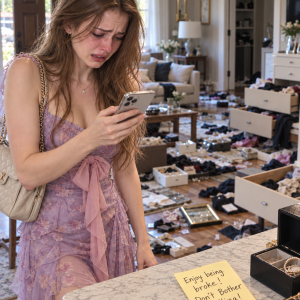
“The wedding is over, Natalie.”
“Yes, it is.”
The following morning, I finalized every cancellation.
Then I sent them a clear message stating that their flights and accommodations had been canceled and that they should not arrive at the airport expecting to travel with us.
My mother responded almost immediately.
When you are finished being angry, we can talk like adults.
She thought I was threatening her.
She did not understand that I had stopped negotiating.
Part 3 — The Groom Who Finally Asked About Lily

A week later, Daniel called unexpectedly.
His first question was simple.
“How is Lily doing?”
He was the first adult connected to the wedding who had asked.
I told him she had become unusually quiet and had started wondering whether she needed to change the way she behaved around our family.
Daniel hesitated.
“Natalie, I thought you were the one who decided Lily should not be the flower girl.”
I sat upright.
“Who told you that?”
“Claire. She said you were worried Lily might feel overwhelmed during the ceremony and preferred having her sit beside you.”
I stared at the wall.
“I never said that.”
That evening, Daniel accessed the shared wedding-planning account.
He found an updated ceremony schedule dated November 2.
The flower girl listed on that version was Madison Sterling.
The rehearsal where Lily supposedly proved herself too disruptive had taken place on November 21.
They had decided to replace her almost three weeks before the incident they later used as justification.
Yet they still allowed Lily to attend fittings.
Practice with the coordinator.
Complete the rehearsal.
Believe until the morning of the wedding that she still had a special role.
Daniel forwarded the planning records to me.
The empty display box had never caused anything.
It had simply provided a convenient excuse.
The real question was why.
Part 4 — The Airport
December 20 arrived with San Diego International Airport packed with holiday travelers before sunrise.
Lily and I reached the departure hall with two suitcases and enough time to eat breakfast before boarding.
Then I saw my parents.
They were standing near the airline counter surrounded by luggage, apparently ready for a vacation that no longer included them.
My mother held a printed copy of the old itinerary.
I stopped.
“What are you doing here?”
She lifted the papers.
“We are going to Vail with you.”
I answered:
“Your tickets were canceled three weeks ago.”
“I saw your message. Now fix the reservation.”
I walked toward the check-in counter instead of arguing.
My mother followed and handed both passports to the airline representative.
“We are all traveling under the same booking.”
The representative checked the computer.
“I’m sorry, ma’am. Your tickets were canceled and refunded several weeks ago by the primary customer.”
My mother turned toward me.
“You actually canceled them?”
“I told you exactly what I had done.”
“I thought you were threatening us because you were angry.”
I replied:
“I was angry. I was also completely serious.”
My father asked whether replacement seats were available.
The holiday flight was full.
My mother leaned toward the desk.
“Then put us in first class or on standby. We are already here.”
I shook my head.
“No.”
She stared at me.
“What about the resort?”
“I changed the suite.”
“The ski packages?”
“Canceled.”
“The dinners?”
“They are reservations for two now.”
Her anger turned into disbelief when she finally realized I was not bargaining.
“How can you do this to your own family at Christmas?”
I tightened my grip around Lily’s hand.
“I thought our family rule was that invitations could disappear without warning whenever someone became inconvenient.”
I did not wait for an answer.
Lily and I walked toward security.
That evening in Vail, after Lily had fallen asleep, Daniel sent another series of messages.
He had confronted Claire with the planning records.
Eventually, she showed him an older email chain.
His final message said:
Your mother planned the entire thing.
Then another appeared.
The reason is worse than the lie.
Part 5 — Why Madison Sterling Got the Basket

The emails began in early November.
Madison Sterling was the daughter of Grant Sterling, a powerful commercial real-estate developer whose projects stretched across Southern California and the Bay Area.
Claire worked as a luxury real-estate agent.
She had recently lost two important listings.
My mother had written:
I heard Grant Sterling’s daughter loves weddings and would enjoy being a flower girl. Giving their family this kind of personal attention might open doors for Claire when those mixed-use developments begin marketing.
Claire replied:
Natalie will never agree. Lily has been practicing for weeks and thinks this is the most important job she has ever had.
My mother answered:
Then do not tell Natalie beforehand. She is too polite to make a scene in front of guests, and once the ceremony begins, she will accept it.
I read that message several times.
My mother had not merely predicted how I would behave.
She had designed her plan around it.
She knew I would swallow humiliation rather than create conflict at Claire’s wedding.
She treated my patience as something she could exploit.
Another email made everything worse.
The Sterlings were also expected to spend part of Christmas in Vail.
My mother intended to use the thirty-thousand-dollar vacation I was financing to engineer a supposedly accidental social meeting between Claire and Grant Sterling.
My seven-year-old daughter had been removed from a wedding so another seven-year-old could become a business introduction.
Then I was expected to pay for the follow-up.