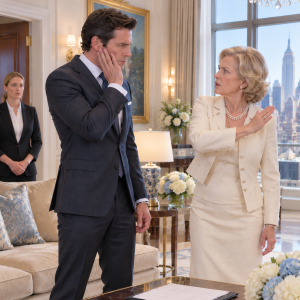
“Seeking psychological help does not embarrass me. Exploiting a patient’s vulnerability to interfere with her marriage should embarrass you.”
Nobody answered.
Rachel, Maya, and I walked toward the waiting car.
I never looked back.
Part 5 — What Happened After the Wedding

The consequences did not happen because I created them at the reception.
They happened because the evidence already existed.
The following Monday, the private Manhattan clinic where Caroline practiced suspended her pending investigation.
Professional regulators opened formal proceedings involving conflicts of interest, professional boundary violations, and confidentiality concerns.
The civil action proceeded separately.
Nathan called repeatedly.
At first, dozens of times each day.
Then came voicemails.
“You have taken this too far. Caroline’s entire career is collapsing because of you.”
Another said:
“My mother is devastated, everyone is talking about the wedding, and you have destroyed my life.”
There was never a meaningful apology.
Nathan came to my Brooklyn apartment building once.
Security refused to let him inside.
He left a handwritten letter accusing me of destroying his future.
I forwarded it directly to Maya.
About a month later, Patricia asked to meet.
We sat inside a quiet Manhattan café.
She placed a box of my personal belongings on the table.
The woman who once seemed to enjoy humiliating me looked considerably smaller.
“I am not asking for forgiveness.”
I waited.
“Nathan told me you were paranoid and controlling. He said his relationship with Caroline began after your marriage had effectively ended.”
She looked down.
“I believed him because believing my son was easier than questioning him.”
I took a sip of tea.
Patricia continued.
“I still behaved cruelly toward you, regardless of what he told me.”
That was the closest thing to accountability I ever received from her.
We did not hug.
We did not reconcile.
She pushed the box toward me and left.
Nathan and Caroline’s marriage lasted less than four months.
The investigations, financial pressure, public embarrassment, and collapse of the fantasy surrounding their relationship proved much stronger than the extraordinary romance they had described.
Caroline eventually lost the ability to continue practicing under the same professional standing she once possessed.
The civil litigation resulted in a financial settlement.
I used part of that settlement to move into a larger apartment.
Then I began doing things I had postponed for years.
I enrolled in painting classes.
Traveled through Sedona.
Spent entire weekends without explaining where I was to anyone.
Most importantly, I found another psychologist through a respected research institute.
During our first appointment, I admitted that opening myself to another therapist felt almost impossible.
She listened without interrupting.
Then she said:
“Trust is not something you owe immediately. It is something another person demonstrates they can safely receive.”
I wrote that sentence down after the appointment.
Part 6 — The Woman I Became Afterward
One year after the wedding, I found the invitation while reorganizing my home office.
The gold lettering still looked extravagant.
Patricia’s handwriting remained visible on the back.
Come and see what a real woman looks like.
I laughed.
This time, there was no shock in the sound.
No bitterness.
For years, I had believed that being a strong woman meant enduring discomfort gracefully.
I thought maturity meant never becoming jealous.
I believed commitment required remaining composed even when people repeatedly crossed boundaries.
Nathan benefited enormously from those beliefs.
So did Caroline.
They both understood that I was more likely to question myself than accuse someone I loved.
That had been their greatest advantage.
Therapy after the scandal taught me something different.
Healthy self-examination does not mean automatically assuming every conflict is your fault.
Compassion does not require accepting manipulation.
Forgiveness does not mean allowing someone back into your life.
And professional authority does not make someone morally trustworthy simply because a certificate hangs on the wall.
Nathan wanted me at his wedding because he wanted visible proof that he had won.
Patricia wanted me there because she expected humiliation to teach me obedience.
Caroline probably expected me to arrive emotionally shattered and easy to dismiss as a jealous ex-wife.
They misunderstood why I came.
I did not leave that wedding with Nathan.
I did not leave with revenge.
I left with something I had lost long before the divorce became official.
Confidence in my own perception.
For months, I knew something was wrong.
Nathan’s unexplained absences felt wrong.
The missing investment funds felt wrong.
Caroline’s insistence that I stop asking questions increasingly felt wrong.
Yet both of them had trained me to interpret every internal warning as evidence that I was irrational.
That was the deepest betrayal.
Not simply that Nathan chose another woman.
Not even that the woman was my psychologist.
They had used my willingness to examine myself as a weapon against me.
I would never make that mistake again.
I placed the wedding invitation into the shredder and watched the gold lettering disappear between the blades.
There was no satisfaction in destroying it.
Only finality.
Nathan once told me that Caroline understood him better than I ever had.
Perhaps she did.
She understood his secrets.
His willingness to hide money.
His need to feel admired.
His belief that truth mattered less than controlling whoever told the story.
Maybe they really had been remarkably compatible.
That was no longer my concern.
I had finally stopped asking what Caroline possessed that I lacked.
The better question was why I had spent so much time believing Nathan’s choice measured my worth.
It did not.
His choices measured him.
Caroline’s choices measured her.
My decision to protect myself belonged entirely to me.
That distinction became the foundation of everything that followed.
The failed marriage was part of my history.
The wedding was part of my history.
The betrayal inside a therapy room was part of my history.
None of those things needed to become my identity.
I opened the window beside my desk.
Brooklyn noise drifted upward from the street.
Ordinary.
Alive.
One year earlier, I had walked into a Hamptons wedding surrounded by people expecting to watch me collapse.
Instead, I walked out carrying evidence, supported by people who believed me, and finally free from the need to convince Nathan that I deserved respect.
That was the only victory I needed.
THE END