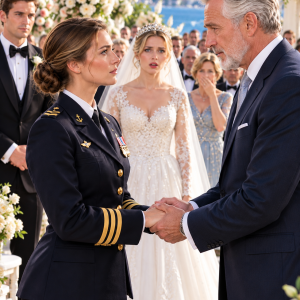
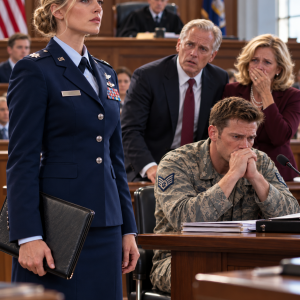
“Yes.”
I remembered her feeding me ice chips after one procedure.
I remembered her driving me home.
I remembered Daniel arriving late while Brooke stood in my kitchen asking whether I needed anything.
For years, those memories had represented support.
Now they represented deception.
Brooke began explaining that she had envied my marriage, my foundation, the respect people showed me, and the life she believed I possessed effortlessly.
I stopped her.
“You could have disliked me honestly. You did not need to pretend you loved me while helping dismantle my life.”
She cried harder.
For once, I did not comfort her.
Some pain was no longer mine to manage.
Part 5 — The Story Daniel Could No Longer Control

Daniel attempted one final defense.
“Our marriage was already finished.”
I looked at him steadily.
“I was still undergoing medical treatment for that marriage while you were sleeping with my best friend and hiding test results from me.”
He said nothing.
I continued.
“You watched me apologize after every failed cycle. Then, during the divorce, you allowed everyone around us to believe I had failed you medically and emotionally.”
Daniel’s expression changed.
Eventually, he admitted what I had already understood.
He had been ashamed of the fertility diagnosis.
He feared I would see him as less masculine.
I answered quietly.
“So you protected yourself by making sure I felt defective as a woman.”
Daniel closed his eyes.
For the first time, his confidence completely disappeared.
I gathered my medical records.
“I don’t want the house back, and I don’t want you back. I also will not participate in using that child as a weapon against anyone.”
Daniel looked helpless.
“What am I supposed to do now?”
For years, I had solved both practical and emotional problems for him.
I refused to solve this one.
“Find out the truth. What you do afterward belongs to you.”
I left the room.
Dr. Whitaker was waiting in the hallway.
He did not ask what had happened.
I appreciated that more than he probably realized.
Behind the closed door, there was no shouting.
Only silence.
For once, Daniel had to sit with uncertainty instead of transferring it to me.
Part 6 — Eleven Days Later
Daniel called eleven days later.
His voice sounded nothing like the man who had confronted me outside the maternity ward.
“We completed the test.”
I waited.
“He isn’t biologically mine.”
There was no satisfaction in hearing those words.
Only sadness for the child.
I said:
“Whatever happens between you and Brooke, remember that he did nothing wrong.”
Daniel told me they had separated.
The boy, however, still called him Dad.
Daniel did not know whether he could simply disappear from the child’s life.
I could have pointed out the cruelty of the irony.
Instead, I said:
“Then make your decision based on what is best for him rather than what protects your pride. Biology mattered enormously when you used it against me. Now you have to decide what fatherhood means when biology no longer serves your argument.”
Later, Daniel reviewed our old medical records and spoke with people who had known us during treatment.
He finally acknowledged that he understood doctors had serious concerns about his fertility.
He admitted that he deliberately allowed friends to believe I alone was responsible because admitting the truth embarrassed him.
More importantly, he corrected the story he had told the board of the charitable foundation.
He admitted that my departure had not been caused by emotional instability from fertility treatment.
He acknowledged the affair.
He acknowledged the deception.
Then he finally said the words I had imagined hearing for a year.
“I’m sorry.”
I believed him.
That surprised me.
But believing someone regrets what they did does not require reopening a relationship destroyed by those actions.
I told him:
“I believe you are sorry, Daniel. Forgiveness will never become a road back to our marriage.”
He answered quietly.
“I understand.”
Part 7 — What I Took Back

Brooke contacted me several weeks later.
She asked to meet.
I agreed once.
She apologized without blaming Daniel or circumstances.
She admitted that she betrayed me during the period when I trusted her most.
She acknowledged helping preserve a false story about my fertility.
She admitted remaining silent because Daniel’s version of events gave her the life she wanted.
I believed her regret too.
I told her:
“I’m glad you understand what you did, but we will not become friends again.”
Brooke nodded through tears.
Some relationships survive ordinary mistakes.
Ours had been built on a level of intimate trust that made this betrayal impossible for me to rebuild.
Later, the foundation board invited me to return.
I accepted only after the governance rules were changed so no single individual could ever control the organization the way Daniel had during our divorce.
Seeing my name restored to the founder’s plaque affected me more deeply than I expected.
I had built that foundation over six years.
Losing it had felt like another consequence of being supposedly defective.
Returning reminded me how much of my life I had surrendered because I believed I deserved to lose everything.
Months later, I returned to Harbor Point alone.
I sat across from Dr. Whitaker and finally asked the question that had terrified me for years.
“Based on my medical history, is there any reason to believe I could never have a child?”
He answered carefully.
“No responsible physician can promise a future pregnancy. However, your available medical history does not support the conclusion that you are incapable of becoming pregnant.”
I cried.
Not because anyone had promised me motherhood.
Nobody could.
I cried because Daniel’s sentence was no longer masquerading as medical truth.
When I left the hospital, I passed the same maternity corridor where Daniel had once pointed toward a baby and told strangers that I could never give him a family.
I remembered Brooke’s pearl earrings.
The bottle falling to the floor.
Dr. Whitaker’s sealed envelope.
Daniel’s confident smile before the truth reached him.
For years, I believed the cruelest fact of my marriage was that my body had failed us.
That had never been the cruelest truth.
The cruelest truth was that Daniel knew enough to let me carry shame that belonged partly to him because allowing me to collapse beneath it protected his pride.
But I was not leaving Harbor Point collapsed.
I carried my records under one arm.
My name had been restored to the foundation I created.
My future no longer depended on a former husband’s judgment about my body, my worth, or the kind of family I might someday have.
The lie had damaged several years of my life.
It had not defined my body.
It had not erased what I built.
It had not transformed betrayal into my failure.
When I stepped outside, late-afternoon sunlight reflected across the hospital windows.
For the first time in years, uncertainty did not frighten me.
My future remained unwritten.
And that was exactly what made it mine.
THE END