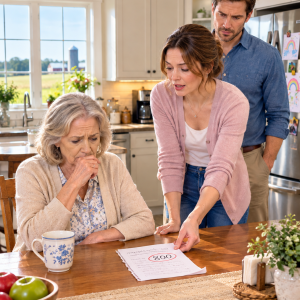
She leaned into my arms.
We remained on the kitchen floor until her breathing slowed.
Then I brought two towels.
Together, we cleaned the spilled milk.
It was a small household accident.
Yet for Emma, the experience became one more opportunity to discover that an adult could respond to mistakes without cruelty.
During the following months, Dr. Mitchell used drawing, play, storytelling, and age-appropriate conversations to help Emma express her feelings.
At first, Emma filled entire pages with dark houses and closed doors.
She drew a stone fireplace so often that I wondered whether she would ever imagine a room without one.
Later, her drawings began including gardens, animals, and open windows.
Eventually, she started drawing our kitchen.
She gave herself enormous yellow slippers and surrounded our dining table with bright flowers.
One afternoon, she showed Dr. Mitchell a picture of a girl standing beneath a blue umbrella.
“The umbrella means she can feel sad without getting hurt,” Emma explained.
Her therapist smiled.
“That’s a wonderful idea, Emma. Everyone deserves a safe place for their feelings.”
I watched my daughter become more comfortable speaking about her fears.
She began saying no when she disliked something.
She told me when she wanted privacy.
Sometimes she still cried unexpectedly, especially after difficult appointments.
I learned not to rush her toward happiness simply because her sadness frightened me.
Healing didn’t mean pretending the terrible afternoon had never happened.
It meant helping her understand that the experience no longer controlled every moment of her life.
As summer passed, Emma’s physical recovery also progressed.
Her medical team gradually adjusted her diet and monitored the healing of her jaw.
She grew tired of soup, yogurt, and carefully prepared soft meals.
Whenever we passed the produce section at the supermarket, she paused beside the apples.
“When can I eat a crunchy one again, Mommy?”
I promised we would ask her surgeon.
Autumn was approaching.
And for the first time in months, Emma had begun looking forward to something ordinary.
Part 7: The First Bite of October

By October, the trees surrounding Tacoma had turned gold, amber, and deep red.
Rain washed the sidewalks, and the air smelled of wet leaves and woodsmoke.
Emma’s final follow-up appointment came on a clear morning.
The surgeon examined her carefully and reviewed her progress.
The fracture had healed, and the team had completed the necessary treatment to restore her bite and jaw function.
After confirming that she could return to an unrestricted diet, the surgeon smiled.
“Everything looks excellent, Emma, and you can gradually enjoy the foods you’ve been missing.”
My daughter immediately looked at me.
“Does that mean I can finally eat a Honeycrisp apple?”
The surgeon laughed.
“As long as you follow the advice we’ve discussed, there’s no reason you can’t enjoy your apple.”
Outside the clinic, I offered to take her wherever she wanted for a celebration.
Pizza, burgers, ice cream, or pancakes were all possibilities.
Emma barely considered them.
“I want a really crunchy Honeycrisp apple, Mommy, but I want to eat it at home with you.”
I agreed.
We stopped at a grocery store and chose three bright-red apples.
Back home, sunlight filled our kitchen.
I washed one apple, peeled it, and cut it into thin slices.
Emma sat at the table, watching every movement.
Her expression held equal parts excitement and caution.
She picked up a slice.
“Are you absolutely sure this won’t hurt anymore, Mommy?”
I smiled.
“Your doctor says you’re healing beautifully, sweetheart, so take your time and listen to what feels comfortable.”
She raised the slice toward her mouth.
Then she took a small bite.
A crisp sound broke the quiet afternoon.
Emma chewed carefully.
She paused, waiting for the pain she had learned to expect.
Nothing happened.
Slowly, her face brightened.
“Mommy, it doesn’t hurt! I can really eat apples again!”
She laughed.
It was the kind of unguarded, joyful laughter I hadn’t heard since before the incident.
I reached for a napkin, pretending I needed to wipe my hands.
In truth, I was trying to hide my tears.
Emma put down the apple and climbed into my lap.
“Mommy, I never have to go back to that house with the stone fireplace, do I?”
I held her close.
“The court has put protections in place, Emma, and I will do everything I can to keep you safe.”
She became quiet.
Then she asked something I had been expecting for months.
“Is it okay if I still miss Daddy sometimes, even after what happened?”
I brushed her hair away from her forehead.
“Of course it is, sweetheart. You can miss somebody and still understand that being around them isn’t safe.”
She leaned against me.
“I don’t have to choose between missing him and being happy here?”
I kissed her forehead.
“You never have to pretend your feelings are simpler than they really are, Emma, and you can always tell me what you’re feeling.”
For several minutes, we sat beside the sunny kitchen window.
The half-eaten apple rested on a white plate.
Outside, the October leaves moved gently in the breeze.
Emma eventually returned to the table and finished another slice.
She was still a seven-year-old girl who loved unicorns, bedtime stories, and making enormous messes with her art supplies.
But she was also learning that adults could listen without threatening her.
She could be frightened without being blamed.
She could make mistakes without being punished violently.
And she could love someone while recognizing that her safety required distance from them.
Part 8: What Safety Really Means
My emergency-response identification remained in a drawer beside my work equipment.
I still reported for difficult search-and-rescue operations, responded to mountain emergencies, and helped strangers through some of the worst moments of their lives.
Those fifteen years had taught me how quickly dangerous situations could develop.
They had also taught me that effective rescue depended on recognizing danger before it became impossible to escape.
For too long, I had believed that preserving equal custody was the best way to protect Emma’s relationship with her father.
I had mistaken cooperation for safety.
Now I understood that a child needed more than the appearance of a complete family.
Emma needed adults who would respond when she asked for help.
She needed a home where crying wasn’t treated as defiance.
She needed to know that love wasn’t something she could lose by spilling milk or becoming frightened.
One evening, several weeks after her return to ordinary meals, I found her drawing at the dining table.
She had covered the page with a blue house, a green garden, and a bright yellow sun.
Inside the house stood two figures holding hands.
I asked what she was drawing.
“It’s our house, Mommy. I made all the windows big so nobody has to be scared of what’s hiding inside.”
I sat beside her.
She added a small red apple to the kitchen table.
Then she looked up.
“Do you know what my favorite thing about our house is?”
I shook my head.
“You always listen when I tell you I’m scared, and you don’t get angry when I cry.”
I held her hand.
“I hope you always tell me when something feels wrong, sweetheart, because your feelings matter and you deserve to be heard.”
She smiled and returned to her drawing.
For fifteen years, I had devoted my professional life to helping people survive dangerous situations.
But the greatest responsibility of my life wasn’t measured by uniforms, emergency calls, or the number of strangers I’d helped rescue.
It was protecting the little girl sitting safely at my kitchen table.
The people at Christopher’s house believed strength meant forcing children to remain silent.
Emma was teaching me something entirely different.
Real strength meant having the courage to ask for help.
It meant refusing to accept cruelty as discipline.
And sometimes, it meant creating enough safety for a frightened child to take one ordinary bite of an apple without expecting pain.
A real family isn’t defined by shared blood, a perfect custody arrangement, or adults who insist that everyone forgive and forget.
A real family is a place where a child can cry, make mistakes, ask for comfort, and know that love will never be withdrawn as punishment.
For Emma, that place was finally home.
THE END