I told Matthew that we’d both been trying to reconcile the person we knew with the evidence before us.
But that afternoon, I wouldn’t ask anyone to believe me simply because I was Mother’s daughter.
I would let her documents speak.
Part 6 — The Sentence That Made My Husband Drop His Phone
Nathan arrived at Mother’s house carrying the same confidence he’d displayed at her funeral.
Vanessa followed him, wearing a navy dress and holding a slim document folder.
Matthew sat beside me while Harrison prepared the estate papers.
The attorney began by reviewing Mother’s smaller bequests and explaining the responsibilities associated with administering her estate.
Then he reached the Victorian house.
“Mrs. Whitfield directed that her interest in this property pass to her daughter, Caroline Lawson, without granting Nathan Lawson any independent authority to manage or dispose of it.”
Nathan interrupted immediately.
“That’s not what she discussed with me, and I have documents showing that she wanted me involved in managing the property.”
Harrison explained that a private conversation wouldn’t override the governing documents or establish authority that had never been validly granted.
Then he opened the seventh attachment.
“Your mother also directed the executor to preserve evidence of attempted unauthorized transfers, representations, or financial dealings involving this property and make it available to the appropriate authorities.”
Nathan reached for his phone.
As Harrison finished reading, it slipped from his hand and struck the wooden floor.
Vanessa stared at the papers.
Harrison removed his glasses and turned toward her.
“Ms. Collins, this matter concerns you as well, because your name appears in the supporting records connected to the disputed authorization.”
He placed the unsigned document beside the version displaying my supposed signature.
Vanessa’s witness signature was visible.
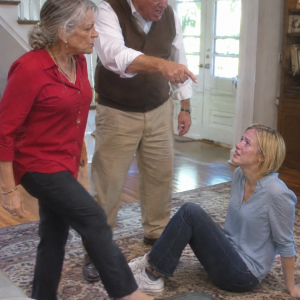
“I never signed either version of that authorization,” I stated, looking directly at her.
Nathan attempted to explain that I’d verbally agreed.
Vanessa contradicted him, insisting she’d only witnessed paperwork Nathan provided.
“You told me Caroline had already approved everything and that nobody would ever question the signatures!”
Nathan turned sharply toward her.
“You said the documents would be accepted without anyone discovering how they were prepared!”
The room fell silent.
They’d exposed their own inconsistent explanations before either could invent a convincing defense.
Harrison calmly ended the discussion.
The records would be preserved for further legal examination, and neither Nathan nor Vanessa would be permitted to act for the estate without valid authority.
I looked at my husband.
“You brought another woman to my mother’s funeral because you thought I was too devastated to protect what she left behind.”
He couldn’t meet my eyes.
“Now you can stop treating her house as something you already own.”
Part 7 — The Decision I Made After the Truth Came Out

Three weeks later, Nathan had moved out of our shared residence, and my attorneys were handling the separation.
The estate’s counsel formally notified him that he had no independent authority to list, transfer, mortgage, or manage Mother’s property.
The disputed documents were secured, and the relevant evidence was provided for professional review.
Vanessa resigned from the real estate company’s client-services department.
I never learned exactly what arrangement she’d hoped to gain from Nathan’s proposed sale.
By then, I no longer wanted to spend my days interpreting their relationship.
Harrison explained the legal options available concerning the disputed signature and attempted property transactions.
He also warned me not to assume I could personally control every potential investigation.
I chose not to pursue a separate civil fraud lawsuit.
That decision wasn’t forgiveness.
I simply wanted to protect Mother’s estate, complete my divorce, and avoid turning every remaining year of my life into another argument with Nathan.
The divorce negotiations required compromises.
Nathan retained part of our marital savings under the settlement.
I could have pursued additional contested claims, but after reviewing the financial and emotional costs with my attorney, I accepted the agreement.
Mother’s house remained subject to proper estate administration before the title could be transferred to me.
I waited until those steps were completed.
Then, one Saturday morning, Matthew arrived carrying a toolbox.
He examined a loose railing on the front porch.
“Mother complained about this every time I visited, and I’ve been thinking I should finally repair it properly.”
I brought him a glass of iced tea.
He tightened the loose fittings, replaced damaged wood, and worked quietly until the railing felt secure.
Then he looked at me.
“I should have believed you sooner, Caroline. I let Nathan make me question my own sister when she needed support.”
I sat on the porch step.
“We both underestimated what he was willing to do, Matthew. What matters now is that we stopped letting him divide us.”
He nodded.
We didn’t need an elaborate reconciliation.
We finished the repairs together and spent the afternoon cleaning Mother’s neglected garden.
For the first time since her death, the house felt less like a disputed asset and more like the place where we’d grown up.
Part 8 — The Porch Light My Mother Left Burning
By early autumn, the estate process had reached its conclusion, and the house was legally mine.
I moved into the upstairs bedroom overlooking the garden and converted Mother’s study into a comfortable place for reading.
I kept her desk, photographs, and the brass bowl beside the entrance.
The house still needed repairs, but I no longer felt pressured to make decisions before understanding them.
One evening, I found the photograph Nathan had sent while threatening me.
It showed Mother’s house from across the street, its porch light glowing beneath the darkened windows.
At the time, the picture had frightened me.
Now I looked at the same front steps and remembered Mother waiting there when I came home from college.
She’d always believed a home should be a place where people could return without fearing judgment.
Nathan and Vanessa had seen a property worth $1.3 million.
Mother had seen the life she’d built over forty-one years.
And I’d nearly allowed their greed to turn her final gift into a permanent battlefield.
I placed the photograph inside the folder containing the completed estate records.
Then I walked outside.
The porch light switched on automatically as the evening grew darker.
For a moment, I imagined Mother standing in the doorway, reminding me to lock the garden gate before going to bed.
I missed her more than I could explain.
But I also felt grateful that she’d trusted me enough to leave her instructions rather than allowing someone else to make decisions on my behalf.
My husband thought my mother’s death would give him the perfect opportunity to take her house, but the final gift she left me was something far more valuable than the property itself: the confidence to protect my future without becoming as cruel as the people who tried to steal it.
THE END