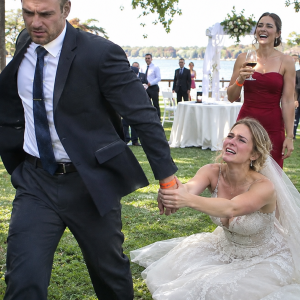
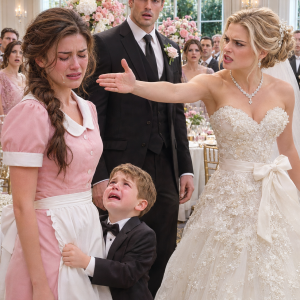
Meanwhile, Eleanor began broadcasting her own version of events from the back seat of a luxury SUV.
She described Brandon as a loving husband who had simply become disappointed by an inadequate wedding present.
“Julia humiliated my son over a car, then attacked him without warning while the rest of our family watched helplessly.”
My mother wanted to answer every accusation, but I asked her not to engage with people who were already determined to believe the worst.
“We don’t need to win an argument in someone’s comment section, Mom, because the ballroom has cameras.”
Daniel arrived the following morning carrying his laptop and a folder containing the venue’s written confirmation that the recordings had been preserved.
Four different cameras had captured the confrontation from separate angles.
One showed Brandon striking me first, while another clearly recorded his demand that I kneel before him.
A third captured his raised arm immediately before I defended myself, and a fourth showed the surrounding guests, including the relatives who applauded his behavior.
An additional camera near the entrance recorded Brandon inspecting the Mercedes keys and angrily confronting his father before returning to the reception.
The venue agreed to provide the original footage to investigators while maintaining its own secure copies.
Daniel explained that the recordings would be more useful than a public argument with Brandon’s relatives.
“The entire sequence matters, Julia, because a carefully selected fragment can create a completely false impression.”
I understood his point, although the speed with which people had accepted the edited video still disturbed me.
For years, Brandon had insisted that appearances mattered more than uncomfortable conversations.
Now his family was attempting to turn that philosophy into a public defense of his behavior.
Part 5 — The Warning Signs I Had Explained Away

Daniel asked me to describe the confrontation in detail while my memories were still clear.
I explained Brandon’s anger about the Mercedes, his mother’s insults, the first strike, and the demand that I kneel.
Then I described how he had raised his hand again before I reacted.
As we discussed earlier arguments, I began remembering incidents I had minimized during our engagement.
Several months before the wedding, Brandon had grabbed my wrist during a disagreement about household expenses.
The pressure left visible marks, but he apologized afterward and blamed his behavior on exhaustion.
Another evening, he blocked a doorway when I attempted to leave an argument about his parents’ interference.
He insisted that walking away from him was disrespectful, and I eventually waited until he moved.
I had regarded those events as signs of stress rather than indications that our relationship was becoming unsafe.
The realization was painful because I had spent years teaching myself to recognize physical threats inside a boxing ring.
Outside that environment, emotional attachment had complicated judgments that once seemed straightforward.
“I should have recognized what was happening much earlier,” I admitted.
Daniel listened without interrupting before answering carefully.
“Recognizing danger in a sporting contest isn’t the same as expecting someone you love to hurt you, Julia.”
He reminded me that our immediate priority was preserving evidence, obtaining appropriate medical care, and deciding where I could recover safely.
That night, Brandon sent a message accusing me of making him look ridiculous.
A second message claimed that I owed him an apology and that my parents owed his family compensation.
Daniel instructed me to preserve the messages without responding.
Detective Sofia Ramirez contacted me shortly afterward to arrange a formal interview.
She asked whether I felt safe returning to the house Brandon and I had planned to share.
I told her that I did not.
My parents offered me their guest room, and I accepted because I needed distance from the person who had injured me.
For the first time, I stopped treating preserving the relationship as an obligation more important than my safety.
Part 6 — Four Camera Angles and One Unchanging Truth
The investigation began moving forward once Detective Ramirez obtained the original surveillance footage.
The ballroom’s management provided the recordings through the appropriate evidence procedures, retaining copies and documenting their handling.
Daniel reviewed the sequence with me beforehand so that I understood exactly what the cameras showed.
The first angle captured Brandon’s expression changing when he discovered that the Mercedes was not the Maybach he had demanded.
The second showed his initial strike and my immediate loss of balance against the decorative table.
The third documented the applause from several relatives, followed by Brandon ordering me to kneel.
The final angle clearly captured him raising his arm again, my movement away from the threatened strike, and the single defensive blow that knocked him down.
My actions ended as soon as the immediate threat stopped.
The medical report also documented the two fractures in my nose, providing independent evidence of the injury sustained during the confrontation.
Several wedding guests who were not closely connected to either family gave statements confirming the general sequence of events.
Detective Ramirez explained that the investigation would consider the recordings, medical evidence, witness accounts, and applicable legal standards.
“We’re examining what happened before and after each person’s actions, not just the few seconds circulating online.”
I appreciated her measured approach.
Unlike the people commenting on Paige’s video, she was not promising an outcome before reviewing the available evidence.
The venue manager also informed Daniel that Eleanor had attempted to obtain copies of the recordings before investigators received them.
She claimed the family needed the footage to protect Brandon’s reputation.
The manager refused to release anything outside the established procedures.
When I learned that, I finally understood why the Sterling family’s online campaign had intensified so quickly.
They knew the full recordings would challenge their account.
Eleanor had described me as calculating and dangerous, while Paige’s video concealed the very actions that explained my response.
Neither could change what four cameras had independently recorded.
For the first time since the wedding, I began to believe that the truth might receive a fair hearing.
Part 7 — The Stories That Began Falling Apart

Three days after the wedding, Detective Ramirez contacted Daniel to confirm that investigators had received all four primary camera recordings.
They had also reviewed the hospital documentation and spoken with independent witnesses who were willing to describe the incident accurately.
The police opened a formal investigation into Brandon’s conduct and documented the threatening messages he had sent afterward.
They also preserved information concerning the misleading video, although Daniel cautioned that selective editing alone would not automatically establish a separate criminal offense.
By then, Paige’s recording had spread beyond the original circle of wedding guests.
Eleanor continued insisting that her son had been the victim of an unprovoked attack, but the venue’s confirmation that complete footage existed weakened her version of events.