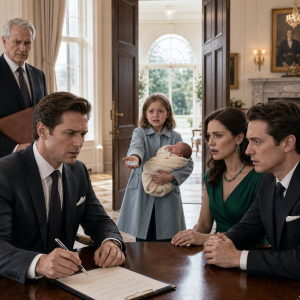
From then on, their enemy wasn’t just disease—it was Ryan, sharpening the law into a weapon.
The girls sensed danger. One night, they stood in front of Ethan in the library.
“Uncle Ethan,” Sophie asked quietly, “are you going to die?”
No one had asked him so directly.
“Yes,” he said. “My body’s like an old car. Some parts can’t be fixed. One day my lungs will stop. When that happens, I’ll go on a long trip to a place without pain—the same place your mom went.”
“Can you send letters?” Lily whispered.
“I wish,” he said. “But I’ll watch you from the sky. Until then, every minute I have is yours. Help me fill this house with so many good memories it never goes quiet again. Will you?”
“We’ll take care of you,” Sophie replied, “and you take care of us. That’s family.”
They made a list: beach, real birthday party, plant a tree, see snow, help Bea talk. They did it all—except the last item.
Meanwhile, Ryan’s lawyers pushed for an emergency hearing. The state argued Ethan’s home was now basically a hospice. A judge set a decision for the next morning. At nine, social workers would come to take the girls away and split them up.
That night, Ethan crashed.
His lungs failed. Monitors screamed. Adults ran. Upstairs, the girls heard the panic, and Grace’s terrible words: “It’s only a matter of time.”
In the middle of sobbing sisters, Sophie remembered Bea’s earlier whisper over a drawing of Ethan in bed surrounded by them:
“I know how to fix your heart, Daddy.”
Sophie stood. “The grown-ups gave up,” she said. “We don’t.”
They walked into the library.
Grace tried to stop them. Sophie’s calm reply—“This is the only time we have”—made her step aside.
They circled the bed. Bea cupped Ethan’s cheeks. Sophie took his right hand, June his left. Lily placed her hands over his chest.
They sang the lullaby their mom used on cold street nights. Their voices were thin and shaky, but determined. Bea hummed a low note, steady as a heartbeat.
Grace watched the monitor. Ethan’s chaotic rhythm smoothed, trying to follow their song.
Hours passed. Just before dawn, the heart line went flat.
The crash team rushed in. As they raised the paddles, Bea leaned to Ethan’s ear and used her first word in a year:
“Daddy.”
On the monitor, a single spike broke the flat line.
Then another.
Then another.
Slow. Weak. But undeniable.
There was no medical explanation. But Ethan was alive—in a coma, yet breathing.
At the hearing, the state’s lawyer described him as “practically vegetative” and demanded the girls be placed in state care. David had nothing but the impossible truth. He told it anyway.
While the judge listened, David’s phone buzzed. Grace: “He woke up. He’s talking.”
Minutes later, Ethan appeared on the courtroom screen, pale but conscious, four blond heads squeezed in around him.
“Mr. Hayes,” the judge asked, “can you really care for four girls?”
“The question,” Ethan said, looking at his daughters, “is whether I can live without them. They gave me a reason to fight for every breath. They’re not a burden. They’re my cure. Take them away—that’s the blow I won’t survive.”
After a long silence, the judge spoke.
“Petition denied. And given this bond and these extraordinary circumstances, I grant the immediate, permanent adoption of Sophia, June, Lily, and Beatrice Hayes. You are, in law and in fact, a family.”
Back home, joy shook the house.
A week later, Dr. Evans showed Ethan new scans. The scars in his lungs had shrunk.
“I don’t know how to explain this,” the doctor admitted. “Your disease isn’t just stalled. It’s reversing. The only variable I can’t measure is them.”
Ethan didn’t need more.
He traded boardrooms for school plays, bedtime stories and art shows. With Grace and David, he launched the Helen Foundation: small family-style homes instead of giant institutions—light, safety, gardens, soft blankets.
He named his daughters as co-founders. They knew, better than anyone, what makes a house a home.
Ryan’s empire collapsed under investigations and debt. One day he came to Ethan’s back door, thinner, desperate, asking for money.
“I won’t give you a check,” Ethan said quietly. “That only pays for the same mistakes. But the foundation is hiring. If you want a second chance, start by serving kids like the ones you tried to take everything from.”
Whether Ryan changed was his story to write.
Ethan’s was already clear.
He thought he’d rescued four little girls from the storm.
In the end, it was their love that pulled him out of his.