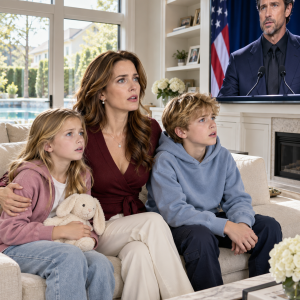
Above the fireplace hung a framed document.
It appeared to be a property deed, and where my name should have been, I could see my father’s.
On the dining room table were several folders, financial statements, and a stack of papers bearing the heading Custody Petition.
My mother followed my gaze.
“We were trying to protect your interests, Daniel. Someone had to make decisions while you were gone.”
I looked at the framed deed again.
“Who gave you permission to transfer my house?”
My father stepped forward.
“I handled what needed to be handled. You were overseas, and your wife wasn’t making sensible decisions.”
“That’s not an answer.”
Trevor leaned against the wall.
“Maybe you should just accept that things changed while you were away.”
I studied their faces, wondering how long they had rehearsed this conversation and how certain they had become that I would believe them.
What they didn’t know was that the house had never been held in my name alone in the simple way they imagined.
Years earlier, after receiving an inheritance from my grandfather, I had worked with a military attorney to place several family assets, including the house, into a carefully structured trust.
Any legitimate transfer required specific authorization and verification that I had never provided.
Whatever document my father had framed above the fireplace, I had serious reasons to question its validity.
And that wasn’t the only thing he had misunderstood.
Part Four: The Things They Thought I Couldn’t See

Before my deployment, I had installed a home security system that recorded activity around the front entrance, hallway, and shared living spaces.
The visible cameras were easy to identify, and when I looked toward the hallway, I noticed that the small indicator light on one of them was no longer glowing.
My father followed my eyes.
“Those cameras haven’t worked properly for months,” he said.
I didn’t respond, although his comment immediately caught my attention.
The original system had been upgraded shortly before I left, with encrypted recordings stored remotely so that earlier footage would remain accessible even if the equipment inside the house was disconnected.
I had arranged the additional backup after several package deliveries disappeared from our porch, and because the recordings were stored through a separate account, my parents had never needed to know the details.
I returned upstairs, closed the bedroom door, and opened the secure application on my phone.
The connection was slow because of the weather, but after several attempts, the archive loaded.
I could see dated recordings from the front porch and portions of the main floor, including footage from earlier that evening.
I selected the camera nearest the front entrance.
At 6:42 p.m., Claire appeared in the hallway holding Benjamin, with my mother standing close behind her.
My father approached from the living room, carrying what looked like a folder, while Trevor stood beside the front door.
There was no audio from that camera, but the images were clear enough to show Claire attempting to remain inside as my father directed her toward the porch.
A few moments later, the door closed.
My wife remained outside with our son.
I watched her knock repeatedly, then move toward the corner of the porch where the wind was less direct, before sitting down and wrapping her coat around Benjamin.
I stopped the recording.
I had already seen enough to know that the account my parents had given me was not consistent with what had happened.
For several minutes, I sat quietly beside the bed, listening to the storm press against the windows while Claire rested with Benjamin close to her.
My phone contained evidence that could be preserved and reviewed, but it could not undo the hours my family had spent outside.
I opened another contact and called Major Allison Bennett, the Army attorney who had previously helped me understand the trust arrangements and coordinate with civilian counsel.
She answered after several rings.
“Daniel? I thought you were still traveling home.”
“I arrived tonight, Major, and I’ve found some serious problems involving my property and my family.”
I explained what had happened, including the deed, the financial documents, and the petition concerning Benjamin.
She listened without interrupting.
“First, make sure your wife and child receive medical attention,” she said. “Then preserve every document and recording exactly as it is. Don’t sign anything, and don’t try to settle this with your relatives tonight.”
“Can they actually take the house?”
“Not simply by producing a document, Daniel. The trust records and any recorded transfer will need to be examined, but if you never authorized a transaction, that’s a significant issue.”
She gave me the contact information for a civilian attorney familiar with property and family matters in Vermont, promising to help coordinate the records she had access to.
Before ending the call, she added something I would remember for a long time.
“You don’t have to solve everything tonight. Your responsibility right now is to keep Claire and Benjamin safe.”
I looked toward my wife, whose eyes were finally beginning to close as she held our son.
“That’s exactly what I’m going to do.”
Part Five: The Visitor Nobody Mentioned

Downstairs, my father was still insisting that I had misunderstood the situation, although his voice had become less confident once he realized I had contacted people outside the family.
I walked to the top of the staircase and looked down at the three people who had once seemed incapable of doing anything that could truly harm me.
“I know you changed the locks, and I know Claire was put outside with Benjamin. I’ve seen the recording.”
My mother stared at me.
“What recording?”
“The security footage.”
Trevor straightened.
“Dad said those cameras were off.”
My father turned toward him so quickly that Trevor stopped speaking.
That small exchange told me more than another hour of arguing might have.
“The documents will be reviewed by an attorney,” I continued. “The bank accounts will be examined, and nobody is making another decision about my wife, my son, or this house without proper legal authority.”
My father gave a dismissive laugh.
“You think one phone call changes everything?”
“No,” I answered. “I think the records will tell us what actually happened.”
I returned to the bedroom without waiting for his response.
While checking the recordings again, I began moving backward through the archive, hoping to identify when the locks had been replaced and whether there was footage of anyone entering the house with the paperwork.
At first, I saw only familiar scenes: my mother carrying groceries, Trevor moving boxes through the hallway, and my father speaking to someone on the front steps.
Then I reached footage from four days earlier.
A dark SUV had pulled into our driveway shortly after noon, and a man wearing a charcoal overcoat had stepped out carrying a leather briefcase.
He was approximately my father’s age, with silver hair and a manner that suggested he knew exactly where he was going.
My father greeted him at the door.
The man entered the house and remained for nearly two hours.
I moved to the hallway camera, where I could see him standing near the dining table with several documents spread in front of him.
My mother was there, along with Trevor, and at one point the visitor handed my father a folder that looked remarkably similar to the one now resting beside the custody papers.
I paused the video and enlarged the image.