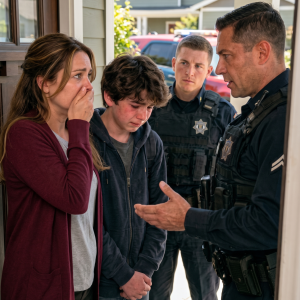
“Where’s Sophie?”
I felt my stomach tighten.
“She’s safe.”
For the first time that morning, he seemed to understand that something had gone very differently from what he expected.
Part 3: What the Porch Light Remembered

The police asked me to wait at the station while investigators examined the house, and during those long hours I discovered that exhaustion can feel almost peaceful when your mind has reached the limit of what it can absorb.
Sophie sat beside me in a small interview room, coloring quietly with crayons an officer had found for her, while I answered questions about Nathan’s finances, his recent behavior, and the insurance documents he had brought home.
I explained that he had seemed increasingly worried about money, although he always assured me his consulting business was doing well.
Several months earlier, he had become unusually protective of his phone, and more than once I had heard him arguing with someone late at night, only for him to explain that a difficult client was creating problems.
I had believed those explanations because I wanted our marriage to be the ordinary, dependable marriage I thought we had built.
By early afternoon, Detective Caroline Brooks came into the room carrying a folder.
She was a thoughtful woman in her fifties whose calm manner reminded me of the supervisors who had trained me during my first years at dispatch.
“Emily, the recording from your porch camera is going to be important,” she said, taking the chair opposite mine.
She explained that the equipment had captured Nathan approaching the house and attempting to damage the rear entrance, while additional recordings from earlier in the week showed him speaking on the porch late Sunday night.
The camera had picked up enough of that conversation for investigators to identify references to the heating system, a planned payment, and the exact morning of his supposed trip.
“We’re also looking into the insurance paperwork,” she continued. “There are discrepancies that suggest some documents may have been altered after you signed them.”
I stared at the folder.
“Are you saying he planned all of this because of money?”
“That’s one of the possibilities we’re investigating, and we’re finding evidence of serious financial problems he hadn’t disclosed to you.”
Later, I learned that Nathan had accumulated substantial debts through speculative investments and had improperly used money belonging to several clients.
An audit of his business records was approaching, and the amount of insurance coverage connected to me was close to what he needed to settle his most urgent obligations.
What troubled me most was not simply the financial dishonesty, but the extraordinary distance between the husband I thought I knew and the decisions investigators believed he had made.
That morning, before leaving for the airport, Nathan had cooked Sophie her favorite cinnamon pancakes and reminded her to take her sweater because the weather was getting colder.
He had kissed me beside the kitchen counter and suggested we stop for a treat on the way to school.
I kept remembering those pancakes, the little puddle of syrup on Sophie’s plate, and the casual way he had waved goodbye.
It was difficult to reconcile those ordinary gestures with the evidence being gathered.
By evening, investigators had restricted access to parts of the house while specialists assessed the damage and checked for hazardous materials.
We could collect a few belongings under supervision, but we could not stay there.
When I told Sophie, she asked only one question.
“Does that mean Dad won’t be there?”
I knelt beside her.
“No, sweetheart. He won’t be there.”
She considered this quietly before reaching for my hand.
“Then I think I can sleep somewhere else.”
I held her for a long time, wishing that her sense of safety had not become dependent on the absence of someone she had once trusted completely.
Part 4: The People Who Choose Sides
Nathan’s mother, Patricia Whitmore, called me repeatedly during the following days, although I initially avoided answering because I had neither the strength nor the desire to explain something the investigators were still trying to understand.
Eventually, I answered one afternoon while Sophie was resting.
Patricia did not ask how her granddaughter was feeling.
Instead, she began talking about the pressure Nathan had been under, the damage the investigation might do to his reputation, and the importance of keeping private family difficulties away from public attention.
“Emily, you have to understand that he’s been carrying more responsibility than you realize,” she said. “People make terrible decisions when they feel cornered.”
“Patricia, Sophie was frightened enough to tell me we couldn’t go home, and the police found Nathan trying to force his way into our house. This isn’t something I can smooth over.”
She sighed impatiently.
“You’re going to let one terrible morning erase twelve years of marriage?”
I looked through the window at Sophie sleeping on the sofa.
“I’m trying to make sure my daughter has a future where she feels safe.”
Patricia ended the conversation shortly afterward, and although she continued sending letters asking me to reconsider my position, I eventually stopped reading them.
The legal process moved slowly, with financial reviews, interviews, and court appearances that seemed to multiply whenever I thought we were approaching an answer.
Nathan faced serious charges connected to the property incident and the financial arrangements investigators uncovered, while his business collapsed under the weight of the audit.
Our shared accounts became entangled in the investigation, leaving me dependent on my wages and the small savings I had kept separately.
The most painful changes, however, were the ordinary ones.
Sophie could no longer attend the private school she loved, and we had to explain why she would be transferring to a public elementary school in another neighborhood.
We packed our belongings into borrowed boxes, gave away furniture that would not fit into a smaller home, and spent several evenings sorting through the things that had once made our house feel permanent.
One night, I found Sophie sitting inside a blanket fort she had made beside her bed, surrounded by stuffed animals and the drawings she refused to leave behind.
I crawled inside and sat next to her.
“What are you thinking about, sweetheart?”
She traced a finger across the edge of her sketchbook.
“I keep wondering if I should have told you sooner.”
I felt tears gathering before she finished speaking.
“Sophie, you did exactly what you needed to do. You told me when you understood something was wrong, and I listened. None of this was your responsibility.”
She leaned against my shoulder.
“Will we ever have a normal house again?”
I thought about our old kitchen, the garden my father had helped plant, and the family photographs still waiting to be packed.
“Yes,” I told her. “It might look different from the one we had, but we’ll make it ours.”
Part 5: A House With Green Shutters

We found our new home in a quiet neighborhood outside Beaver, a modest rental cottage with faded cream siding, green shutters, and a narrow porch overlooking a small front garden.