My Son Pushed Me To The Floor In Front Of His Wife… So The Next Morning, While He Sat In His Office, I Sold The Mansion He Thought Was His
The Night My Son Forgot Who Built His Life
At sixty-one years old, I never imagined I would be standing in the entryway of a Beverly Hills mansion while my own son pointed at the door and told me to leave.
My name is Marianne Caldwell.
For more than three decades, I had been a mother before I was anything else. Before I was a business owner. Before I was the woman who built Caldwell Urban Properties from one small renovation loan and a half-empty checking account. Before anyone called me “ma’am” in boardrooms or asked for my signature on buildings worth millions.
I was simply Austin’s mother.
I raised him after his father left when he was nine. I worked late nights. I skipped vacations. I wore the same winter coat for six years so he could attend private school. I sat through every school play, every soccer game, every graduation ceremony, clapping until my palms hurt because I wanted him to know he was never alone.
And maybe that was where I went wrong.
Because somewhere along the way, my love became invisible to him.
The mansion he lived in with his wife, Brielle, sat behind tall iron gates and perfectly trimmed hedges. Marble floors, custom windows, imported lighting, a pool that looked out over the city. Austin loved telling people it was “his place.”
But it had never been his.
The house belonged to Caldwell Urban Properties, held under one of my company’s asset branches. I allowed Austin and Brielle to live there because I thought giving my son a beautiful life was the same as giving him a good one.
That night, I learned the difference.
I had come over after receiving a strange message from Austin. He said we needed to “talk about boundaries.” When I arrived, Brielle was sitting on the sofa in a silk robe, holding a glass of lemon water like she was watching a show she had already paid to enjoy.
Austin stood near the fireplace, jaw tight, eyes cold.
“Mom, we need to stop pretending this arrangement works,” he said.
I set my handbag on the console table. “What arrangement?”
He laughed, but there was no warmth in it.
“You showing up here like you still own everything.”
I stared at him. “Austin, I do own this house.”
Brielle smiled softly, not kindly, but with the kind of smile that cuts without making a sound.
“Marianne, maybe legally,” she said. “But emotionally? This is our home now.”
I turned to my son. “Is that what this is about? You want me to sign the property over?”
His face hardened.
“I want you to stop holding things over my head.”
I felt something inside me go still.
“I have never held anything over your head. I gave you this place because I wanted you to feel secure.”
Austin stepped closer. “No, you gave it to me so I’d keep acting grateful.”
That sentence landed harder than I expected.
I looked at the grown man in front of me, a man wearing a watch I bought, standing in a house I paid for, speaking with confidence built on a foundation I had poured beneath his feet.
“Grateful?” I said quietly. “Austin, I never asked you to worship me. I only asked you to respect me.”
His face twisted.
“Respect goes both ways. You don’t get to walk in here and act like the queen just because you made money before I did.”
Brielle let out a small laugh.
“She does have that energy,” she murmured.
I looked at her. “Brielle, this is between me and my son.”
She lifted one shoulder.
“Then maybe your son should finally say what he feels.”
Austin moved fast after that.
He grabbed my phone from my hand when I tried to call my attorney, holding it above my reach like I was a child. Then he pointed sharply toward the front door.
“Get out.”
I did not move.
“Give me my phone, Austin.”
“No. You’re not calling anyone from inside my house.”
“It is not your house.”
His eyes flashed.
Then he shoved me.
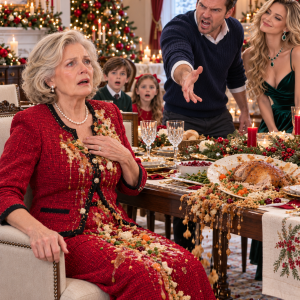
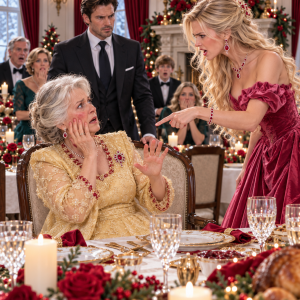
Not hard enough to send me across the room, but hard enough that I lost my balance. My heel caught against the edge of the rug, and I fell onto the marble floor, one hand striking the ground before my hip followed.
For a moment, the room became completely silent.
My son stood above me, breathing hard.
Brielle did not gasp. She did not rush forward. She did not tell him to stop.
She simply looked down at me and said, “Maybe this is what happens when people refuse to leave gracefully.”
I slowly pushed myself up.
My wrist ached. My pride hurt more.
Austin tossed my phone onto the rug near my feet.
“Take it,” he snapped. “And don’t come back unless you’re ready to stop controlling us.”
I picked up my phone. I picked up my handbag. Then I looked at my son one last time.
“You are right about one thing,” I said. “Something needs to stop.”
He frowned. “What does that mean?”
I did not answer.
I walked out through the front door of the mansion I had bought, past the fountain I had designed, down the driveway I had paid to pave.
Behind me, Brielle laughed softly.
I heard Austin close the door.
And with that sound, something inside me closed too.
The Morning I Became Marianne Again

At 5:10 the next morning, I sat in the kitchen of my small Brentwood apartment with an ice pack on my wrist and black coffee beside my laptop.
I had not slept.
But I had become very clear.
For thirty-two years, I had been Austin’s mother first.
That morning, I became Marianne Caldwell again.
I opened my laptop and called Elise Warren, my corporate attorney and closest friend for almost twenty years. She answered with a sleepy voice that changed the moment she saw my face on the screen.
“Marianne, what happened?”
“Austin pushed me last night,” I said calmly. “He took my phone, yelled at me, and told me to leave the house.”
Elise went completely still.
“The Beverly Hills property?”
“Yes.”
Her eyes narrowed. “Do you want to file a report?”
“Not today,” I said. “Today I want to sell the house.”
Elise blinked once.
“You’re serious.”
“Completely.”
I opened a folder on my desktop and sent her the property documents.
“The title is held under Caldwell Urban Properties West Branch. Austin and Brielle are occupants under a family-use agreement, not owners. I want the property transferred today.”
Elise leaned closer to the screen.
“That estate is worth around fourteen million.”
“Call Franklin Rhodes at Stonegate Capital,” I said. “He has been trying to buy that land for months. Tell him I’ll accept ten million in cash if he closes before 10:00 a.m.”
“Marianne, that is a four-million-dollar discount.”

“It is also the price of immediate peace.”
Elise exhaled slowly.
“And Austin?”
I looked down at my coffee.
“Austin has until noon to learn the difference between living in a house and owning one.”
By 8:45 a.m., Austin was probably in his glass office downtown, sitting behind a desk he used to brag about, wearing a navy suit I helped him buy. He likely thought I was embarrassed. Maybe he thought I was sitting alone, crying, wondering how my son could treat me that way.
I was not crying anymore.
At 9:18 a.m., Franklin Rhodes signed the digital purchase agreement.
At 9:47 a.m., the wire cleared.
Ten million dollars entered my company account.
The mansion was no longer mine.
And it had certainly never been Austin’s.
At 10:05 a.m., I hired a professional property transition team and private security. I gave simple instructions.
No drama. No arguments. No damage. Personal belongings only.
Everything listed in the corporate inventory stayed.
The Knock Behind the Iron Gates
At 11:12 a.m., Brielle was by the pool, wearing sunglasses and scrolling through her phone, probably planning another photo caption about gratitude, elegance, and living well.
Then the gates opened.
Two black SUVs, a moving truck, and a property management vehicle rolled into the driveway.
Brielle stormed toward the front door.
“Excuse me!” she shouted before anyone even rang the bell. “This is private property.”
A man in a gray suit held up a clipboard.
“Mrs. Caldwell, my name is Daniel Price. I represent Stonegate Capital. This property was purchased this morning from Caldwell Urban Properties West Branch.”
Brielle froze.
“That’s impossible.”
“The deed has been transferred.”
“No. My husband owns this house.”
Daniel’s expression remained polite.
“Your husband does not own this property. According to the documents, you and Mr. Caldwell were permitted occupants. The new owner is requesting possession today.”
Her face turned pale.
“You can’t just throw us out.”
“You have forty-five minutes to collect personal items. Clothing, toiletries, private documents, jewelry that belongs to you personally. The furniture, artwork, appliances, and listed décor remain with the property.”
Brielle’s mouth opened, but nothing came out.
Then she grabbed her phone and called Austin.
The Call From His Office
Austin answered on the second ring.
“Brielle, I’m in a meeting.”
“Come home now,” she cried. “There are people here. They’re saying your mother sold the house.”
A pause.
Then Austin laughed.
“She’s trying to scare us.”
“They have paperwork, Austin.”
His voice changed.
“Put one of them on.”
A minute later, my phone rang.
I was sitting in a quiet café two blocks from his office, eating scrambled eggs and toast. I looked at his name on the screen and let it ring three times.
Then I answered.
“Good morning, Austin.”
“Mom, what did you do?”
“I sold a company asset.”
“That is my house.”
“No,” I said gently. “It was the house you lived in.”
His breathing grew heavy.
“You can’t do this to me.”
“I already did.”
“Brielle is crying. There are strangers in our driveway.”
“Then she should pack quickly.”
His voice cracked into anger.
“You’re doing this because of last night?”
I set my fork down.
“Last night, you pushed your mother to the floor. You took my phone from my hand. You pointed at the door and told me to get out of a house I bought. And your wife stood there and enjoyed it.”
Silence.
Then quieter, “Mom, I was upset.”
“No, Austin. You were honest.”
“I didn’t mean it like that.”
“You meant every word until the deed changed hands.”
He swallowed hard.
“Where are we supposed to go?”
“You are thirty-two years old. You have a job, expensive clothes, leased cars, and all the confidence in the world. Use one of those things.”
“Mom, please.”
The word please almost reached the old part of me.
Almost.
But then I remembered the marble floor beneath my hand. I remembered Brielle’s voice saying I should leave gracefully. I remembered my son looking down at me like I was no longer his mother, only an obstacle.
“Austin,” I said, “I loved you by making your life easy. That was my mistake. I will not repeat it today.”
“So that’s it? You’re choosing money over your son?”
I closed my eyes for one second.
“No. I am choosing dignity over disrespect.”
He said nothing.
“You have less than forty minutes,” I added. “Do not make this harder than it needs to be.”
Then I ended the call.
For the first time in my adult life, I blocked my son’s number.
Not forever, maybe.
But for that day, I needed silence more than I needed forgiveness.
The Life That Was Never Really His
The news traveled faster than I expected.
Within two weeks, Austin’s perfect world began folding in on itself.
The private club membership ended when the payment failed. The luxury car company called about the leases because my company guarantee had been removed. The bank lowered his credit line. Brielle stopped posting photos and started deleting old ones.
Then came the letter from Austin’s attorney.
He claimed the mansion had been an implied gift.
Elise read the letter aloud in my office, then looked over her glasses at me.
“Do you want me to respond politely or accurately?”
“Accurately.”
She sent six years of property tax records, insurance payments, maintenance invoices, the signed family-use agreement, and the corporate ownership documents.
Austin’s attorney withdrew from the matter two days later.
Brielle left him not long after.
She packed designer bags, took what jewelry she could claim, and moved into a condo owned by a man who sold ocean-view properties in Malibu.
Austin called me from an unknown number a month after the sale.
I almost did not answer.
But I did.
“Mom,” he whispered.
I knew from that one word that life had finally touched him without my protection standing in the way.
The Diner Conversation
We met at a small diner in Pasadena, the kind of place with chipped mugs, old booths, and waitresses who called everyone honey.
Austin looked different.
Not older exactly, but smaller.
His expensive haircut had grown out. His shirt was wrinkled. The sharp confidence that once made people move out of his way was gone.
He sat across from me and stared at his hands.
“Brielle left,” he said.
“I heard.”
“She said she didn’t marry me to struggle.”
I stirred my coffee.
“Then she told the truth once.”
His eyes filled with tears.
“I lost almost everything.”
I looked at him carefully.
“Almost?”
He nodded slowly.
“I still have my job, for now. I found a small apartment in Glendale. It’s nothing like the house.”
“Most homes are not mansions, Austin.”
He swallowed.
“I know.”
For a while, neither of us spoke.
Then he said the thing I had waited years to hear, though not in the way I wanted.
“I’m sorry, Mom.”
I looked out the window at the bright California morning.
“Are you sorry because you hurt me, or because your life changed after you hurt me?”
His face collapsed.
“Both,” he admitted.
That answer was imperfect.
But it was honest.

“I was awful to you,” he said. “I thought everything you gave me proved I deserved it. I didn’t understand that it proved you loved me.”
My throat tightened, but I kept my voice steady.
“Love without boundaries can become damage. I see that now.”
He wiped his face.
“Can you help me? Not like before. Just enough to get stable.”
There it was.
The old door.
The familiar chance to rescue him before life taught him anything.
I reached into my purse and placed a small envelope on the table.
His eyes lifted with hope.
“There is no money in there,” I said.
He froze.
“It is the name of a financial counselor, a therapist, and a recruiter who works with people rebuilding their careers. I called ahead. They will meet with you if you choose to show up.”
His lips trembled.
“That’s all?”
“That is more than enough for a man who wants to change. And not nearly enough for a man who only wants to be saved.”
He stared at the envelope.
“You really won’t give me money?”
I shook my head.
“No, Austin. Giving you money right now would be me apologizing for your lesson.”
He cried quietly then.
Not loudly. Not dramatically.
Just like a person finally realizing that comfort and love are not always the same thing.
I stood and placed a twenty-dollar bill on the table for my coffee.
Before I left, I rested my hand gently on his shoulder.
He flinched at first, then closed his eyes.
“I still love you,” I said. “But I will never again lose myself to prove it.”
Then I walked out into the sunlight.
For the first time in thirty-two years, I did not feel responsible for fixing my son’s life.
I had given him many gifts.
That day, I gave him the hardest one.
A beginning he had to build for himself.
Sometimes the strongest love is not the love that keeps giving, but the love that finally stops feeding someone’s entitlement and allows them to meet the consequences of their own choices.
A parent can sacrifice everything for a child, but if that child never learns gratitude, those sacrifices may become invisible instead of meaningful.
Respect should never disappear just because someone has been kind to you for too long, because kindness is not weakness and patience is not permission.
The people who enjoy your comfort may not always honor your pain, and the moment you set boundaries, you often discover who valued you and who only valued what you provided.
Wealth can open doors, buy houses, and create beautiful surroundings, but it cannot build character in someone who refuses to learn humility.
A mother’s heart can forgive deeply, but forgiveness does not require her to keep standing in the same place where she was hurt.
When someone mistakes your generosity for obligation, stepping back may be the only way to teach them the difference between love and ownership.
Losing comfort can feel like punishment to a spoiled person, but sometimes it is simply life removing the cushion that kept them from growing.
A true apology is not measured by tears in a difficult moment, but by the willingness to change when no one is offering a reward.
The day you choose dignity over fear may feel painful at first, but it can become the first day you finally belong to yourself again.