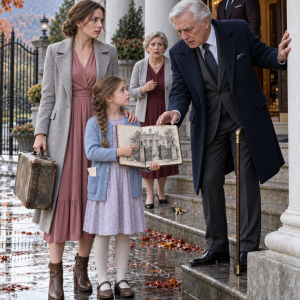
“I’m asking for two things,” she said.
The room became quiet.
“First, review the hours of every contracted cleaning crew, not only the team I supervised.”
One board member leaned forward.
“How far back?”
“Three years.”
“That could involve hundreds of people.”
“That is exactly why it should be done.”
She paused before continuing.
“Second, employees need a way to challenge schedules and quotas through an independent review. When someone refuses to sign something inaccurate, that person should receive a fair hearing. She should not slowly disappear from the schedule until she has no choice but to leave.”
Douglas was dismissed for serious misconduct, and the matter was transferred to outside counsel.
That was only the beginning.
A total of 209 workers received corrective payments. Some still worked in our buildings, while others had to be located months later. One woman sat silently in the payroll office after learning that she would receive more than four thousand dollars, then covered her face and began to cry because she had never imagined anyone would return what had been taken from her wages.
I asked the communications department to leave my name out of every announcement.
I had not repaired the injustice.
I had occupied the highest office in a company that allowed it to continue.
Claire completed her trial period and became a permanent employee. Several months later, she joined the committee that redesigned our vendor-monitoring system. She insisted that cleaning staff, maintenance workers, and overnight supervisors participate in the final review because, as she explained, the people closest to a problem often recognized it long before executives did.
She and Lily eventually moved into a modest two-bedroom apartment with reliable heat and a small balcony where Lily grew marigolds in painted coffee cans. Bills still hung on the refrigerator, but none warned that they might lose their home.
My other unfinished responsibility moved much more slowly.
One evening, I wrote Caroline a message.
I did not explain how lonely I had been. I did not discuss her mother, my childhood, or the pressure of managing a company. For once, I resisted the temptation to build a defense around my apology.
I wrote:
“Caroline, I confused providing for you with being present for you. I believed paying for things meant I was acting like a father, and I was wrong for many years. You do not have to answer this.”
I sent it.
She did not respond.
A week later, I sent a photograph of the small hardware store my father had owned in Wisconsin.
Still nothing.
Two weeks after that, I sent a short note saying that I hoped her school year was going well.
Again, nothing.
For the first time in my life, I tried not to treat another person’s silence as a problem I had the right to solve. I stopped sending gifts. I did not contact her friends, appear at her apartment, or ask an assistant to arrange a meeting. I waited, though patience was a skill I had never practiced well.
Nearly ten months later, a message arrived.
“The middle school where I work is holding a community collection on Saturday. We need people to carry tables. If you want to help, be there at 7:30.”
Thirty seconds later, another message appeared.
“No donations. No photographers. Don’t send an employee in your place. You.”
I arrived at 7:11.
The Photograph Behind the Photograph
Caroline was standing behind the registration table when I entered the school gymnasium.
I had imagined our reunion hundreds of times. In some versions she embraced me; in others, she cried or delivered a speech that finally explained everything she had felt. In none of those imagined scenes did she say what she actually said.
“You’re early.”
“Yes.”
She pointed toward a row of folded tables leaning against the wall.
“Those go beneath the scoreboard.”
“All right.”
That was all.
There was no embrace, no grand reconciliation, and no assurance that I had been forgiven. I carried tables, then boxes, then folding chairs. A teenage volunteer told me I had arranged the chairs incorrectly, so I moved every one of them without explaining who I was or how many offices I controlled.
Near midmorning, I saw Claire and Lily enter the gym.
Caroline had met Claire through a partnership between our company and the school, though I had deliberately stayed away from the planning. Claire began sorting winter coats while Lily took charge of the lost-and-found table with a seriousness that seemed far too large for her small face.
Several hours later, Lily discovered a coin purse beneath the bleachers. She carried it directly to the front desk, gave it to the coordinator, and returned to her task in less than a minute.
I watched her run back across the gym and thought about the rainy afternoon when doing the right thing had required nearly two hours of waiting in the cold.
Now she could do the same thing inside a warm, safe place.
At the end of the event, I went looking for my overcoat. Before I found it, Lily appeared in front of me holding something familiar.
My wallet.
Again.
“You left it on one of the tables, Mr. Whitmore.”
I laughed, and to my surprise, Caroline glanced over from across the room with the faintest suggestion of a smile.
“Perhaps I should stop carrying one,” I said.
I opened it.
The old photograph of Caroline on the pier was still tucked behind my insurance card, but there was another picture behind it. Someone had printed it in the school office that afternoon.
In the new photograph, Caroline was speaking to a group of volunteers with one hand raised. Claire stood nearby laughing, while Lily grinned at the camera from behind a mountain of donated coats.
I was in the background, slightly out of focus, carrying a cardboard box.
For years, my wallet had held a picture of the daughter I believed I had lost. Now it held an image of the woman she had become, and I was not at the center of the photograph, directing the moment or paying for it.
I was simply there.
Caroline passed me carrying another box.
“We’re doing this again next Saturday.”
I looked at her.
“What time?”
“Seven.”
“I’ll be here.”
She continued walking, but after a few steps, she turned back.
“Dad?”
“Yes?”
“Bring coffee. Regular coffee, not the expensive kind from your building.”
I smiled.
“Regular coffee. I can manage that.”
She nodded and carried the box outside.
A year earlier, a little girl had waited in the rain to return something I did not yet realize I had misplaced.
For a long time, I believed the important thing was the wallet, because it contained my identification, money, access cards, and the photograph I could not bear to remove. Only much later did I understand that leather and paper had almost nothing to do with what Lily gave back to me.
I had misplaced my attention long before I misplaced my wallet.
I had stopped seeing the people who worked through the night in my buildings, stopped questioning the polished numbers placed in front of me, and stopped understanding that love could not be measured by the bills I paid or the problems I made disappear.
Most painfully, I had stopped seeing my daughter as someone who needed my time rather than my resources.
Lily did not restore those things for me. That would have been too simple, and real change is rarely that generous. She did something more important.
She made me notice where I had left them.
The following Saturday, I arrived at the school at 6:52 with two cardboard carriers of ordinary coffee. Caroline was already unlocking the supply closet.
She looked at the cups, then at me.
“You remembered.”
“I’m trying to get better at that.”
She handed me a ring of keys and pointed toward the gym.
“Then start with the tables.”
So I did.