“That money is meant to help you build a future,” she said. “You need to stay warm long enough to have one. Pay for the coat.”
That evening, someone knocked sharply at the front door. My stomach tightened. I imagined my father standing on the porch, ready to take me home whether I wanted to go or not. June raised a hand to calm me, then walked to the door. She lifted a brass umbrella stand as she went, which made me wonder if I should be frightened or impressed.
It was Aunt Ruth, carrying a duffel bag and a cardboard box.
“I brought what I could before Frank got home,” she said. “Your laptop, your papers, and your boots.”
I hugged her, and the last of my composure gave way. We sat around June’s kitchen table while Ruth explained that Mom was telling neighbors I had run off after an argument, and Dad was presenting himself as a concerned father. Paige, she said, was still upset about the money.
“I can’t go back there,” I whispered.
June looked at my aunt, then at me.
“You don’t have to. You can stay here while you figure out your next step. You’ll help with groceries and chores, and we’ll make a plan. But you won’t be sent back to a house that put you out in a storm.”
A Different Kind of Discipline

For the next two months, my life felt as though it had been paused between one chapter and the next. I still worked at the grocery store near Erie, but getting there from Brookville took time and money. Some days, I borrowed Ruth’s car. Other days, I pieced together long bus routes. My savings were no longer growing; they were slowly being spent on transportation and everyday necessities.
One gray afternoon, I stopped outside a strip mall to catch my breath. In the window of a recruiting office, a poster showed a line of soldiers in dress uniforms. The words beneath them read U.S. Army.
I had never imagined a military life for myself. I was not someone who had dreamed of adventure or wanted to be in the spotlight. I liked organized shelves, schedules, and knowing what was expected of me. But I needed housing, steady pay, and a way forward that did not depend on my parents.
I opened the door.
Sergeant Cole sat behind a metal desk. He asked about my grades, my health, and the kind of work I liked. He did not promise that the Army would solve everything.
“This isn’t an escape hatch,” he said. “It’s demanding work, and you’ll have to earn your place. But if you’re willing to put in the effort, it can give you training and structure.”
“I like structure,” I replied. “I want to know what’s expected of me, and I want to be accountable for it.”
He slid a practice test across the desk.
“Let’s see whether your math is as strong as your confidence.”
That night, June found me at the kitchen table working through the test.
“Thinking about the Army?”
“Maybe. It would give me a place to live, a paycheck, and a chance to start over somewhere else.”
She adjusted her glasses and looked over the pages.
“After living with Frank Mercer, basic training may feel like a vacation.”
I laughed, and the sound surprised me. It was the first time I had laughed without forcing it since the night of the storm.
I went through the medical screenings, the background checks, and the paperwork. I enlisted as an automated logistical specialist, a role built around tracking supplies, maintaining records, and getting equipment where it needed to go. The work suited the part of me that had always found comfort in order.
When I left for training in early May, June stood in her driveway at five in the morning with a travel mug in her hand. I had one duffel bag. She gave me a paper sack with a turkey sandwich, an apple, and two oatmeal cookies.
“The Army feeds people, June.”
“I don’t trust any place that expects you to work this early without proper breakfast.”
I hugged her. She smelled of lavender soap and coffee, and for a moment I wanted to stay in that driveway.
“I’ll call when I can.”
“You’d better. I’ll drive this Subaru right through the gate if I have to.”
At basic training in South Carolina, the heat, the running, and the strict routines all felt like a shock at first. The days were long. The drill sergeants were loud. We cleaned the barracks until every corner was in order. But the rules were clear, and that mattered to me.
At home, expectations had shifted whenever Paige needed something. In training, the same standard applied to everyone. If my boots were not polished, I had a task to redo. If I fell behind, I worked to catch up. Once I corrected the mistake, the matter was over.
My bunkmate, Tessa, was a tough, quick-witted woman from Missouri. When I struggled with a rope climb and landed hard in the dirt, she pulled me up by the sleeve.
“Mercer, if you stay down there, I’ll have to organize your locker myself, and I’ve seen your system. I’m not doing that.”
Mail call was harder than the training. Other recruits received letters from parents, partners, and friends. June wrote about her garden and the raccoons that kept getting into it. Ruth sent short notes to remind me that she was thinking of me.
Nothing came from Mom or Dad.
I told myself I didn’t care, but some evenings the quiet still hurt. At graduation, I stood in my uniform and looked across the bleachers. June was waving a bright green handkerchief, and Ruth stood beside her, cheering. I felt proud—not because my parents had changed their minds, but because I had made it there without them.
After advanced training in Virginia, I received orders to Fort Campbell, Kentucky. I was assigned to a logistics unit and reported to Staff Sergeant Leah Price, a sharp-eyed leader who seemed to notice everything.
In my third week, I entered two digits incorrectly on an inventory transfer. Staff Sergeant Price called me to her desk.
“Mercer, explain this discrepancy.”
I reviewed the screen and felt my stomach drop.
“I entered the wrong item code, Sergeant. The shipment is going to the wrong unit.”
I braced for the kind of criticism that made a mistake feel like a permanent flaw. Instead, she pointed to the phone.
“Are you going to stare at it, or are you going to call the transport team and correct the paperwork?”
“I’ll fix it now, Sergeant.”
When the records were corrected, I stood beside her desk.
“I’m sorry, Sergeant.”
“I want you to be accurate. Mistakes happen. What matters is whether you own them and correct them. Understand?”
“Understood.”
I went back to my desk thinking about how different it was to be held responsible without being made to feel worthless. It was a kind of fairness I had not known I was missing.
The Story My Father Told
A year after the snowstorm, I was sitting on my barracks bed, unlacing my boots, when an unfamiliar Pennsylvania number appeared on my phone. I let it go to voicemail. A minute later, the message appeared.
“Nora, it’s Dad. We need to talk. Paige is in trouble.”
There was no question about whether I was well. No mention of the night he had left me on the highway. Just Paige.
Before I could decide what to do with the message, an email arrived from Aunt Ruth. Its subject line read, You should see this.
The attachment was a photograph of a printed pamphlet on glossy paper. At the top, it said, The Mercer Family: A Year of Faith and Sacrifice.
I read it once, then again. The first paragraphs praised Dad’s long career and described a family that had come together through a difficult year. The next section said that my parents had provided substantial financial help as I found my way in the Army. It described my distance from them as a painful result of my desire for independence.
The final paragraph asked the community to contribute to a fund that would help Paige pay her debts and restart her business.
I set my phone down and walked outside. Under the lights near the barracks, I called June.
“He’s telling people he paid for my move and helped me get started,” I said. “He’s using the story to raise money for Paige.”
June let out a long breath.
“Frank always did like a good story. What are you going to do about it?”
“Part of me wants to go there and shout until everyone hears me.”
“That’s understandable,” she said. “But it might not help. Think it through.”
The next morning, Staff Sergeant Price noticed I was distracted. Before lunch, she asked me to come into her office and sit down. I told her about the money, the storm, and the pamphlet. When I finished, she read the email.
“What do you want to accomplish?” she asked.
“I want people to know what actually happened. I don’t want him using my name to raise money with a false story.”
“Then make sure you can show them the facts. Don’t let anger decide how you present them.”
I nodded. The word that came to mind was proof.
That evening, I met by video with an attorney named Margaret Ellis, whom Ruth had found in Pittsburgh. She listened carefully as I explained what my father had printed and distributed.
“Family disputes are complicated,” she said. “But if he is making false claims about your finances to encourage donations, you should keep a record of everything. Bank statements, the dispatch record from that night, and any messages that show what happened.”
“I don’t want to take him to court,” I said. “I want him to stop telling people I took his help and walked away.”
“Then keep your response factual and calm. Let the documents speak for themselves.”
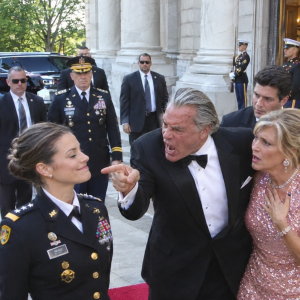
A week later, Ruth called. Dad’s retirement dinner was scheduled for the following Saturday at a community hall outside Erie. He expected a large crowd and planned to introduce Paige’s recovery fund in a speech.
I requested leave. When Staff Sergeant Price signed the paperwork, she handed it back.
“Keep your bearing, Mercer.”
I booked a flight and rented a small car. Two days before I left, Mom called. I watched her name on the screen for a long moment before answering.
“Nora,” she said, her voice thin with worry. “Your aunt told me you might be coming home.”
“I’m coming to the dinner.”
“Please don’t turn your father’s retirement into a scene. This is an important night for him.”
“I’m not planning to make a scene. I’m going to correct what he’s telling people.”
She became upset.
“Why are you still punishing us over one bad evening? Your father lost his temper. You’re tearing this family apart.”
I felt something inside me settle into place.
“He left me in a snowstorm, and you knew I was out there. You don’t get to call that one bad evening and then ask me to protect his reputation.”
She did not answer. I ended the call.
I packed my dress uniform. June had suggested I wear civilian clothes, but I wanted to arrive as the person I had worked to become. When I reached Brookville, she was waiting on her porch.