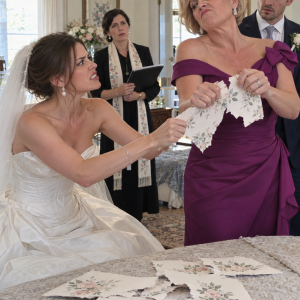
I looked at her.
“When we were children, I gave up things because Mom said you needed them more. When you became pregnant, I lost my bedroom. Now you’re asking me to give up my home again.”
Kelsey shook her head.
“You chose to leave!”
“I asked to sleep on the couch, Kelsey.”
“Well, I was pregnant! What did you expect us to do?”
I realized she genuinely believed her circumstances had always justified pushing me aside.
“I hope you find somewhere safe tonight,” I said. “But you cannot stay here.”
At 6:52 p.m., the U-Haul finally pulled away.
For the first time all afternoon, the driveway was quiet.
One Last Attempt to Take What Was Mine
The next morning, my attorney called.
Mom had contacted his office claiming that I had previously agreed to let Kelsey’s family live with me.
There was no written agreement, no message, and no evidence of any such promise.
Then she raised another issue.
She claimed Grandma Ruth had left me money that should have been shared with Kelsey.
My attorney reviewed the estate documents.
The truth was straightforward.
Grandma had left each granddaughter a modest inheritance.
Kelsey had received her portion years earlier.
I had used mine for education and the deposit on my first rented room.
There was no hidden money and no unpaid obligation.
After the call, I opened my desk drawer.
Inside was a small wooden box containing a letter Grandma had written before she passed away.
I unfolded the familiar paper.
Her handwriting brought tears to my eyes.
“My sweet Brooke, never confuse being easy to love with asking for less. You deserve a place where you feel safe, and you have every right to protect it. You can care about people without allowing them to decide how much of yourself you must give away. Some things can be repaired, sweetheart, including a life that hasn’t been treated gently. Love, Grandma Ruth.”
I read it twice.
For years, I had believed success would finally make my mother proud of me.
But sitting in that office, I understood something more important.
I no longer needed her approval.
The Message From My Twin Sister
Three days later, Kelsey sent me a photograph.
Her children were sitting on the floor of a small temporary apartment, eating pizza from paper plates.
Her message read:
“The kids want to know why their wealthy aunt wouldn’t let them stay in her big house.”
A second message followed.
“Mom has been crying all day. I hope you’re happy.”
I studied the photograph.
The apartment was modest, but it looked clean and comfortable.
The children had food and somewhere safe to sleep.
I felt sad that they were experiencing uncertainty.
I also remembered the nineteen-year-old girl who had once slept beneath a leaking tent without a single call from her family.
I replied:
“I’m glad the children are safe. I hope you and Scott can use this time to make a stable plan for your family.”
I didn’t send money.
I didn’t offer my guest rooms.
And I didn’t apologize for having boundaries.
Several months later, Aunt Linda told me Scott had accepted a job at a woodworking company.
He and Kelsey had rented a smaller house.
The children were doing well.
I was genuinely relieved.
Their lives were moving forward without requiring me to sacrifice mine.
The Home I Finally Learned to Protect
Six months after the U-Haul appeared, my company celebrated completing one of our largest restoration projects.
All twelve employees gathered in the workshop for a photograph.
Walter came to visit, wearing the same old jacket he had owned when I first asked him for work.
He looked around at the machinery, the finished cabinets, and the people laughing together.
“You’ve built something wonderful, Brooke.”
I smiled.
“I couldn’t have done it without you.”
He rested a hand on my shoulder.
“Maybe not. But you kept going long before anyone offered to walk beside you.”
That evening, I drove home through the quiet Ohio countryside.
When I reached my gate, I stopped for a moment.
At nineteen, I had dreamed of owning a house so my mother would finally realize what she had lost.
I wanted her to see my success and regret how she had treated me.
But at thirty-one, I didn’t feel that way anymore.
My home wasn’t a message to my mother.
My business wasn’t an argument with my sister.
They were simply the life I had worked hard to create.
I pressed the remote, and the gate opened.
As I drove toward my house, I thought about the girl who once carried everything she owned in two black trash bags.
I wished I could tell her that she would eventually be okay.
That she would have people who respected her.
That she would build a company, own a home, and learn that being loved shouldn’t require disappearing to make room for someone else.
Behind me, the gate slowly closed.
Not because I hated my family.
Not because I wanted revenge.
But because I had finally learned that a closed gate doesn’t always mean an angry heart.
Sometimes, it simply means you’ve stopped allowing other people to decide what you’re supposed to give up.
At nineteen, I had $23.47 and nowhere to go.
At thirty-one, I had a home, a business, and the keys to both.
My mother and sister had arrived expecting the same Brooke who always stepped aside.
But that girl had grown into a woman who understood her own worth.
And this time, I stayed exactly where I belonged.
Messages to Remember
Sometimes the people who teach us the most about strength are the ones who leave us with no choice but to discover how much we can accomplish on our own.
Being related to someone does not automatically give that person permission to make decisions about your home, your finances, or the peaceful life you worked so hard to create.
You can genuinely care about your family and still recognize that their difficulties do not require you to abandon your own needs, dreams, and responsibilities.
A person who has spent years being overlooked may eventually realize that earning love should never depend on constantly giving up what matters most to them.
The home you build after experiencing uncertainty becomes more than a place to live, because every room represents the courage, patience, and effort that helped you move forward.
Helping someone is a beautiful act of kindness when it comes from genuine willingness, but it loses its meaning when others treat your generosity as something they are automatically owed.
Children deserve compassion and stability, yet adults must also take responsibility for creating those conditions rather than expecting another family member to solve every problem.
You do not need an apology from someone who hurt you in order to acknowledge what happened, understand its impact, and choose a healthier direction for your future.
Real success is not measured by how deeply those who doubted you regret their choices, but by how peacefully you can live without needing their approval.
And sometimes the greatest act of self-respect is not proving that you are stronger than the people who once overlooked you, but quietly closing the gate and choosing the life you have finally learned to value.